
Phase 2 — Science as worship
Reading the sky
- 10 min
- Gratuit — sans inscription
Cordoba, a thousand years ago
Cordoba, a thousand years ago

The sun and the moon, measured
What this verse teaches

Explore the astrolabe
Touchez un numéro pour en savoir plus sur cette partie.
-
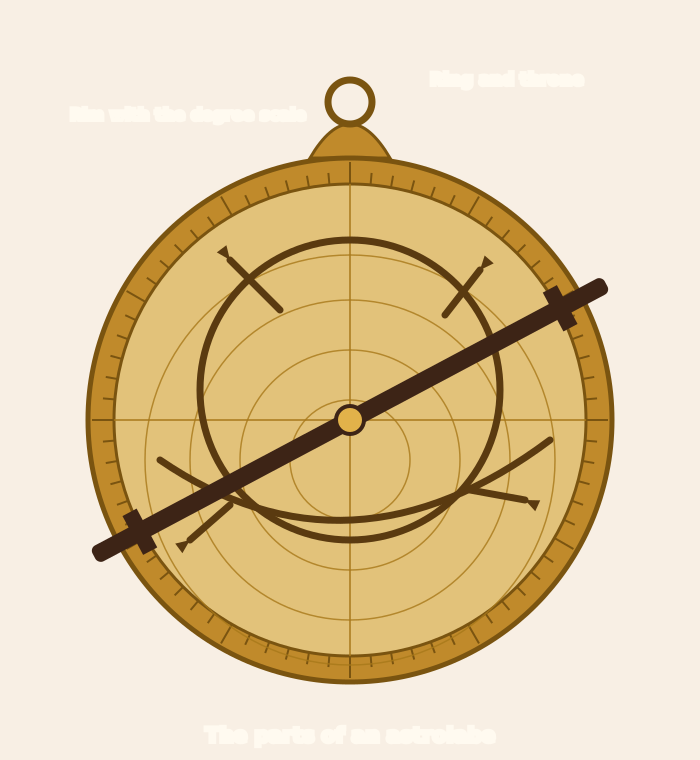
You hang the astrolabe from the ring so it hangs straight.
-
Marked in degrees to measure the height of a star or the sun.
-
An open star map. Its pointers mark bright stars; it turns like the sky.
-
A sighting rule on the back, used to measure angles.
-
Engraved for one latitude: one city’s sky.
What an astrolabe did
An astrolabe is a model of the sky in brass. With it you could find the time from the sun or a star, the height of a building, or the direction of the qiblah.
Muslim makers perfected it, and it was used from al-Andalus to India for centuries: a pocket computer of its age.
Watch: Explore the astrolabe
Find the part
Measuring the earth
Al-Biruni (973 to about 1050), of Khwarazm, measured the earth’s size using a mountain, the horizon and trigonometry. His answer for its radius is usually given as about 6,340 km; today’s figure is about 6,371.
Later, great observatories were built at Maragha in Iran (1259) under Nasir al-Din al-Tusi, and at Samarkand (1420s) under Ulugh Beg.
Prayer times today
Your timetable uses the same astronomy. Fajr and Isha are set by how far the sun is below the horizon, and masjids choose different angles, so their times differ.
Asr is set by shadows. In summer in northern lands Isha may be very late, and scholars give rules for it. Follow your local masjid’s timetable.
Check
Measuring the earth
Check
Common mistakes
For your life
Set your prayer app to your local masjid’s method, with Asr set to the later time. Find the qiblah at home once with a compass or the masjid’s direction, and mark it discreetly. Then you never have to guess.
A heart moment
The astronomers saw the sky as a clock set by Allah. When did you last look up at it and think of its Maker?
Privé : conservé uniquement dans ce navigateur, jamais envoyé chez nous.
The lesson in three lines
Keep it
In one line: Muslim astronomers read the sky for prayer times, the qiblah and the calendar.
Try it today: Look up the exact time of Maghrib today and watch the sun set.