الجغرافيا
The Rihla of Ibn Battuta
- بواسطة
- Abu Abd Allah Muhammad ibn Abd Allah al-Lawati al-Tanji (Ibn Battuta) أبو عبد الله محمد بن عبد الله اللواتي الطنجي (ابن بطوطة)
- متى
- 1355 م
- أين
- Fez, Marinid Morocco
Ibn Battuta was born in Tangier in 1304 into a family of legal scholars. In 1325, aged 21, he set out on the pilgrimage to Mecca, and he did not return home for 24 years.
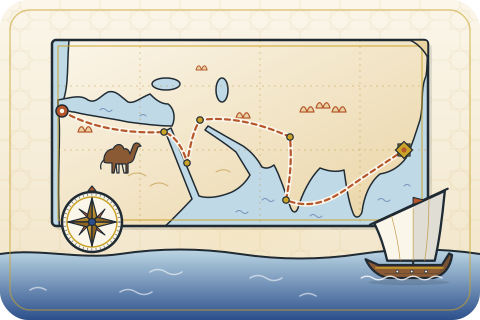
His journeys took him through North Africa, Egypt, Syria, Arabia, Iraq, Iran, Anatolia, the lands of the Golden Horde, Central Asia, India, the Maldives, Sri Lanka, Bengal, Southeast Asia and the Swahili coast, and he said he reached China. He often served as a judge along the way. After returning to Morocco he also crossed the Sahara.
The Marinid sultan Abu Inan asked him to record his travels. He dictated them to the scholar Ibn Juzayy, and the book was completed in 1355. Its full title means A Gift to Those Who Contemplate the Wonders of Cities and the Marvels of Travelling, but it is usually called simply the Rihla, "the journey".
The Rihla needs careful reading. Ibn Battuta kept no notes, and Ibn Juzayy copied some descriptions, for example of Damascus, Mecca and Medina, from the earlier traveller Ibn Jubayr. Historians doubt that every journey happened as told: a trip to Volga Bulgaria is thought very unlikely, and some question whether he reached China.
الأثر
The Rihla is a major source for the 14th-century world, from the Delhi sultanate to the Maldives and the East African coast. Modern estimates put his total journey at roughly 117,000–120,000 km, and he is often described as having travelled further than any other explorer before the age of steam.
المصادر:
Wikipedia, "Ibn Battuta"; UC Berkeley ORIAS, "Writing the Rihla: 1355"