
What is salah?
Salah is the ritual prayer Muslims pray five times a day. It is the second pillar of Islam and the first act of worship a new Muslim learns. Each prayer is made of units called rak'ahs: standing and reciting the Quran, bowing, and prostrating twice.
Salah is how a Muslim stays connected to Allah through the day — a pause at dawn, midday, afternoon, sunset and night to remember Him, thank Him and ask for His help.
المصادر 2
إِنَّنِىٓ أَنَا ٱللَّهُ لَآ إِلَٰهَ إِلَّآ أَنَا۠ فَٱعْبُدْنِى وَأَقِمِ ٱلصَّلَوٰةَ لِذِكْرِىٓ
14Lo! I, even I, am Allah, There is no Allah save Me. So serve Me and establish worship for My remembrance.
ٱتْلُ مَآ أُوحِىَ إِلَيْكَ مِنَ ٱلْكِتَٰبِ وَأَقِمِ ٱلصَّلَوٰةَ ۖ إِنَّ ٱلصَّلَوٰةَ تَنْهَىٰ عَنِ ٱلْفَحْشَآءِ وَٱلْمُنكَرِ ۗ وَلَذِكْرُ ٱللَّهِ أَكْبَرُ ۗ وَٱللَّهُ يَعْلَمُ مَا تَصْنَعُونَ
45Recite that which hath been inspired in thee of the Scripture, and establish worship. Lo! worship preserveth from lewdness and iniquity, but verily remembrance of Allah is more important. And Allah knoweth what ye do.
الصلوات الخمس
وحدات كل صلاة من الصلوات الخمس على المذهب الحنفي. افتح أي وحدة لتتدرّب عليها خطوة بخطوة.
-

Fajr
4 ركعات في المجموع
-

Dhuhr
12 ركعات في المجموع
-

Asr
8 ركعات في المجموع
-

Maghrib
7 ركعات في المجموع
-

Isha
17 ركعات في المجموع
يصلّي أكثر الناس أيضًا ركعات من السنة قبل هذه الصلوات أو بعدها، ويعرض الاستوديو البنية الكاملة لكل صلاة.
Before you pray
- Be in wudu. Make wudu if you do not already have it.
- Be clean and covered. Clean clothes that cover you modestly, on a clean place.
- Know the time. Each prayer has its own window of time.
- Face the Qiblah. The direction of the Kaaba in Makkah.
- Make your intention. Know in your heart which prayer you are praying.
خطوة بخطوة
Every rak'ah follows the same pattern: stand and recite Al-Fatihah (and in the first two rak'ahs another short passage), bow, stand up again, prostrate, sit briefly, and prostrate a second time. After every two rak'ahs you sit for the tashahhud, and the last sitting ends with the salam.
المرحلة 1 من 17
Preparing for prayer
Al-isti'dad lis-salah
Before you begin, make sure your body, your clothes and the place where you will pray are clean. Cover yourself modestly, as you would when standing before someone you deeply respect. Many people keep a prayer mat for this, but any clean surface will do.
Take a moment to put your phone away and settle your mind. The prayer is a meeting with Allah; arriving calmly is part of praying well.
المرحلة 2 من 17
Purification (wudu)
At-tahārah
The Quran describes the washing that prepares a believer for prayer: the face, the arms to the elbows, wiping the head and the feet to the ankles. This is wudu. If you still have wudu from an earlier prayer, you do not need to repeat it.
The Wudu Learning Center walks you through every step with illustrations.
المرحلة 3 من 17
Intention (niyyah)
An-niyyah
The intention is made in the heart: you know which prayer you are praying (for example, the two fard rak'ahs of Fajr) and that you are praying it for Allah. There is no set wording you must say aloud.
Intention turns a set of movements into worship. It is also a moment to remind yourself why you are standing here.
المرحلة 4 من 17
Facing the Qiblah
Istiqbāl al-qiblah
Muslims everywhere face the same direction in prayer: towards the Kaaba in Makkah. It is a beautiful picture of unity — millions of people, in every country, turning to one point.
If you are unsure of the direction, use the Qiblah finder, a compass app or ask someone local. Doing your honest best is what is asked of you.
المرحلة 5 من 17
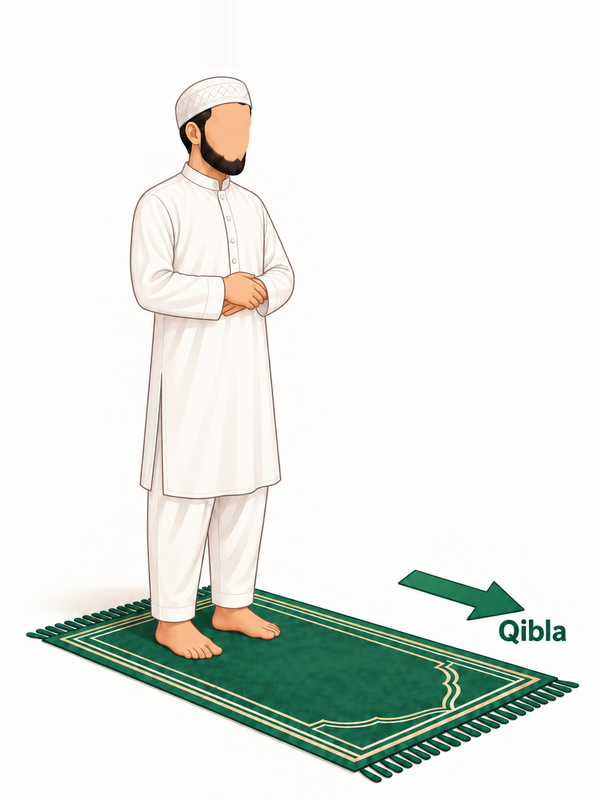
Standing (qiyam)
Al-qiyām
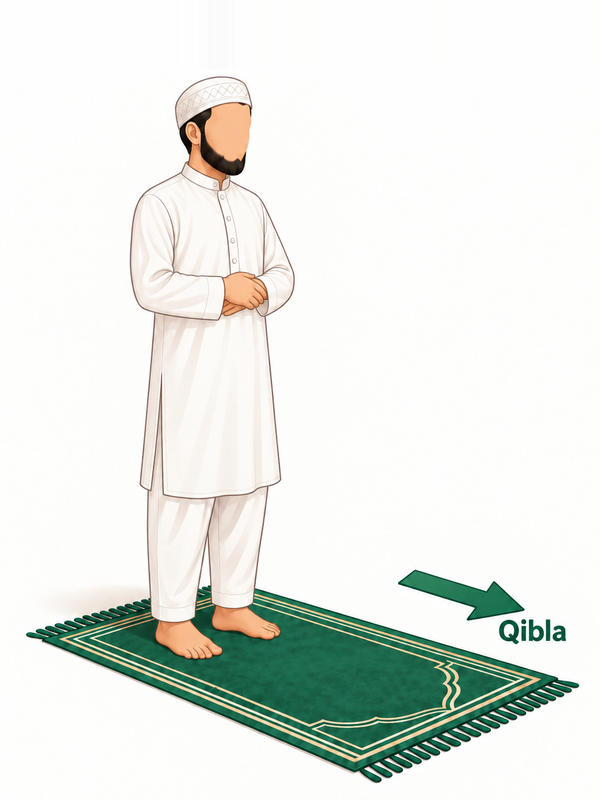
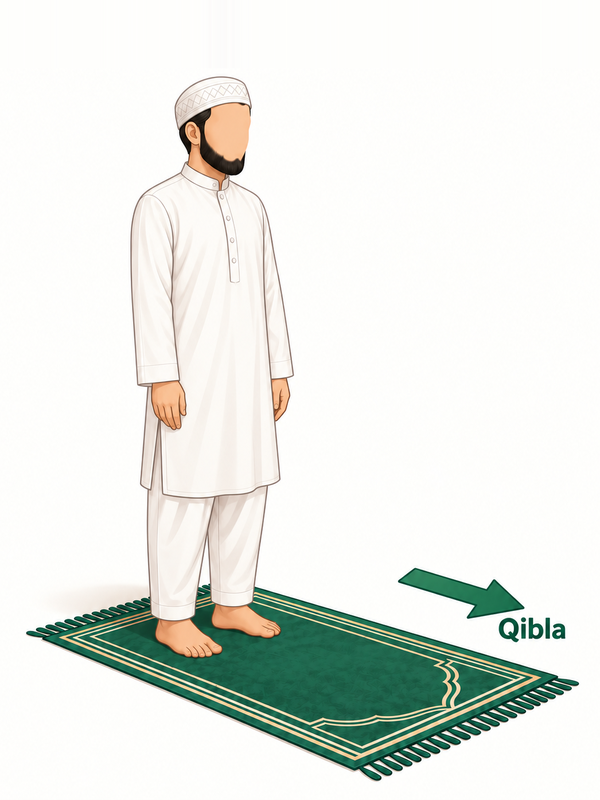
Stand upright and still, feet comfortably apart, looking down towards the place where your forehead will rest in prostration. Standing is a posture of humility and readiness: you are a servant standing before your Lord.
Someone who cannot stand may pray sitting, and someone who cannot sit may pray lying down; the prayer adapts to what each person can do.
المرحلة 6 من 17
The opening takbir
Takbīrat al-iḥrām
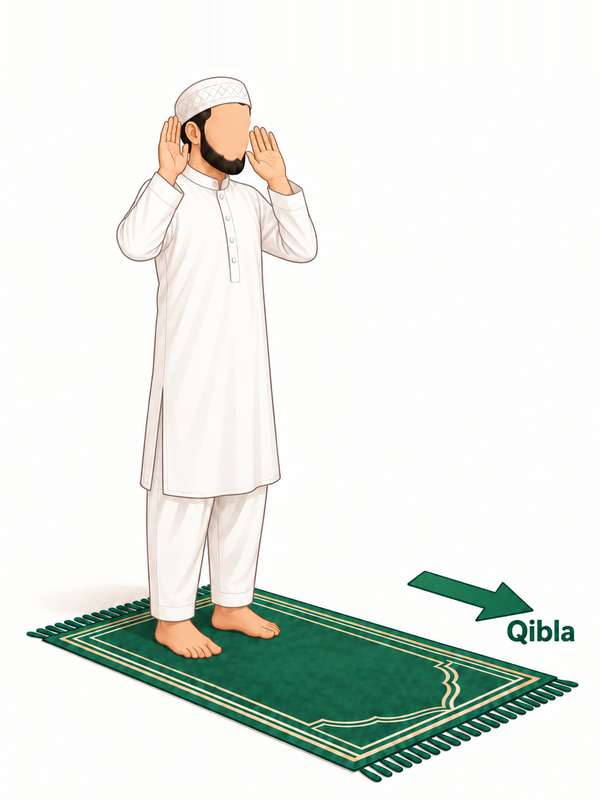
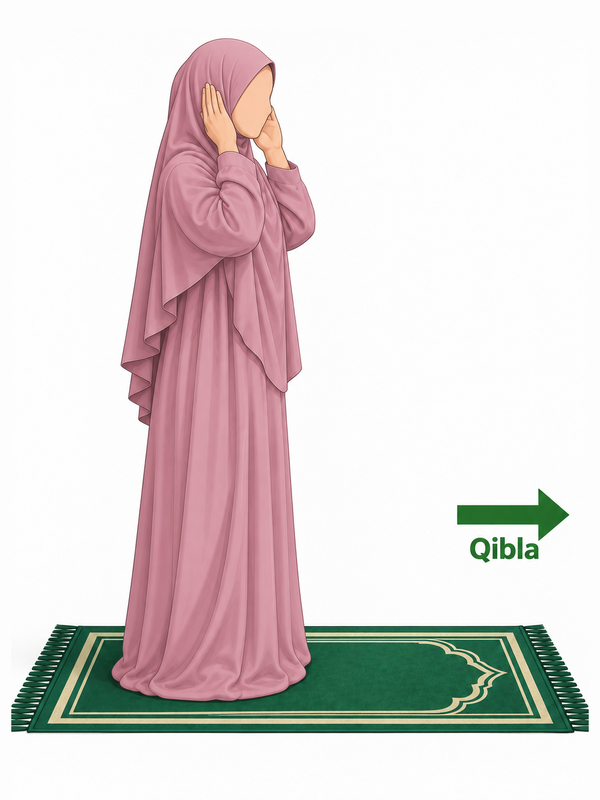
Raise your hands and say Allahu Akbar, "Allah is the Greatest". This first takbir is called the takbir of entering into sanctity (iḥrām): from this moment ordinary talk, eating and turning away are set aside until the prayer ends.
Whatever is on your mind, Allah is greater. Saying it as you begin is a way of putting the world behind you.
المرحلة 7 من 17
The opening supplication
Du'ā' al-istiftāḥ
After the opening takbir, many Muslims say a short opening supplication praising Allah, then seek refuge in Allah from Satan and say Bismillah before Al-Fatihah. Several wordings were taught; the walkthrough shows a common one.
المرحلة 8 من 17
Al-Fatihah
Al-Fātiḥah
Al-Fatihah, the first surah of the Quran, is recited in every rak'ah of every prayer. In seven short verses it praises Allah, remembers the Day of Judgement, declares that we worship Him alone and ask Him alone for help, and asks to be guided on the straight path.
Learning its meaning changes how the prayer feels: each time you stand, you are having the same heartfelt conversation.
المرحلة 9 من 17
Recitation after Al-Fatihah
Qirā'at as-sūrah
In the first two rak'ahs, another passage of the Quran is recited after Al-Fatihah — often a short surah such as Al-Ikhlas. In the third and fourth rak'ahs of the obligatory prayers only Al-Fatihah is recited.
Begin with the short surahs you know. Each new surah you memorise is a gift you can bring to every prayer.
المرحلة 10 من 17
Bowing (ruku)
Ar-rukū'
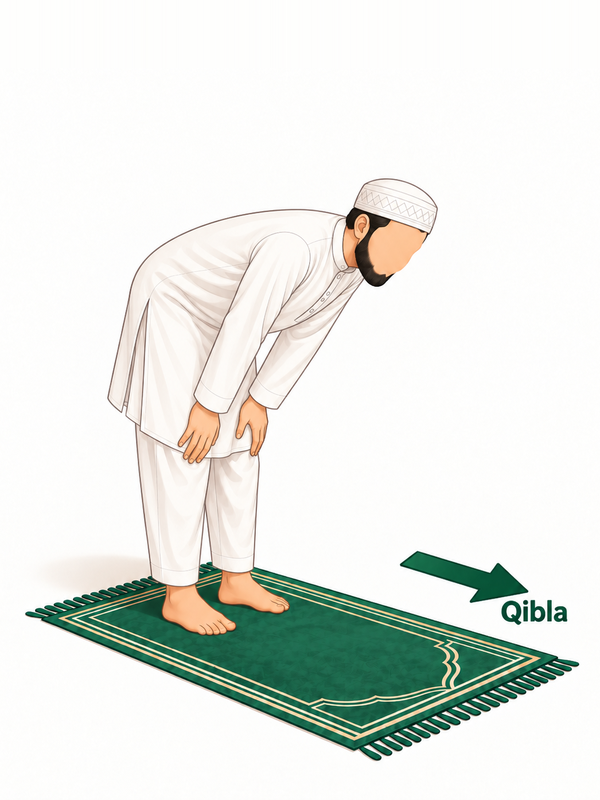
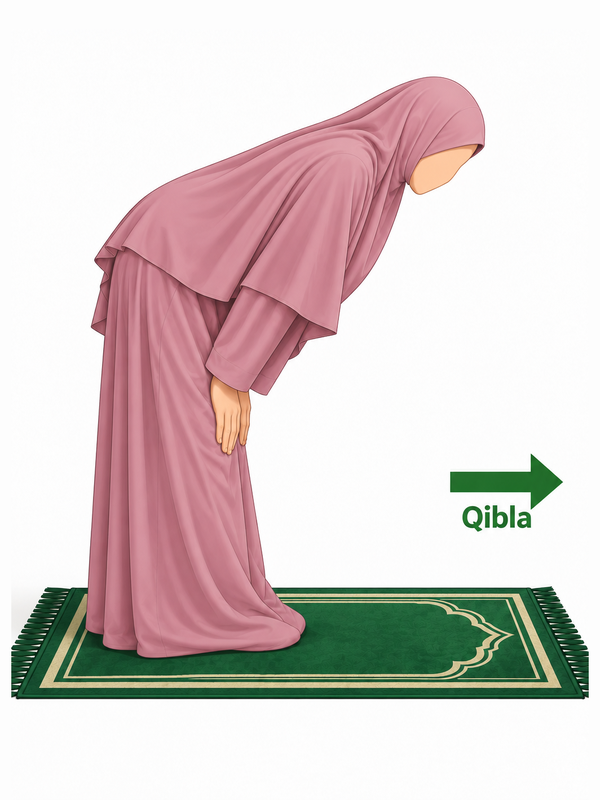
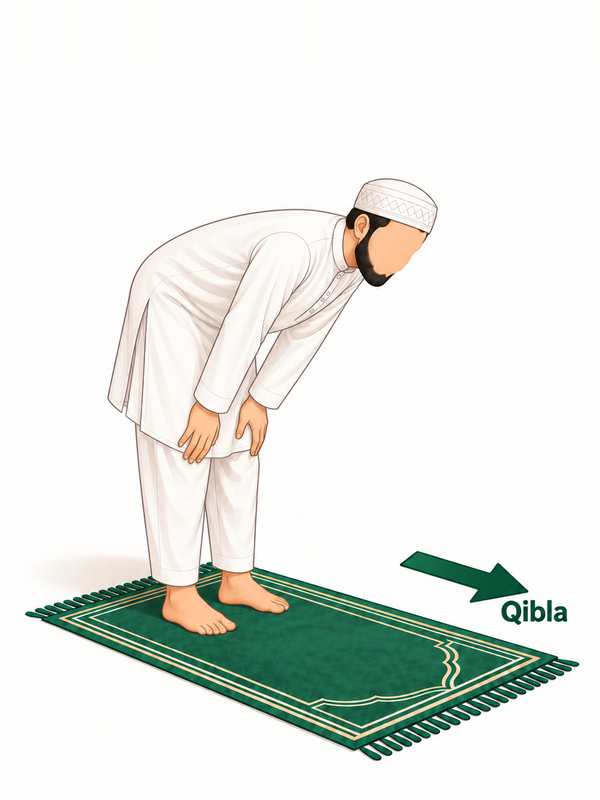
Say Allahu Akbar and bow, placing your hands on your knees with your back level. Stay still for a moment and glorify your Lord: Subhana Rabbiyal 'Azim — "Glory be to my Lord, the Most Great".
Bowing is how people have always shown respect. In salah, we bow to Allah alone.
المرحلة 11 من 17
Standing up from bowing (qawmah)
Al-qawmah
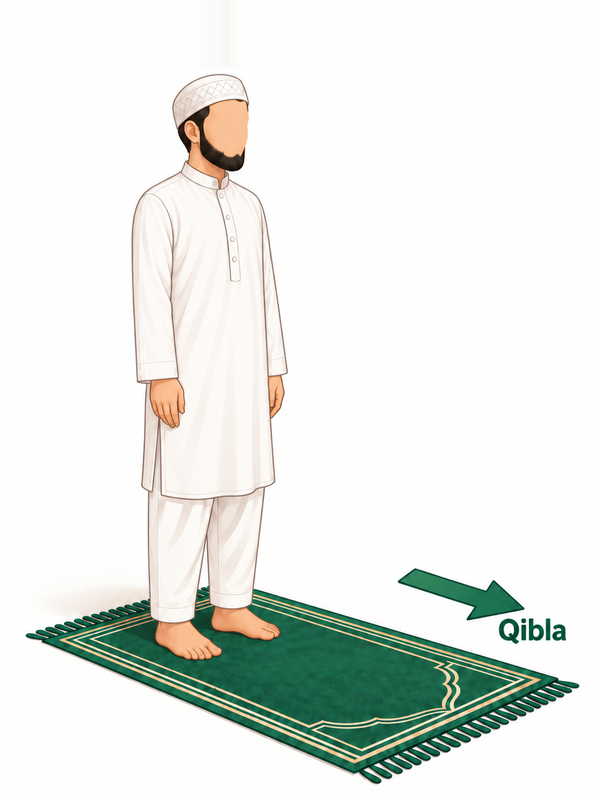
Rise from the bow saying Sami' Allahu liman hamidah — "Allah hears the one who praises Him" — and, once upright, Rabbana wa lakal-hamd — "Our Lord, and to You belongs all praise". Stand fully straight and still before going down.
A common mistake is to rush from bowing straight into prostration. Pausing here is part of praying calmly.
المرحلة 12 من 17
Prostration (sujud)
As-sujūd
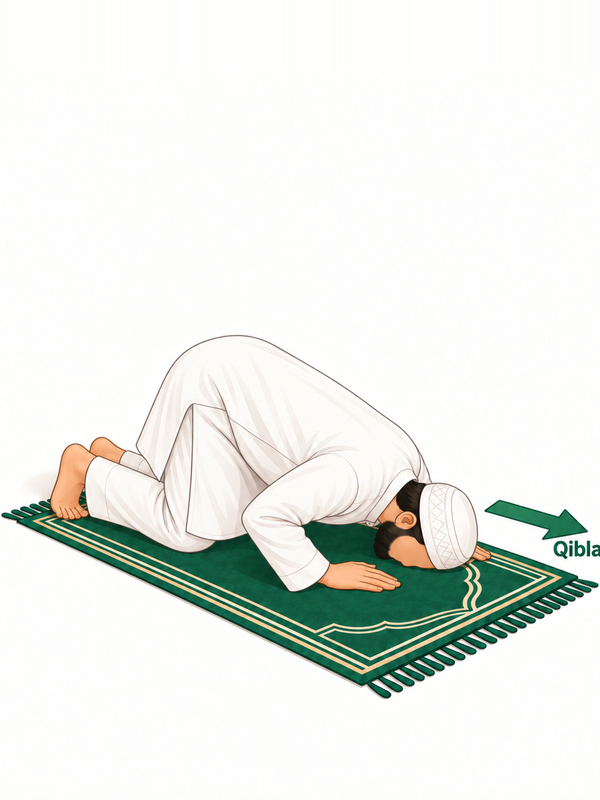
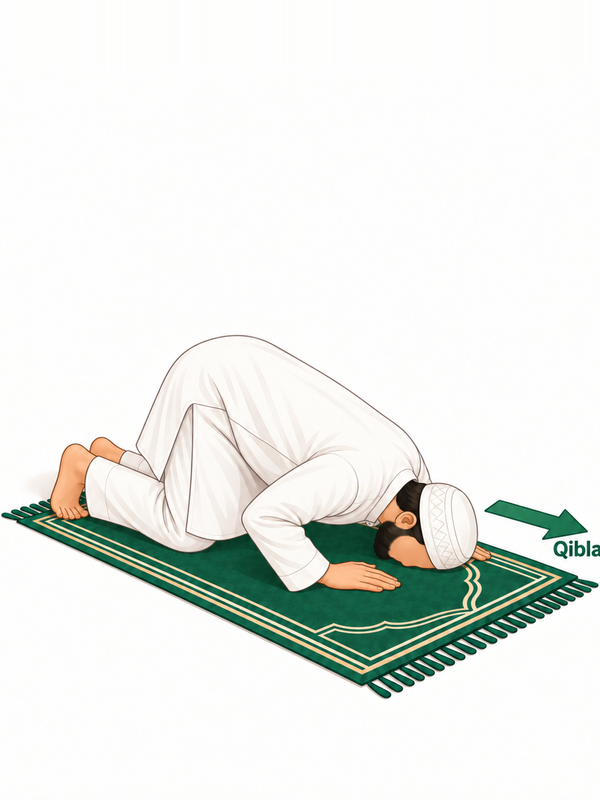
Say Allahu Akbar and go down, placing your forehead and nose, both palms, both knees and the toes of both feet on the ground. Glorify your Lord: Subhana Rabbiyal A'la — "Glory be to my Lord, the Most High".
Placing the highest part of your body on the ground is the deepest expression of humility. Many people find this the most peaceful moment of the prayer; it is a time to ask Allah for what you need.
المرحلة 13 من 17
Sitting between the two prostrations (jalsah)
Al-jalsah bayna as-sajdatayn
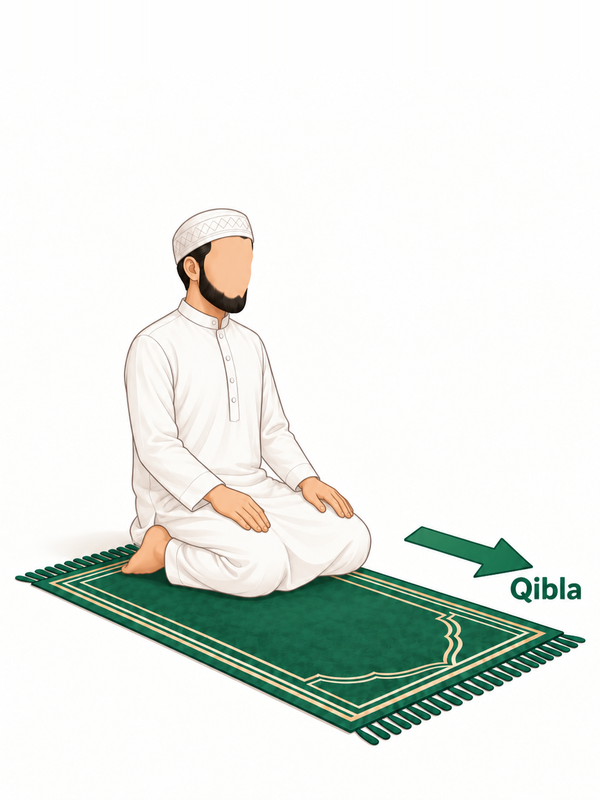
Rise from the first prostration saying Allahu Akbar and sit upright for a moment, asking Rabbighfir li — "My Lord, forgive me". Then make the second prostration exactly like the first. Two prostrations complete the rak'ah.
المرحلة 14 من 17
The tashahhud
At-tashahhud
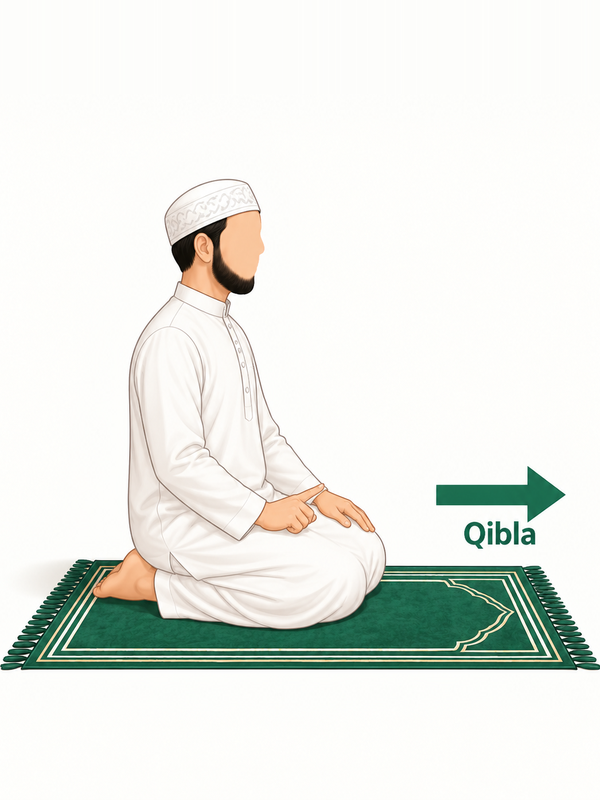
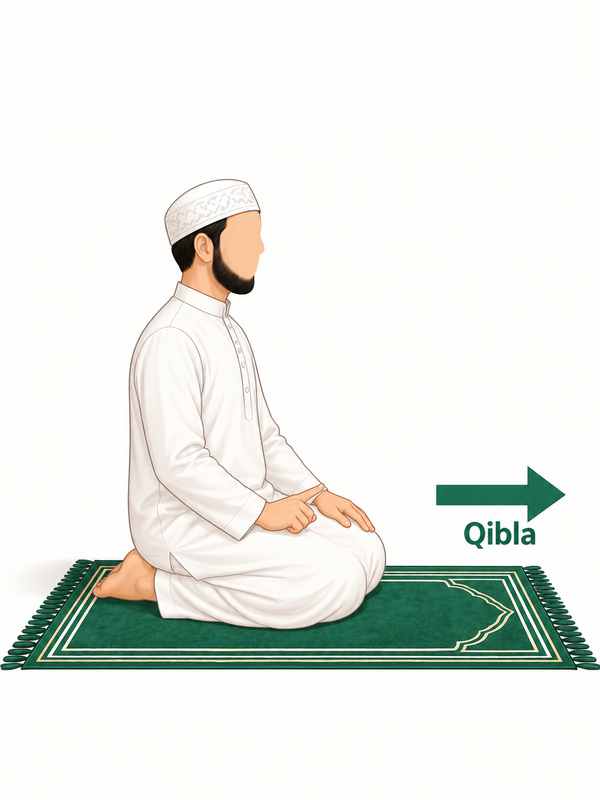
After every two rak'ahs you sit and recite the tashahhud, beginning At-tahiyyatu lillah — "All greetings are for Allah". It sends peace upon the Prophet ﷺ and upon all Allah's righteous servants, and ends with the testimony of faith. While saying the testimony, the index finger of the right hand points.
In a prayer of three or four rak'ahs, the first sitting is short: you recite the tashahhud only and stand up again. In the final sitting the tashahhud is followed by blessings on the Prophet ﷺ and a supplication.
المرحلة 15 من 17
Sending blessings upon the Prophet ﷺ
As-salāh 'alan-nabiyy
In the final sitting, after the tashahhud, you ask Allah to send blessings upon the Prophet Muhammad ﷺ and his family as He blessed Ibrahim and his family. It joins every prayer to the long line of prophets and to the love Muslims have for the Messenger ﷺ.
المرحلة 16 من 17
A supplication before ending
Ad-du'ā'
Before ending the prayer, it is recommended to make a short supplication. A well-loved one comes from the Quran: "Our Lord, give us good in this world and good in the Hereafter, and protect us from the punishment of the Fire." Many people also seek refuge in Allah from the four things the Prophet ﷺ taught.
المرحلة 17 من 17
Ending the prayer (taslim)
At-taslīm
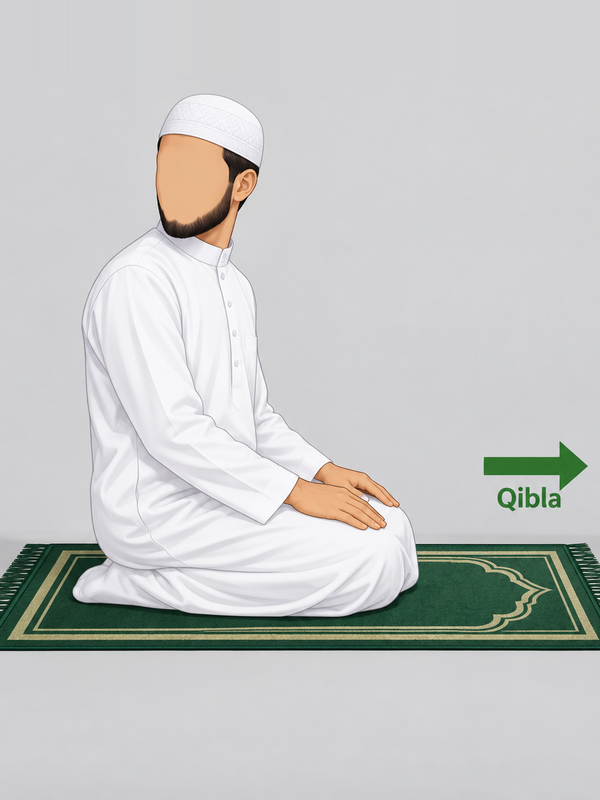
Turn your head to the right saying As-salamu 'alaykum wa rahmatullah — "Peace and the mercy of Allah be upon you" — and then to the left. The prayer that began with "Allah is the Greatest" ends by wishing peace on those around you.
هل أنت مستعد للتجربة؟
تنقّل في ركعتي الفجر على مهلك، مع كل حركة وكل ذكر ومعناه.
كيف تصلي
اضغط على وضعية لتتعلم كيف تؤديها وما تقرؤه بالضبط في كل مرحلة.
تتغير الصور بهذا الاختيار؛ والتعليمات واحدة للجميع.
Qiyam (Standing)
طريقة الأداء
-
1Niyyah — IntentionFace the Qiblah, stand upright and make the intention in your heart for the prayer you are about to perform.
-
2Takbiratul IhramRaise both hands to your ears (or shoulders) and say the opening takbir. This begins the prayer.
-
3Qiyam — RecitationPlace your right hand over your left, then recite Surah Al-Fatihah followed by another passage of the Quran.
أخطاء شائعة
- Not standing calmly
- Wrong Qiblah direction
- Incorrect hand placement
- Looking away from focus point
ماذا تقرأ
In order, while standing
اللّٰهُ أَكْبَرُ
سُبْحَانَكَ اللّٰهُمَّ وَبِحَمْدِكَ، وَتَبَارَكَ اسْمُكَ، وَتَعَالَىٰ جَدُّكَ، وَلَا إِلٰهَ غَيْرُكَ
أَعُوذُ بِاللّٰهِ مِنَ الشَّيْطَانِ الرَّجِيمِ ۞ بِسْمِ اللّٰهِ الرَّحْمٰنِ الرَّحِيمِ
بِسْمِ اللّٰهِ الرَّحْمٰنِ الرَّحِيمِ ١ الْحَمْدُ لِلّٰهِ رَبِّ الْعَالَمِينَ ٢ الرَّحْمٰنِ الرَّحِيمِ ٣ مَالِكِ يَوْمِ الدِّينِ ٤ إِيَّاكَ نَعْبُدُ وَإِيَّاكَ نَسْتَعِينُ ٥ اهْدِنَا الصِّرَاطَ الْمُسْتَقِيمَ ٦ صِرَاطَ الَّذِينَ أَنْعَمْتَ عَلَيْهِمْ غَيْرِ الْمَغْضُوبِ عَلَيْهِمْ وَلَا الضَّالِّينَ ٧
قُلْ هُوَ اللّٰهُ أَحَدٌ ١ اللّٰهُ الصَّمَدُ ٢ لَمْ يَلِدْ وَلَمْ يُولَدْ ٣ وَلَمْ يَكُنْ لَهُ كُفُوًا أَحَدٌ ٤
Ruku (Bowing)
طريقة الأداء
-
1Ruku — BowingSay the takbir, bow with a straight back and hold your knees, then glorify your Lord three times.
-
2Qawmah — Standing from RukuRise from bowing and stand fully upright before prostrating.
أخطاء شائعة
- Back not straight
- Hands off the knees
- Head too high or low
- Rushing the position
ماذا تقرأ
In order, while bowing
اللّٰهُ أَكْبَرُ
سُبْحَانَ رَبِّيَ الْعَظِيمِ
سَمِعَ اللّٰهُ لِمَنْ حَمِدَهُ، رَبَّنَا وَلَكَ الْحَمْدُ
Sujood (Prostration)
طريقة الأداء
-
1Sujood — ProstrationGo down to prostration placing forehead, nose, palms, knees and toes on the ground. Glorify your Lord three times.
-
2Jalsa — Sitting between prostrationsSit up briefly between the two prostrations and ask for forgiveness.
-
3Second SujoodProstrate a second time exactly as before. This completes one rakah.
أخطاء شائعة
- Forehead not touching ground properly
- Elbows resting on the floor
- Rushing the sujood
- Feet not in correct position
ماذا تقرأ
In order, in prostration
اللّٰهُ أَكْبَرُ
سُبْحَانَ رَبِّيَ الْأَعْلَى
رَبِّ اغْفِرْ لِي
Tashahhud (Sitting)
طريقة الأداء
-
1Short Qaʿdah — At-Taḥiyyāt OnlyAfter the 2nd rakaʿat sit and recite At-Taḥiyyāt ONLY. Do NOT recite Durūd here — you will stand up to continue with the remaining rakaʿāt.
-
2TashahhudAfter the required rakahs, sit and recite the tashahhud, raising the index finger at the declaration of faith.
أخطاء شائعة
- Not sitting calmly and still
- Keeping the finger raised the whole time
- Forgetting Durood in the final sitting
- Rushing through the words
ماذا تقرأ
In order, while sitting
التَّحِيَّاتُ لِلّٰهِ وَالصَّلَوَاتُ وَالطَّيِّبَاتُ، السَّلَامُ عَلَيْكَ أَيُّهَا النَّبِيُّ وَرَحْمَةُ اللّٰهِ وَبَرَكَاتُهُ، السَّلَامُ عَلَيْنَا وَعَلَىٰ عِبَادِ اللّٰهِ الصَّالِحِينَ، أَشْهَدُ أَنْ لَا إِلٰهَ إِلَّا اللّٰهُ وَأَشْهَدُ أَنَّ مُحَمَّدًا عَبْدُهُ وَرَسُولُهُ
اللّٰهُمَّ صَلِّ عَلَىٰ مُحَمَّدٍ وَعَلَىٰ آلِ مُحَمَّدٍ، كَمَا صَلَّيْتَ عَلَىٰ إِبْرَاهِيمَ وَعَلَىٰ آلِ إِبْرَاهِيمَ، إِنَّكَ حَمِيدٌ مَجِيدٌ، اللّٰهُمَّ بَارِكْ عَلَىٰ مُحَمَّدٍ وَعَلَىٰ آلِ مُحَمَّدٍ، كَمَا بَارَكْتَ عَلَىٰ إِبْرَاهِيمَ وَعَلَىٰ آلِ إِبْرَاهِيمَ، إِنَّكَ حَمِيدٌ مَجِيدٌ
رَبَّنَا آتِنَا فِي الدُّنْيَا حَسَنَةً وَفِي الْآخِرَةِ حَسَنَةً وَقِنَا عَذَابَ النَّارِ
Salam (Closing)
طريقة الأداء
-
Salam — ConcludingTurn your head to the right then to the left, giving salam each time. The prayer is complete.
أخطاء شائعة
- Turning the head before finishing the words
- Saying Salam only to one side
- Standing up immediately without calmness
ماذا تقرأ
To end the prayer
السَّلَامُ عَلَيْكُمْ وَرَحْمَةُ اللّٰهِ
السَّلَامُ عَلَيْكُمْ وَرَحْمَةُ اللّٰهِ
مواضع اختلاف المذاهب
تتفق المذاهب الأربعة على هيئة الصلاة، وتتبع في بعض التفاصيل روايات مختلفة ذات أصل معتبر. واصل الصلاة كما تعلّمتها.
Where the hands are placed while standing
Raising the hands
Saying "Bismillah" aloud before Al-Fatihah
Saying "Ameen" after Al-Fatihah
If you are just starting
No one learns the prayer in a day. Begin with the movements and Al-Fatihah, and keep a printed card beside you while you learn the rest by heart. Pray with others when you can — following an imam is one of the easiest ways to learn. Allah sees the effort of every learner.
After the prayer
Many Muslims remain seated after the salam for a few moments of remembrance: seeking forgiveness, glorifying Allah and making personal supplications in any language. The Dhikr & Tasbih page has the remembrances taught for after prayer.
المزيد عن الصلاة
المواقيت وأنواع الصلاة وترتيبها والأوضاع، بشرح واضح.
What is Salah?
Salah (prayer) is an act of worship in Islam that connects us directly with Allah ﷻ. It is one of the Five Pillars of Islam and a duty upon every Muslim.
Salah purifies the heart, brings discipline to life and keeps us on the right path.
Connects us with Allah
Forgives sins
Brings peace & tranquility
Increases patience & gratitude
Protects from wrongdoing
Niyat (Intention)
Purify your intention and make Niyat in your heart that you are praying for the sake of Allah.
"Actions are judged by intentions, and every person will get what he intended."Qiblah (Direction)
Face the Qiblah (direction of the Ka'bah in Makkah) in all prayers. Use a Qiblah compass or app to find the correct direction.
Learn MorePrayer Time
Fajr
Before Sunrise
Dhuhr
After Midday
Asr
Late Afternoon
Maghrib
Just After Sunset
Isha
Night
What is a Rak'ah?
Rak'ah is a unit of prayer. Each Salah consists of a certain number of Rak'ahs. In each Rak'ah we stand, bow, prostrate and sit in a specific order.
Prayer Types
Fard (Obligatory)
Prayers that are compulsory.Witr (Wajib)
Special night prayer. Odd Rak'ahs prayed in Isha.Sunnah Muakkadah (Emphasized)
Sunnah prayers strongly encouraged.Sunnah Ghair Muakkadah
Sunnah prayers encouraged.Nafl (Voluntary)
Extra prayers done for the sake of Allah.Prayer Orders (Tarteeb)
Prayer Positions (Arkan ul Salah)
Qiyam (Standing)
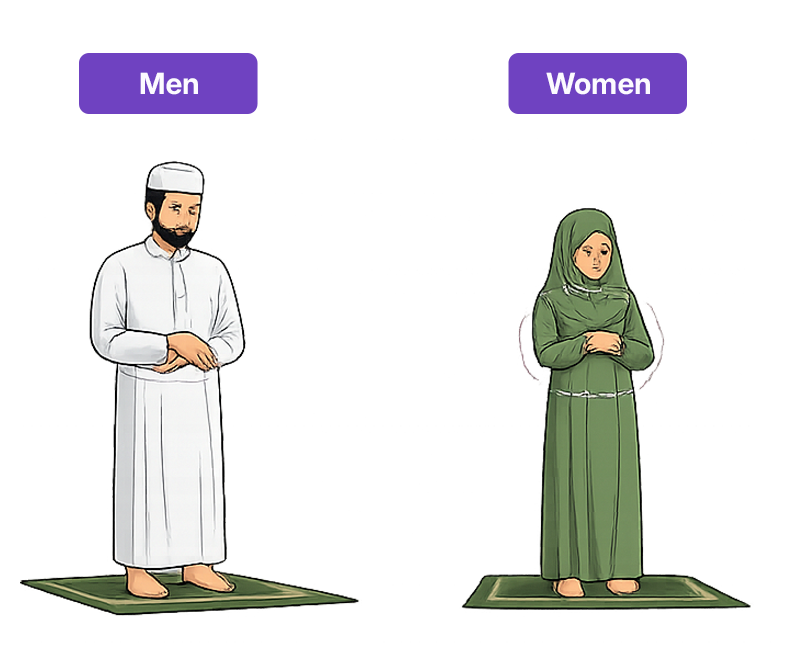
Hands folded below the chest.
Hands folded Slightly higher on the chest.
How to Do
- 1 Stand facing the Qiblah.
- 2 Place your feet parallel.
- 3 Raise your hands to your ears saying "Allahu Akbar".
- 4 Place your right hand over the left on your chest.
- 5 Look down at the place of prostration.
Qiblah Direction
Face the Qiblah (direction of the Ka'bah in Makkah) in all prayers. Use a Qiblah compass or app to find the correct direction.Common Mistakes
- Not standing calmly.
- Wrong Qiblah direction.
- Incorrect hand placement.
- Looking away from focus point.
Ruku (Bowing)
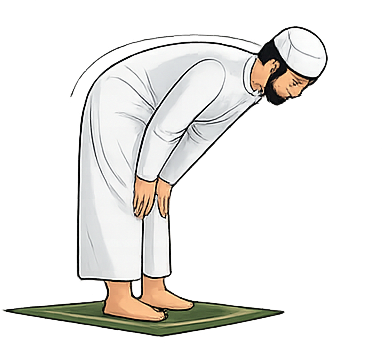
How to Do
- 1 Say “Allahu Akbar” and bow forward.
- 2 Place hands on knees.
- 3 Keep back straight.
- 4 Look at your feet.
- 5 Say “Subhana Rabbiyal Azeem”.
Common Mistakes
- Bowing too early or too late
- Bent back (not straight)
- Hands not on knees
- Raising head while bowing
Sujood (Prostration)
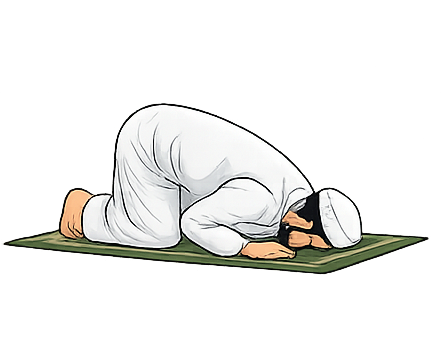
How to Do
- 1 Say “Allahu Akbar” and go down.
- 2 Place hands, knees, and forehead on the ground.
- 3 Keep elbows off the ground.
- 4 Point toes towards Qiblah.
- 5 Say “Subhana Rabbiyal A’la”.
Common Mistakes
- Elbows touching the ground
- Not placing all seven points
- Raising toes too early
- Toes not towards Qiblah
Tashahhud (Sitting)
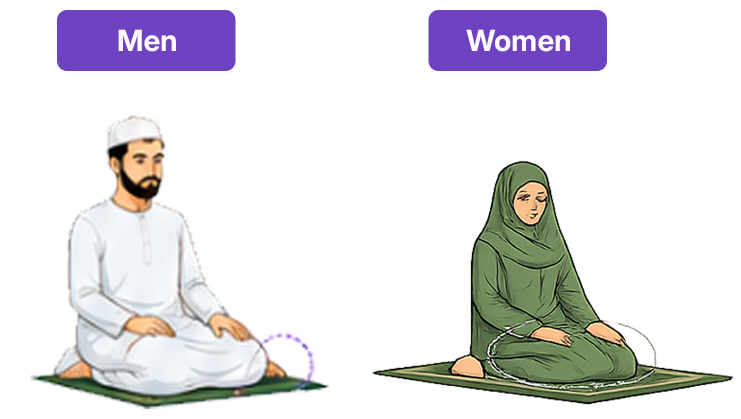
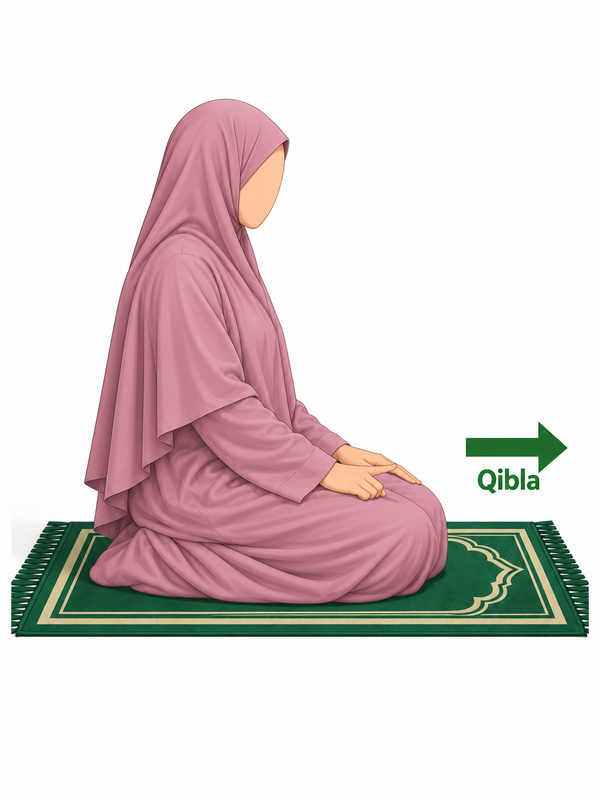
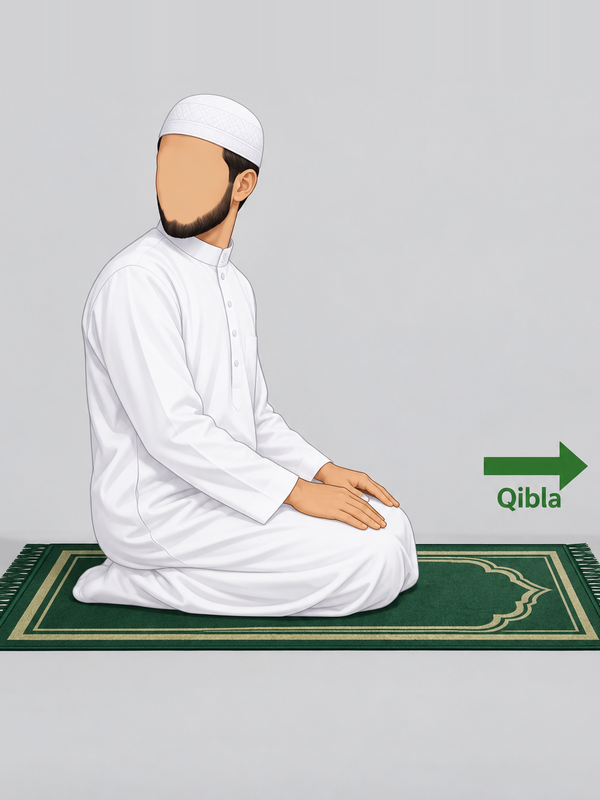
Sit on your left leg with toes upright. Right foot upright with toes towards Qiblah. Hands on thighs.
Sit on the floor with legs to one side. Hands on thighs.
How to Do
- 1 Sit properly after the second sujood.
- 2 Place hands on thighs.
- 3 Keep back straight.
- 4 Recite Tashahhud.
- 5 Send blessings upon the Prophet ﷺ.
Tashahhud (What to say)
At-tahiyyatu lillahi was-salawatu wat-tayyibat. As-salaamu ‘alayka ayyuhan-Nabiyyu wa rahmatullaahi wa barakaatuh. As-salaamu ‘alayna wa ‘alaa ‘ibaadillahis-saaliheen. Ash-hadu an laa ilaaha illallaahu wa ash-hadu anna Muhammadan ‘abduhu wa rasooluh.Common Mistakes
- Sitting carelessly
- Hands not on thighs
- Forgetting Tashahhud
- Moving unnecessarily
Salam (Closing)
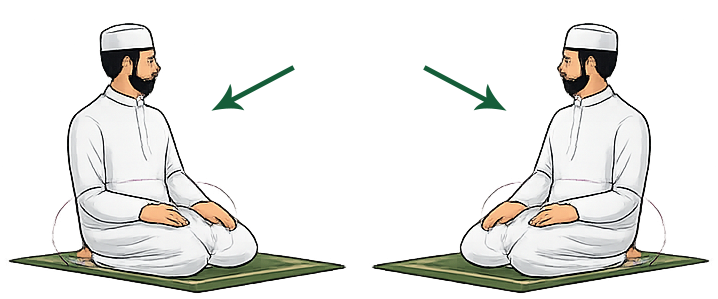
Turn head to the right
Turn head to the left
How to Do
- 1 Turn head to the right and say “Assalamu Alaikum wa Rahmatullah.”
- 2 Turn head to the left and say the same.
- 3 This completes the prayer.
Common Mistakes
- Turning whole body
- Incorrect words
- Skipping second side
Before You Pray (Essential Preparations)
Wudu (Ablution)
Learn the correct way of making Wudu.
Steps of Wudu
- 1 Intention (Niyyah)
- 2 Wash hands up to wrists (3 times)
- 3 Rinse mouth (3 times)
- 4 Rinse nose (3 times)
- 5 Wash face (3 times)
- 6 Wash right arm up to elbow (3 times)
- 7 Wash left arm up to elbow (3 times)
- 8 Wipe head (Masah)
- 9 Wipe ears
- 10 Wash right foot up to ankle (3 times)
- 11 Wash left foot up to ankle (3 times)
Cleanliness (Body & Clothes)
It is essential to be clean for Salah.
Body Cleanliness
- Bath regularly
- Keep body parts clean
- Trim nails
- Remove unwanted hair
- Use perfume (for men)
Clothes Cleanliness
- Wear clean clothes
- Remove stains and impurities
- Clothes should be free from najasah (impurity)
Sattar (Covering)
Covering the body is a condition of Salah.
For Men
- From navel to knees must be covered.
- Should not wear silk or gold.
- Clothes should be loose and decent.


For Women
- Whole body must be covered except face and hands.
- Loose, non-transparent clothes.
- No tight fitting or showing shape.

أسئلة يطرحها المبتدئون
Do I have to recite in Arabic?
The recitations of the prayer — above all Al-Fatihah — are learned in Arabic, the language of the Quran, and every Muslim learns them step by step. The personal supplications you make, outside the fixed recitations, can be in any language. Ask your local imam how to manage while you are still learning.
How long does a prayer take?
A two-rak'ah prayer usually takes three to five minutes when prayed calmly; a four-rak'ah prayer, five to ten. There is no rush — praying calmly is part of praying well.
Which prayers are recited aloud?
In Fajr, and in the first two rak'ahs of Maghrib and Isha, the imam recites Al-Fatihah and the surah aloud. Dhuhr and Asr are recited quietly. When praying alone, many people recite the loud prayers audibly to themselves.
Do men and women pray differently?
The prayer is the same for everyone: the same times, recitations and movements. Some schools teach small differences in posture for women, such as keeping the arms closer to the body. The walkthrough lets you choose the figure that matches you; the instructions are the same.