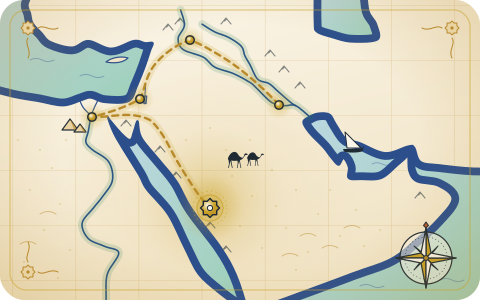
الأنبياء الخمسة والعشرون المذكورون في القرآن، بالترتيب الذي حفظه التراث. اختر نبيًّا لترى متى وأين عاش، وإلى من أُرسل، وما يقوله القرآن عنه.
الخط الزمني للأنبياء
أولو العزم: الرسل أصحاب العزيمة الثابتة
مؤرَّخ من مصدر موثَّق
التاريخ غير معروف
الأجيال الأولى
جزيرة العرب القديمة
إبراهيم وآله
أنبياء بني إسرائيل
خاتم الرسل
اسحب أو مرّر أو استخدم مفاتيح الأسهم للتنقل على الخط الزمني.
1 من 25آدمAdamالأجيال الأولى
Adam
1st Prophet & 1st Human
العصر
التاريخ غير معروفلا يُعرف تاريخ موثوق. يحافظ الخط الزمني على الترتيب الذي يذكره التراث.
أُرسل إلى
His children — all of humanity
المكان
Mount Arafat, near Meccaبحسب ما ورد في التراث
Allah ﷻ created Adam ﷺ from clay, and breathed His spirit into him. He was the very first human being and the first prophet. Allah taught Adam the names of all things, a knowledge the angels themselves did not possess, demonstrating the unique honour given to mankind. Adam and his wife Hawwa (Eve) were placed in Jannah and allowed to enjoy its pleasures freely. They were forbidden only from one tree. Iblis (Shaytan) — who had refused to bow to Adam out of arrogance — tricked them into eating from it. Adam ﷺ disobeyed and then sincerely repented, and Allah forgave him and chose him as His prophet. He was then sent to earth as its first inhabitant, where he and Hawwa built family life and spread the worship of one God across generations.
And We said: O Adam! Dwell thou and thy wife in the Garden, and eat ye freely (of the fruits) thereof where ye will; but come not nigh this tree lest ye become wrong-doers.
التاريخ غير معروفلا يُعرف تاريخ موثوق. يحافظ الخط الزمني على الترتيب الذي يذكره التراث.
أُرسل إلى
His people (later tradition places them in Babylon)
المكان
Babylon, Mesopotamiaبحسب ما ورد في التراثمكان الولادة: Babylon (later tradition)
Prophet Idrīs ﷺ was among the early descendants of Adam ﷺ. He is widely believed to be among the first to write with a pen, to study the stars, and to teach mankind skills of civilisation including sewing, mathematics, and astronomy. He called his people to worship Allah alone and live righteously. Allah ﷻ raised him to a high station — the Quran describes him as being "raised to a high place" (rafa'naahu makaanan 'aliyyaa). Many scholars identify him with Enoch of the Biblical tradition. He was known for his intense worship and steadfast patience.
التاريخ غير معروفلا يُعرف تاريخ موثوق. يحافظ الخط الزمني على الترتيب الذي يذكره التراث.
أُرسل إلى
The people of Nuh
المكان
Mount Judi, south-east Turkeyبحسب ما ورد في التراث
Prophet Nūḥ ﷺ was sent to a people who had completely abandoned monotheism and turned to idol worship. He preached to them for an extraordinary 950 years , inviting them to Allah with patience, wisdom, and unwavering resolve — day and night, in public and in private. Despite his immense effort, only a small number believed. Even his own son and wife rejected him. Allah commanded him to build the Ark (Safinat Nūḥ), and when the great flood came, the disbelievers were drowned. Nūḥ ﷺ, the believers, and pairs of animals were saved. After the flood, the Ark rested on Mount Judi. Nūḥ ﷺ and the survivors repopulated the earth — he is thus called the "second father of mankind" and the entire human race today descends from his three sons: Sam, Ham, and Yafeth.
And verily we sent Noah (as Our messenger) unto his folk, and he continued with them for a thousand years save fifty years; and the flood engulfed them, for they were wrong-doers.
التاريخ غير معروفلا يُعرف تاريخ موثوق. يحافظ الخط الزمني على الترتيب الذي يذكره التراث.
أُرسل إلى
The people of 'Ad
المكان
Al-Ahqaf, Hadramawt, Yemenبحسب ما ورد في التراث
Prophet Hūd ﷺ was sent to the people of 'Ād — a powerful, advanced civilisation of the Arabian Peninsula (modern-day Yemen/Oman region). They were physically imposing, built great structures, and were blessed with fertile land and abundance — yet they were arrogant and rejected monotheism. Hūd ﷺ called them to abandon idol worship and return to Allah. The leaders rejected him mockingly. Allah sent a devastating windstorm that destroyed the 'Ād completely over 7 nights and 8 days. Hūd ﷺ and his small band of followers were saved.
And unto (the tribe of) A'ad (We sent) their brother, Hud. He said: O my people! Serve Allah. Ye have no other Allah save Him. Will ye not ward off (evil)?
التاريخ غير معروفلا يُعرف تاريخ موثوق. يحافظ الخط الزمني على الترتيب الذي يذكره التراث.
أُرسل إلى
The people of Thamud
المكان
Al-Hijr (Hegra, Mada'in Salih), Saudi Arabiaبحسب ما ورد في التراث
Prophet Ṣāliḥ ﷺ was sent to the Thamūd — a civilisation in the Ḥijr region (north-western Arabia) known for carving homes into mountains. They too were prosperous, powerful, and idolatrous. As a sign from Allah, a she-camel appeared miraculously from a rock. Ṣāliḥ ﷺ commanded his people to let her graze freely and not harm her. Despite the miracle, the leaders of Thamūd arrogantly hamstrung the camel. Three days later, a mighty thunderous blast destroyed them all. Ṣāliḥ ﷺ and the believers escaped.
And to (the tribe of) Thamud (We sent) their brother Salih. He said: O my people! Serve Allah. Ye have no other Allah save Him. A wonder from your Lord hath come unto you. Lo! this is the camel of Allah, a token unto you; so let her feed in Allah's earth, and touch her not with hurt lest painful torment seize you.
His people in Mesopotamia, beginning with his own father
المكان
Ur, Mesopotamia (southern Iraq)بحسب ما ورد في التراثمكان الولادة: Ur, Mesopotamia (traditional)
الكتاب
Suhuf (Scrolls) of Ibrahimمذكور في القرآن، Al-A'la 87:18
Prophet Ibrāhīm ﷺ — known as the "Father of the Prophets" — is one of the greatest prophets in Islam. He was born in Ur (modern-day Iraq) into a family of idol-makers. From a young age, he rejected idol worship through pure reasoning, deducing that the stars, moon, and sun — all of which set — could not be his Lord. He concluded that only the Creator of all things deserved worship. His father Āzar was an idol-maker and rejected him bitterly. Ibrāhīm ﷺ smashed the idols of his people and was thrown into a massive fire — but Allah commanded the fire to be "cool and safe" for him. He then migrated to Palestine and later Makkah, where with his son Ismā'īl ﷺ he built the Ka'bah — the first house of worship for Allah on earth. He is the patriarch of three Abrahamic faiths. His lineage produced the greatest prophets: Ismā'īl ﷺ (ancestor of Muhammad ﷺ) and Isḥāq ﷺ (ancestor of Mūsā ﷺ, Dāwūd ﷺ, a
Who is better in religion than he who surrendereth his purpose to Allah while doing good (to men) and followeth the tradition of Abraham, the upright? Allah (Himself) chose Abraham for friend.
An-Nisa 4:125· Marmaduke Pickthall (en.pickthall)مزيد من الآيات
التاريخ غير معروفلا يُعرف تاريخ موثوق. يحافظ الخط الزمني على الترتيب الذي يذكره التراث.
أُرسل إلى
The people of Lut (the cities of Sodom and Gomorrah)
المكان
Near the Dead Sea (Sodom and Gomorrah)بحسب ما ورد في التراثمكان الولادة: Ur, Mesopotamia (traditional)
Prophet Lūṭ ﷺ was the nephew of Ibrāhīm ﷺ. He was sent to the people of Sodom (Qawm Lūṭ) — a people who had fallen into the gravest immorality: sexual transgression with the same sex, open lewdness, and robbery. He called them to purity and monotheism for years. His own wife sided with the disbelievers. When the angels arrived in the form of handsome young men, the people of Sodom tried to assault them. Lūṭ ﷺ desperately protected his guests. The angels then revealed their identity and commanded Lūṭ ﷺ to leave with his family before dawn. A devastating punishment rained down — the entire cities were overturned and pelted with stones of baked clay.
التاريخ غير معروفلا يُعرف تاريخ موثوق. يحافظ الخط الزمني على الترتيب الذي يذكره التراث.
أُرسل إلى
His people in Mecca
المكان
Mecca — the Kaabaبحسب ما ورد في التراثمكان الولادة: Canaan
Prophet Ismā'īl ﷺ was the firstborn son of Ibrāhīm ﷺ through his wife Hājar. As an infant, he was left with his mother in the barren valley of Makkah. When Hājar ran frantically between the hills of Ṣafā and Marwah seeking water, Allah caused the blessed Zamzam spring to gush from the earth beneath baby Ismā'īl's feet. When Ismā'īl grew older, Ibrāhīm ﷺ was commanded in a dream to sacrifice him. In an act of supreme faith, both father and son submitted to Allah's will. Allah then replaced him with a ram — showing His mercy — and this sacrifice is commemorated every Eid al-Adha. He helped his father build the Ka'bah and settled in Makkah among the Arab tribe of Jurhum. He is the forefather of the Adnāni Arabs and the direct ancestor of Prophet Muhammad ﷺ.
And when We made the House (at Makka) a resort for mankind and sanctuary, (saying): Take as your place of worship the place where Abraham stood (to pray). And We imposed a duty upon Abraham and Ishmael, (saying): Purify My house for those who go around and those who meditate therein and those who bow down and prostrate themselves (in worship).
Al-Baqarah 2:125· Marmaduke Pickthall (en.pickthall)مزيد من الآيات
And when Abraham prayed: My Lord! Make this a region of security and bestow upon its people fruits, such of them as believe in Allah and the Last Day, He answered: As for him who disbelieveth, I shall leave him in contentment for a while, then I shall compel him to the doom of Fire - a hapless journey's end!
And when Abraham and Ishmael were raising the foundations of the House, (Abraham prayed): Our Lord! Accept from us (this duty). Lo! Thou, only Thou, art the Hearer, the Knower.
Our Lord! And make us submissive unto Thee and of our seed a nation submissive unto Thee, and show us our ways of worship, and relent toward us. Lo! Thou, only Thou, art the Relenting, the Merciful.
Our Lord! Lo! I have settled some of my posterity in an uncultivable valley near unto Thy holy House, our Lord! that they may establish proper worship; so incline some hearts of men that they may yearn toward them, and provide Thou them with fruits in order that they may be thankful.
التاريخ غير معروفلا يُعرف تاريخ موثوق. يحافظ الخط الزمني على الترتيب الذي يذكره التراث.
أُرسل إلى
His people in Canaan
المكان
Beersheba, Canaanبحسب ما ورد في التراثمكان الولادة: Canaan
Prophet Isḥāq ﷺ was the second son of Ibrāhīm ﷺ, born miraculously to his elderly wife Sārah, who was beyond childbearing age. His birth was itself a miracle — announced by angels who visited Ibrāhīm ﷺ on their way to destroy the people of Lūṭ ﷺ. Isḥāq ﷺ was a prophet in the land of Canaan (Palestine). He continued the mission of his father, calling to monotheism. He is the patriarch of the Israelite line of prophets — his son Ya'qūb ﷺ (Israel) fathered the twelve tribes, from whom came Yūsuf ﷺ, Mūsā ﷺ, Dāwūd ﷺ, Sulaimān ﷺ, and 'Īsā ﷺ.
And when he saw their hands reached not to it, he mistrusted them and conceived a fear of them. They said: Fear not! Lo! we are sent unto the folk of Lot.
التاريخ غير معروفلا يُعرف تاريخ موثوق. يحافظ الخط الزمني على الترتيب الذي يذكره التراث.
أُرسل إلى
His family, the forebears of the Children of Israel
المكان
Hebron, Canaanبحسب ما ورد في التراثمكان الولادة: Canaan (Beersheba, according to Genesis)
Prophet Ya'qūb ﷺ (also known as Isrā'īl, meaning "servant of Allah") was the son of Isḥāq ﷺ and the grandson of Ibrāhīm ﷺ. He had twelve sons — the founders of the twelve tribes of Israel. His beloved son was Yūsuf ﷺ. The greatest trial of Ya'qūb ﷺ was the apparent loss of his beloved son Yūsuf — thrown into a well by his jealous brothers, who then deceived their father with Yūsuf's blood-stained shirt. Ya'qūb ﷺ wept so much that he lost his eyesight, yet he maintained his patience and trust in Allah. Decades later, they were reunited in Egypt — and his sight was restored when Yūsuf's shirt was placed over his face.
The same did Abraham enjoin upon his sons, and also Jacob, (saying): O my sons! Lo! Allah hath chosen for you the (true) religion; therefore die not save as men who have surrendered (unto Him).
Al-Baqarah 2:132· Marmaduke Pickthall (en.pickthall)مزيد من الآيات
Or were ye present when death came to Jacob, when he said unto his sons: What will ye worship after me? They said: We shall worship thy god, the god of thy fathers, Abraham and Ishmael and Isaac, One Allah, and unto Him we have surrendered.
Then, when the bearer of glad tidings came, he laid it on his face and he became a seer once more. He said: Said I not unto you that I know from Allah that which ye know not?
Egypt — the Nile valleyبحسب ما ورد في التراثمكان الولادة: Canaan (Palestine)
Allah called the story of Yūsuf ﷺ the "best of stories" (ahsanul qasas). He was the beloved son of Ya'qūb ﷺ, blessed with remarkable beauty and the ability to interpret dreams. His eleven brothers, consumed by jealousy, threw him into a well and sold him to merchants, who sold him as a slave in Egypt. In Egypt, he was bought by a noble named Al-'Azīz. His wife Zulaykhā tried to seduce him, and when he refused, she had him imprisoned. In prison, he interpreted the dreams of fellow inmates. When the Pharaoh was troubled by a dream no one could interpret, Yūsuf ﷺ was brought forth and correctly interpreted it — warning of seven years of abundance followed by seven years of drought. Impressed, the Pharaoh appointed him over Egypt's treasury. He managed the food stores through the famine brilliantly. When his brothers came to Egypt for food (not recognising him), he eventually revealed himsel
التاريخ غير معروفلا يُعرف تاريخ موثوق. يحافظ الخط الزمني على الترتيب الذي يذكره التراث.
أُرسل إلى
His own people (not named in the Quran)
المكان
Hauran, southern Syriaبحسب ما ورد في التراث
Prophet Ayyūb ﷺ (Job) was a prophet greatly blessed by Allah — with wealth, health, family, and honour. Shaytan challenged that Ayyūb ﷺ only worshipped Allah because of his blessings. So Allah permitted Shaytan to test him severely. He lost his wealth, his children, and was afflicted with a terrible disease (scholars say affecting his skin and body) for 18 years — some narrations say between 7–18 years. He was left with almost nothing, yet his gratitude and patience never wavered. Even his wife remained loyal and served him throughout. At the peak of his suffering, he cried out to Allah humbly — not complaining, but acknowledging his weakness before the Most Merciful. Allah healed him completely, restored his family (doubled), his wealth, and blessed him abundantly. His story is the supreme example of sabr (patient endurance) in Islam.
التاريخ غير معروفلا يُعرف تاريخ موثوق. يحافظ الخط الزمني على الترتيب الذي يذكره التراث.
أُرسل إلى
The people of Madyan
المكان
Madyan — al-Bad', north-west Arabiaبحسب ما ورد في التراث
Prophet Shu'ayb ﷺ was sent to the people of Madyan (in the north-west Arabian Peninsula) and to the people of Al-Aykah. These peoples were notorious for fraud in trade — giving short measure, using false weights, and deceiving in business. Shu'ayb ﷺ was known as the "Khatib al-Anbiya'" — the orator of the prophets — for his eloquent speech and persuasive preaching. He warned them to deal justly and abandon corrupt practices. After prolonged rejection, divine punishment came: a tremendous thundering blast destroyed the people of Madyan, and a scorching heat destroyed Al-Aykah.
And unto Midian (We sent) their brother Shu'eyb. He said: O my people! Serve Allah. Ye have no other Allah save Him! And give not short measure and short weight. Lo! I see you well-to-do, and lo! I fear for you the doom of a besetting Day.
Mount Sinai (Jabal Musa), Sinaiبحسب ما ورد في التراثمكان الولادة: Egypt
الكتاب
Tawrah (Torah); the Suhuf of Musaمذكور في القرآن، Al-Baqarah 2:53
Mūsā ﷺ is the most mentioned prophet in the Quran. He was born in Egypt when Pharaoh (Fir'awn) had decreed that all newborn Israelite boys be killed. By Allah's instruction, his mother placed him in a basket on the Nile — he was found and raised in the very palace of Pharaoh, as a test of destiny. After accidentally killing an Egyptian, he fled to Madyan where he married the daughter of Shu'ayb ﷺ and spent years tending sheep. On his return, near Mount Sinai (Ṭūr), he saw a burning bush. Allah spoke to him directly — "I am Allah, there is no god but Me" — and commanded him to go to Pharaoh. He was given the miraculous staff and a glowing hand as signs. With his brother Hārūn ﷺ, he confronted Pharaoh, performed nine great miracles, and ultimately led the Israelites out of Egypt. When Pharaoh pursued them, Allah parted the Red Sea. The Israelites crossed safely — Pharaoh and his army drown
التاريخ غير معروفلا يُعرف تاريخ موثوق. يحافظ الخط الزمني على الترتيب الذي يذكره التراث.
أُرسل إلى
Pharaoh and his court, and the Children of Israel
المكان
Jabal Harun (Mount Hor), near Petraبحسب ما ورد في التراثمكان الولادة: Egypt
Prophet Hārūn ﷺ (Aaron) was the elder brother of Mūsā ﷺ and was appointed as his minister and co-prophet at Mūsā's ﷺ own request. Mūsā ﷺ asked Allah: "And appoint for me a minister from my family — Hārūn, my brother." He was renowned for his eloquence and gentle manner. When Mūsā ﷺ went to Mount Sinai for 40 nights, he left Hārūn ﷺ in charge of the Israelites. During this period, a man named Al-Sāmirī fashioned a golden calf and led the people into idol worship. Hārūn ﷺ tried his utmost to stop them but was outnumbered and physically restrained. When Mūsā ﷺ returned enraged, Hārūn ﷺ explained his helplessness with humility.
في القرآن
وَٱجْعَل لِّى وَزِيرًۭا مِّنْ أَهْلِى
Appoint for me a henchman from my folk,
Taha 20:29· Marmaduke Pickthall (en.pickthall)مزيد من الآيات
And Aaron indeed had told them beforehand: O my people! Ye are but being seduced therewith, for lo! your Lord is the Beneficent, so follow me and obey my order.
My brother Aaron is more eloquent than me in speech. Therefor send him with me as a helper to confirm me. Lo! I fear that they will give the lie to me.
He said: We will strengthen thine arm with thy brother, and We will give unto you both power so that they cannot reach you for Our portents. Ye twain, and those who follow you, will be the winners.
التاريخ غير معروفلا يُعرف تاريخ موثوق. يحافظ الخط الزمني على الترتيب الذي يذكره التراث.
أُرسل إلى
Not named in the Quran
المكان
Al-Kifl, Iraq (traditional shrine)بحسب ما ورد في التراث
Prophet Dhul-Kifl ﷺ is mentioned briefly in the Quran alongside Ismā'īl ﷺ and Idrīs ﷺ as being among the patient and righteous. His name means "Owner of the Portion/Double Portion" — possibly referring to a doubled reward or a covenant he undertook. Many scholars link him with the Prophet Alyasa' or identify him as a prophet who pledged to fast every day, pray every night, and never make a judgement in anger — and fulfilled this pledge perfectly. He is celebrated for extraordinary patience and steadfast worship.
Prophet Dāwūd ﷺ (David) began as a young shepherd from the tribe of Judah. When the Israelite army faced the giant Goliath (Jālūt), the young Dāwūd defeated him with a sling — one small stone — placing his full trust in Allah. This victory launched his rise to become king and prophet. Allah gave him the Zabūr (Psalms) — a scripture of praises and wisdom. His voice was so beautiful that mountains and birds would glorify Allah alongside him. He was also gifted with knowledge of ironworking — Allah made iron soft for him, and he fashioned armour (chainmail) for the first time. He ruled with justice and wisdom from Jerusalem.
So they routed them by Allah's leave and David slew Goliath; and Allah gave him the kingdom and wisdom, and taught him of that which He willeth. And if Allah had not repelled some men by others the earth would have been corrupted. But Allah is a Lord of Kindness to (His) creatures.
Al-Baqarah 2:251· Marmaduke Pickthall (en.pickthall)مزيد من الآيات
Lo! We inspire thee as We inspired Noah and the prophets after him, as We inspired Abraham and Ishmael and Isaac and Jacob and the tribes, and Jesus and Job and Jonah and Aaron and Solomon, and as We imparted unto David the Psalms;
Jerusalem — the Temple Mountمكان الولادة: Jerusalem
Prophet Sulaimān ﷺ (Solomon) was the son of Dāwūd ﷺ and inherited the kingdom of Israel. Allah blessed him with a kingdom unmatched in the history of mankind. He was given command over the wind, jinn, animals, and could understand the speech of all creatures. His hoopoe bird brought him news of the Queen of Sheba (Bilqīs), who ruled a magnificent kingdom but worshipped the sun. Sulaimān ﷺ sent her a letter in the name of Allah, invited her to Islam, and she ultimately submitted. He built the great Al-Aqsa Mosque in Jerusalem. He asked Allah for "a kingdom never given to anyone after me" — and Allah granted it.
And Solomon was David's heir. And he said: O mankind! Lo! we have been taught the language of birds, and have been given (abundance) of all things. This surely is evident favour.
And unto Solomon (We gave) the wind, whereof the morning course was a month's journey and the evening course a month's journey, and We caused the fount of copper to gush forth for him, and (We gave him) certain of the jinn who worked before him by permission of his Lord. And such of them as deviated from Our command, them We caused to taste the punishment of flaming Fire.
They made for him what he willed: synagogues and statues, basins like wells and boilers built into the ground. Give thanks, O House of David! Few of My bondmen are thankful.
And when We decreed death for him, nothing showed his death to them save a creeping creature of the earth which gnawed away his staff. And when he fell the jinn saw clearly how, if they had known the Unseen, they would not have continued in despised toil.
Baalbek, Lebanonبحسب ما ورد في التراثمكان الولادة: Northern Kingdom of Israel (possibly Tishbe)
Prophet Ilyās ﷺ (Elijah) was sent to the people of the northern kingdom of Israel who had turned to worshipping Baal (the idol of storms and fertility) under King Ahab and Queen Jezebel. He called them forcefully back to monotheism. He was largely rejected and his people continued their idol worship. Allah saved and honoured him. The Quran praises him as one of the righteous and describes how future generations would continue to send peace upon him (Salām 'alā Ilyāsin).
في القرآن
وَإِنَّ إِلْيَاسَ لَمِنَ ٱلْمُرْسَلِينَ
And lo! Elias was of those sent (to warn),
As-Saffat 37:123· Marmaduke Pickthall (en.pickthall)مزيد من الآيات
إِذْ قَالَ لِقَوْمِهِۦٓ أَلَا تَتَّقُونَ
When he said unto his folk: Will ye not ward off (evil)?
Samaria, ancient Kingdom of Israelبحسب ما ورد في التراث
Prophet Al-Yasa' ﷺ (Elisha) was a devoted student and companion of Ilyās ﷺ and became his successor in prophethood. He carried on the call to monotheism among the Israelites after Ilyās ﷺ. The Quran singles him out alongside Dhul-Kifl ﷺ and praises him among "the best of the good." Despite the brevity of Quranic mention, he is ranked among the most honoured prophets. He is identified with Elisha in the Biblical tradition and is noted for performing many miracles in the service of his people.
Nineveh, on the Tigris (modern Mosul, Iraq)بحسب ما ورد في التراثمكان الولادة: Gath-hepher (biblical account)
Prophet Yūnus ﷺ (Jonah) was sent to the people of Nineveh (in modern-day Iraq). After years of preaching with little success, he became frustrated and left his people without Allah's explicit permission — a lapse for a prophet of his station. He boarded a ship, which was struck by a violent storm. The sailors drew lots to see who should be thrown overboard — it fell to Yūnus ﷺ. He was swallowed by an enormous whale. In the darkness of the whale's belly, in the depths of the ocean, he made the most famous supplication of any prophet: After his sincere repentance, Allah commanded the whale to release him on the shore. He was ill and weak — a plant (gourd vine) grew over him for shade and recovery. Allah then sent him back to Nineveh — and this time, 100,000 people believed, one of the greatest mass acceptances in prophetic history.
And (mention) Dhu'n-Nun, when he went off in anger and deemed that We had no power over him, but he cried out in the darkness, saying: There is no Allah save Thee. Be Thou Glorified! Lo! I have been a wrong-doer.
Prophet Zakariyyā ﷺ (Zechariah) was an elderly priest from the lineage of Sulaimān ﷺ. He served in the Temple of Jerusalem and was appointed guardian of the young Maryam (Mary). Whenever he entered her chamber, he found miraculous fruits out of season — she said "it is from Allah." This moved him deeply. Zakariyyā ﷺ was very old and his wife was barren — yet he made a private, heartfelt du'ā to Allah for a righteous heir. Allah answered and sent the angels to announce the birth of Yaḥyā ﷺ — a son unlike any before him. As a sign, Zakariyyā was struck with silence (could not speak) for three days.
The Jordan valley, near Jerichoبحسب ما ورد في التراثمكان الولادة: Judea
Prophet Yaḥyā ﷺ (John the Baptist) was the son of Zakariyyā ﷺ — born miraculously to elderly parents. He was given wisdom as a child and grew up as an ascetic, deeply devout, gentle, and humble. The Quran describes him as "confirming the Word of Allah" — i.e. confirming 'Īsā ﷺ as a prophet. He was known for his remarkable purity of character from birth. Allah granted him peace on the day he was born, the day he would die, and the day he would be resurrected. He was martyred by the tyrant ruler Herod Antipas — making him a prophet of profound piety who died as a shahīd (martyr).
Bethlehem, Palestineبحسب ما ورد في التراثمكان الولادة: Bethlehem (traditional)
الكتاب
Injil (Gospel)مذكور في القرآن، Al-Ma'idah 5:46
Prophet 'Īsā ﷺ (Jesus) was born miraculously to the virgin Maryam (Mary), without a father — by the command of Allah "Be, and it is." He is one of the five greatest prophets (Ulul 'Azm) and is called "Rūḥullāh" (Spirit from Allah) and "Kalimah" (the Word of Allah). He spoke from the cradle as a newborn to defend his mother's honour. He was sent to the Children of Israel, calling them back to the pure monotheism of Mūsā ﷺ and confirming the Torah while bringing the Injīl. He performed extraordinary miracles — healing the blind and lepers, raising the dead, and creating a bird from clay that came to life by Allah's permission. In Islam, 'Īsā ﷺ was not crucified — Allah raised him alive to the heavens. He will return near the Day of Judgement, pray behind Imām al-Mahdī, break the cross, and establish justice. His return is one of the major signs of Qiyāmah (the Last Day).
(And remember) when the angels said: O Mary! Lo! Allah giveth thee glad tidings of a word from him, whose name is the Messiah, Jesus, son of Mary, illustrious in the world and the Hereafter, and one of those brought near (unto Allah).
Ali 'Imran 3:45· Marmaduke Pickthall (en.pickthall)مزيد من الآيات
And We caused Jesus, son of Mary, to follow in their footsteps, confirming that which was (revealed) before him in the Torah, and We bestowed on him the Gospel wherein is guidance and a light, confirming that which was (revealed) before it in the Torah - a guidance and an admonition unto those who ward off (evil).
She said: My Lord! How can I have a child when no mortal hath touched me? He said: So (it will be). Allah createth what He will. If He decreeth a thing, He saith unto it only: Be! and it is.
When Allah saith: O Jesus, son of Mary! Remember My favour unto thee and unto thy mother; how I strengthened thee with the holy Spirit, so that thou spakest unto mankind in the cradle as in maturity; and how I taught thee the Scripture and Wisdom and the Torah and the Gospel; and how thou didst shape of clay as it were the likeness of a bird by My permission, and didst blow upon it and it was a bird by My permission, and thou didst heal him who was born blind and the leper by My permission; and how thou didst raise the dead by My permission; and how I restrained the Children of Israel from (harming) thee when thou camest unto them with clear proofs, and those of them who disbelieved exclaimed: This is naught else than mere magic;
And when I inspired the disciples, (saying): Believe in Me and in My messenger, they said: We believe. Bear witness that we have surrendered (unto Thee) "we are muslims".
When the disciples said: O Jesus, son of Mary! Is thy Lord able to send down for us a table spread with food from heaven? He said: Observe your duty to Allah, if ye are true believers.
All humanity — first his own people, the Quraysh of Mecca
المكان
Mecca and Medina, Arabiaمكان الولادة: Mecca
الكتاب
The Quranمذكور في القرآن، Al-An'am 6:19
Prophet Muhammad ﷺ was born in Makkah in 570 CE into the noble Quraysh tribe — an orphan whose father died before his birth and whose mother passed when he was six. He was raised first by his grandfather 'Abd al-Muṭṭalib, then by his uncle Abū Ṭālib. He was known throughout Makkah as "Al-Amīn" — the Trustworthy — even before his prophethood. At age 40, while meditating in the Cave of Hirā, the Angel Jibrīl ﷺ appeared and delivered the first revelation: "Iqra!" (Read!). He was appointed the Seal of the Prophets — the final messenger to all of humanity until the Day of Judgement. Over 23 years, the Quran was revealed to him. After 13 years of persecution in Makkah, he migrated to Madinah (Hijrah) — the Islamic calendar begins from this event. He united the fractured tribes of Arabia, established an Islamic state, returned to conquer Makkah bloodlessly in the Greatest Conquest (Fatḥ al-Makk
Say (O Muhammad): What thing is of most weight in testimony? Say: Allah is Witness between me and you. And this Qur'an hath been inspired in me, that I may warn therewith you and whomsoever it may reach. Do ye in sooth bear witness that there are gods beside Allah? Say: I bear no such witness. Say: He is only One Allah. Lo! I am innocent of that which ye associate (with Him).
معظم تواريخ الأنبياء الأوائل تقليدية أو موضع خلاف بين المؤرخين. حين يذكر مصدرٌ تاريخًا نوثّقه ونصفه بأنه تقريبي، وحين لا يوجد نصرّح بذلك. والأماكن هي الأكثر ارتباطًا بكل نبي، وكثيرًا ما يكون ذلك بحسب التراث.
اختبر نفسك
ما مدى معرفتك بالأنبياء؟
خمسة أسئلة سريعة من الخط الزمني: من أُرسل إلى أي قوم، ولمن الاسم المكتوب بالعربية. تبقى أفضل نتيجة لك على هذا الجهاز.