

Fajr الفجر
From true dawn until sunrise
Studio de pratique de la salat
Quel que soit votre point de départ, apprenez la prière à votre rythme, avec des images, l'arabe, la translittération, la traduction et l'audio, des exercices en douceur et des guides à imprimer.
Commencez ici
Choisissez la phrase qui vous ressemble le plus. Nous vous proposerons un court chemin à travers le studio.
Votre chemin
Votre chemin
Votre chemin
Votre chemin
Choisir une prière
Chaque partie de chaque prière ouvre le parcours interactif à cet endroit.
From true dawn until sunrise

After the sun passes its zenith until Asr

From mid-afternoon until sunset

Just after sunset until the twilight fades

After twilight disappears until midnight
Le vendredi, à l'heure du Dhuhr
Au-delà des cinq
La Jumu'a, le Witr, la prière de la nuit, les prières de l'Aïd et les prières surérogatoires qu'aimait le Prophète ﷺ.
Midday on Friday, in congregation, in place of Dhuhr
On Friday, at the time of Dhuhr, Muslims gather in the mosque for Jumu'ah. The imam gives a sermon (khutbah) and then leads two rak'ahs, recited aloud, which take the place of Dhuhr's four.
The prayer itself is prayed like any two-rak'ah prayer, following the imam. Arrive early, listen to the khutbah in silence, and many people pray sunnah rak'ahs before and after.
يَٰٓأَيُّهَا ٱلَّذِينَ ءَامَنُوٓا۟ إِذَا نُودِىَ لِلصَّلَوٰةِ مِن يَوْمِ ٱلْجُمُعَةِ فَٱسْعَوْا۟ إِلَىٰ ذِكْرِ ٱللَّهِ وَذَرُوا۟ ٱلْبَيْعَ ۚ ذَٰلِكُمْ خَيْرٌۭ لَّكُمْ إِن كُنتُمْ تَعْلَمُونَ
فَإِذَا قُضِيَتِ ٱلصَّلَوٰةُ فَٱنتَشِرُوا۟ فِى ٱلْأَرْضِ وَٱبْتَغُوا۟ مِن فَضْلِ ٱللَّهِ وَٱذْكُرُوا۟ ٱللَّهَ كَثِيرًۭا لَّعَلَّكُمْ تُفْلِحُونَ
9O ye who believe! When the call is heard for the prayer of the day of congregation, haste unto remembrance of Allah and leave your trading. That is better for you if ye did but know. 10And when the prayer is ended, then disperse in the land and seek of Allah's bounty, and remember Allah much, that ye may be successful.
Abu Hurairah (May Allah be pleased with him) reported: The Messenger of Allah (ﷺ) said, "If anyone performs Wudu' properly, then comes to the Friday prayer, listens to the Khutbah (religious talk) attentively and keeps silent, his (minor) sins between that Friday and the following Friday will be forgiven, with the addition of three more days; but he who touches pebbles has caused an interruption. "
After Isha, before Fajr — the last prayer of the night
Witr closes the night with an odd number of rak'ahs. It may be prayed any time after Isha until dawn: early if you may not wake, or at the end of the night after Tahajjud if you will.
Its shape differs between the schools — see Where the schools differ. The walkthrough lets you practise three rak'ahs of Witr as part of Isha.
Ibn 'Umar (May Allah be pleased with them) reported: The Prophet (ﷺ) said, "Make Witr prayer the last of your Salat at night."
Jabir (May Allah be pleased with him)reported: The Messenger of Allah (ﷺ) said, "He who apprehends that he may not get up in the later part of the night, should observe the Witr prayer in the first part of it; and he who is certain to get up in the last part of it, he should observe Witr at the end of the night, because Salat at the end of the night is attended (by the angels), and that is better."
Voluntary prayer after sleep, best in the last third of the night
Tahajjud is the voluntary prayer of the night, prayed after waking from sleep. It is prayed two rak'ahs at a time, as many as you wish, and is then closed with Witr.
Read the full guide: how to pray Tahajjud, when, and how to begin.
وَمِنَ ٱلَّيْلِ فَتَهَجَّدْ بِهِۦ نَافِلَةًۭ لَّكَ عَسَىٰٓ أَن يَبْعَثَكَ رَبُّكَ مَقَامًۭا مَّحْمُودًۭا
79And some part of the night awake for it, a largess for thee. It may be that thy Lord will raise thee to a praised estate.
Abu Hurairah (May Allah be pleased with him) reported: The Messenger of Allah (ﷺ) said, "The best month for observing Saum (fasting) next after Ramadan is the month of Allah, the Muharram; and the best Salat (prayer) next after the prescribed Salat is Salat at night (Tahajjud prayers)."
Two rak'ahs on the mornings of Eid al-Fitr and Eid al-Adha
On the mornings of the two Eids, Muslims pray two rak'ahs in congregation, usually in a large open space or mosque, followed by a sermon. What makes the prayer different is a set of extra takbirs ("Allahu Akbar") said with raised hands; you simply follow the imam.
Between sunrise (once the sun has risen) and just before Dhuhr
Duha is a voluntary prayer of the morning, prayed two rak'ahs at a time once the sun is well up and before the time of Dhuhr. Two rak'ahs is a lovely place to start.
Abu Hurairah (May Allah be pleased with him) reported: My friend (the Messenger of Allah) (ﷺ) directed me to observe fast for three days in every month, to perform two Rak'ah (optional) Duha prayer at forenoon and to perform the Witr prayer before going to bed..
Umm Hani’ said that the Prophet entered her house on the day of the Conquest of Mecca, bathed and prayed eight rak'as, adding, “I never saw a shorter prayer than it, except that he performed the bowing and the prostration completely.” In another version she said, “That was in the forenoon.” (Bukhari and Muslim.)
After Isha in Ramadan, usually in congregation
In Ramadan, after Isha, mosques pray Tarawih together: two rak'ahs at a time, often reciting the whole Quran over the month, followed by Witr. Mosques differ in the number they pray — commonly eight or twenty — and both are long-established practices.
Two rak'ahs on entering a mosque, before sitting
When you enter a mosque, it is a sunnah to pray two rak'ahs before sitting down, as a greeting to the house of Allah. If the congregation is already praying, simply join them.
Two rak'ahs and a supplication when facing a decision
When you have a decision to make, you can pray two voluntary rak'ahs and then ask Allah, in the supplication the Prophet ﷺ taught, to make it easy if it is good for you and to turn you away from it if it is not. Then take the decision with trust in Allah; there is no need to wait for a dream.
You will find the supplication in the Dua Finder.
Prayed standing, with four takbirs and no bowing or prostration
The funeral prayer is a prayer for the one who has passed away. It is prayed entirely standing: four takbirs, with Al-Fatihah, blessings on the Prophet ﷺ and supplications for the deceased between them, then the salam. There is no bowing and no prostration.
Shortening and combining prayers on a journey
On a journey, the four-rak'ah prayers (Dhuhr, Asr and Isha) may be shortened to two rak'ahs, and some prayers may be combined. When a journey counts as travel, and for how long, is a matter the schools explain differently; the traveller's guide sets this out.
وَإِذَا ضَرَبْتُمْ فِى ٱلْأَرْضِ فَلَيْسَ عَلَيْكُمْ جُنَاحٌ أَن تَقْصُرُوا۟ مِنَ ٱلصَّلَوٰةِ إِنْ خِفْتُمْ أَن يَفْتِنَكُمُ ٱلَّذِينَ كَفَرُوٓا۟ ۚ إِنَّ ٱلْكَٰفِرِينَ كَانُوا۟ لَكُمْ عَدُوًّۭا مُّبِينًۭا
101And when ye go forth in the land, it is no sin for you to curtail (your) worship if ye fear that those who disbelieve may attack you. In truth the disbelievers are an open enemy to you.
Chaque étape
Ce que vous faites, pourquoi vous le faites et ce que cela signifie, de la préparation jusqu'au salam final. Parcourez la prière étape par étape. Utilisez les flèches ou choisissez une étape.
Étape 1 sur 17
A clean body, clean clothes and a clean place
Al-isti'dad lis-salah
Before you begin, make sure your body, your clothes and the place where you will pray are clean. Cover yourself modestly, as you would when standing before someone you deeply respect. Many people keep a prayer mat for this, but any clean surface will do.
Take a moment to put your phone away and settle your mind. The prayer is a meeting with Allah; arriving calmly is part of praying well.
Étape 2 sur 17
Wudu comes before every prayer you are not already in wudu for
At-tahārah
The Quran describes the washing that prepares a believer for prayer: the face, the arms to the elbows, wiping the head and the feet to the ankles. This is wudu. If you still have wudu from an earlier prayer, you do not need to repeat it.
The Wudu Learning Center walks you through every step with illustrations.
يَٰٓأَيُّهَا ٱلَّذِينَ ءَامَنُوٓا۟ إِذَا قُمْتُمْ إِلَى ٱلصَّلَوٰةِ فَٱغْسِلُوا۟ وُجُوهَكُمْ وَأَيْدِيَكُمْ إِلَى ٱلْمَرَافِقِ وَٱمْسَحُوا۟ بِرُءُوسِكُمْ وَأَرْجُلَكُمْ إِلَى ٱلْكَعْبَيْنِ ۚ وَإِن كُنتُمْ جُنُبًۭا فَٱطَّهَّرُوا۟ ۚ وَإِن كُنتُم مَّرْضَىٰٓ أَوْ عَلَىٰ سَفَرٍ أَوْ جَآءَ أَحَدٌۭ مِّنكُم مِّنَ ٱلْغَآئِطِ أَوْ لَٰمَسْتُمُ ٱلنِّسَآءَ فَلَمْ تَجِدُوا۟ مَآءًۭ فَتَيَمَّمُوا۟ صَعِيدًۭا طَيِّبًۭا فَٱمْسَحُوا۟ بِوُجُوهِكُمْ وَأَيْدِيكُم مِّنْهُ ۚ مَا يُرِيدُ ٱللَّهُ لِيَجْعَلَ عَلَيْكُم مِّنْ حَرَجٍۢ وَلَٰكِن يُرِيدُ لِيُطَهِّرَكُمْ وَلِيُتِمَّ نِعْمَتَهُۥ عَلَيْكُمْ لَعَلَّكُمْ تَشْكُرُونَ
6O ye who believe! When ye rise up for prayer, wash your faces, and your hands up to the elbows, and lightly rub your heads and (wash) your feet up to the ankles. And if ye are unclean, purify yourselves. And if ye are sick or on a journey, or one of you cometh from the closet, or ye have had contact with women, and ye find not water, then go to clean, high ground and rub your faces and your hands with some of it. Allah would not place a burden on you, but He would purify you and would perfect His grace upon you, that ye may give thanks.
Étape 3 sur 17
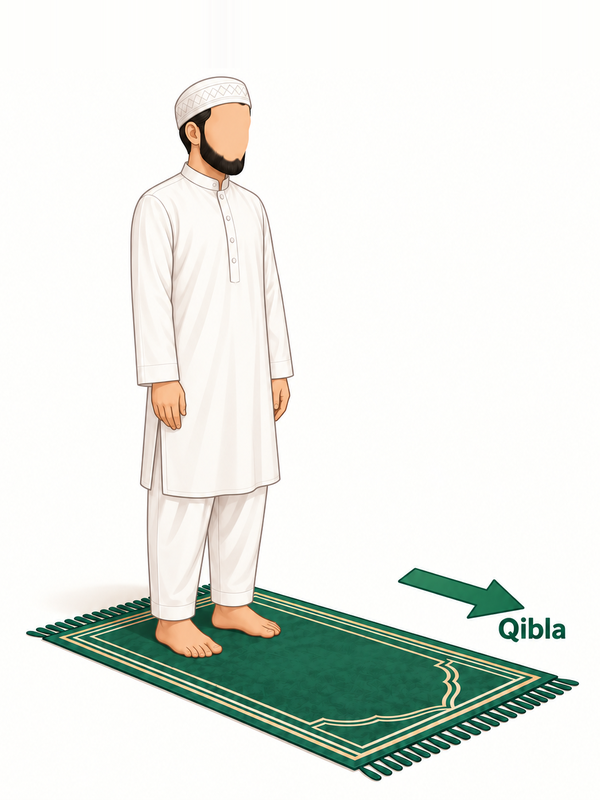
Knowing in your heart which prayer you are about to pray
An-niyyah
The intention is made in the heart: you know which prayer you are praying (for example, the two fard rak'ahs of Fajr) and that you are praying it for Allah. There is no set wording you must say aloud.
Intention turns a set of movements into worship. It is also a moment to remind yourself why you are standing here.
'Umar bin Al-Khattab (May Allah be pleased with him), reported: The Messenger of Allah (ﷺ) said, "The deeds are considered by the intentions, and a person will get the reward according to his intention. So whoever emigrated for Allah and His Messenger, his emigration will be for Allah and His Messenger; and whoever emigrated for worldly benefits or for a woman to marry, his emigration would be for what he emigrated for"..
Étape 4 sur 17
Turning towards the Kaaba in Makkah
Istiqbāl al-qiblah
Muslims everywhere face the same direction in prayer: towards the Kaaba in Makkah. It is a beautiful picture of unity — millions of people, in every country, turning to one point.
If you are unsure of the direction, use the Qiblah finder, a compass app or ask someone local. Doing your honest best is what is asked of you.
قَدْ نَرَىٰ تَقَلُّبَ وَجْهِكَ فِى ٱلسَّمَآءِ ۖ فَلَنُوَلِّيَنَّكَ قِبْلَةًۭ تَرْضَىٰهَا ۚ فَوَلِّ وَجْهَكَ شَطْرَ ٱلْمَسْجِدِ ٱلْحَرَامِ ۚ وَحَيْثُ مَا كُنتُمْ فَوَلُّوا۟ وُجُوهَكُمْ شَطْرَهُۥ ۗ وَإِنَّ ٱلَّذِينَ أُوتُوا۟ ٱلْكِتَٰبَ لَيَعْلَمُونَ أَنَّهُ ٱلْحَقُّ مِن رَّبِّهِمْ ۗ وَمَا ٱللَّهُ بِغَٰفِلٍ عَمَّا يَعْمَلُونَ
144We have seen the turning of thy face to heaven (for guidance, O Muhammad). And now verily We shall make thee turn (in prayer) toward a qiblah which is dear to thee. So turn thy face toward the Inviolable Place of Worship, and ye (O Muslims), wheresoever ye may be, turn your faces (when ye pray) toward it. Lo! Those who have received the Scripture know that (this revelation) is the Truth from their Lord. And Allah is not unaware of what they do.
Étape 5 sur 17
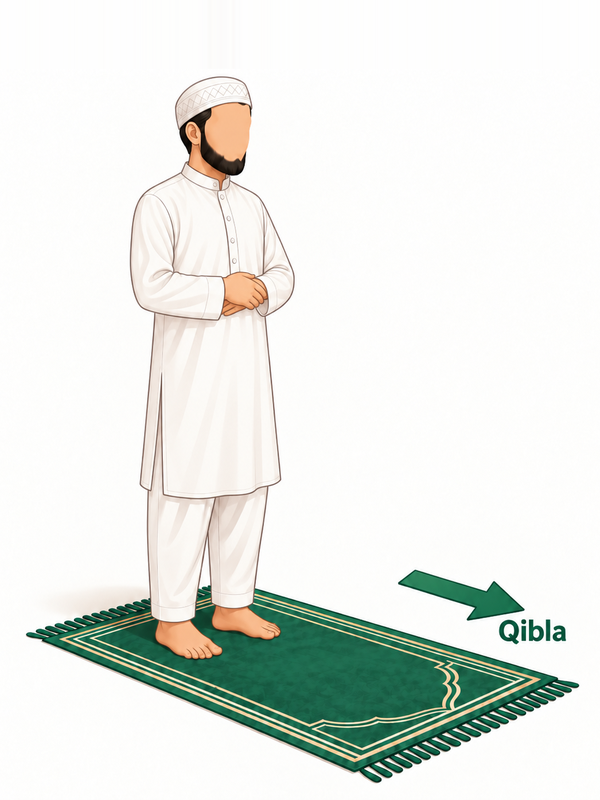
Upright, calm and still, with your gaze lowered
Al-qiyām
Stand upright and still, feet comfortably apart, looking down towards the place where your forehead will rest in prostration. Standing is a posture of humility and readiness: you are a servant standing before your Lord.
Someone who cannot stand may pray sitting, and someone who cannot sit may pray lying down; the prayer adapts to what each person can do.
حَٰفِظُوا۟ عَلَى ٱلصَّلَوَٰتِ وَٱلصَّلَوٰةِ ٱلْوُسْطَىٰ وَقُومُوا۟ لِلَّهِ قَٰنِتِينَ
238Be guardians of your prayers, and of the midmost prayer, and stand up with devotion to Allah.
Étape 6 sur 17
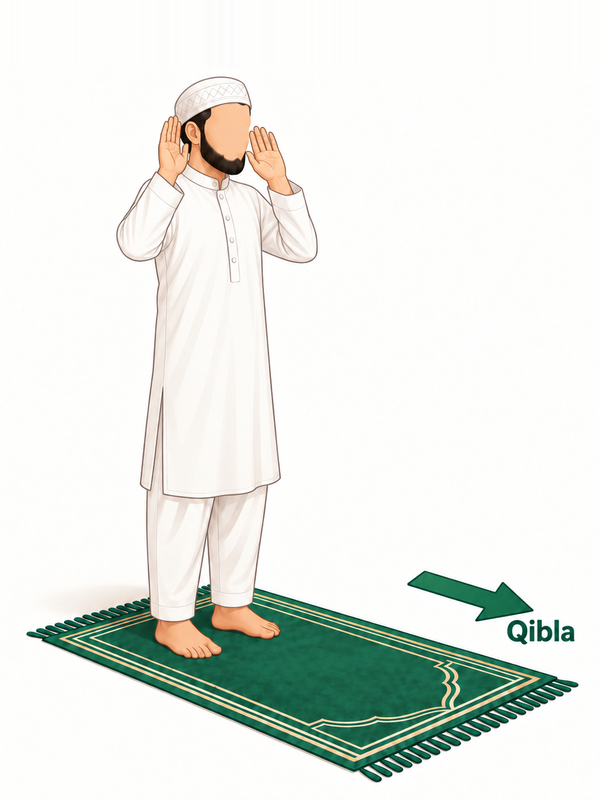
"Allahu Akbar" — the doorway into the prayer
Takbīrat al-iḥrām
Raise your hands and say Allahu Akbar, "Allah is the Greatest". This first takbir is called the takbir of entering into sanctity (iḥrām): from this moment ordinary talk, eating and turning away are set aside until the prayer ends.
Whatever is on your mind, Allah is greater. Saying it as you begin is a way of putting the world behind you.
Wa’il b. Hujr said that he saw the Prophet raise his hands when he began prayer. He said the takbir, then pulled his garment round him, then placed his right hand on his left. When he was about to bow he took his hands out of his garment, and after he had raised (them and said the takbir he bowed. When he said, “God listens to him who praises Him” he raised his hands, and when he prostrated himself he did it between his hands. Muslim transmitted it.
Étape 7 sur 17
A short praise of Allah before reciting, where it is taught
Du'ā' al-istiftāḥ
After the opening takbir, many Muslims say a short opening supplication praising Allah, then seek refuge in Allah from Satan and say Bismillah before Al-Fatihah. Several wordings were taught; the walkthrough shows a common one.
Étape 8 sur 17
The Opening — recited in every rak'ah
Al-Fātiḥah
Al-Fatihah, the first surah of the Quran, is recited in every rak'ah of every prayer. In seven short verses it praises Allah, remembers the Day of Judgement, declares that we worship Him alone and ask Him alone for help, and asks to be guided on the straight path.
Learning its meaning changes how the prayer feels: each time you stand, you are having the same heartfelt conversation.
بِسْمِ ٱللَّهِ ٱلرَّحْمَٰنِ ٱلرَّحِيمِ
ٱلْحَمْدُ لِلَّهِ رَبِّ ٱلْعَٰلَمِينَ
ٱلرَّحْمَٰنِ ٱلرَّحِيمِ
مَٰلِكِ يَوْمِ ٱلدِّينِ
إِيَّاكَ نَعْبُدُ وَإِيَّاكَ نَسْتَعِينُ
ٱهْدِنَا ٱلصِّرَٰطَ ٱلْمُسْتَقِيمَ
صِرَٰطَ ٱلَّذِينَ أَنْعَمْتَ عَلَيْهِمْ غَيْرِ ٱلْمَغْضُوبِ عَلَيْهِمْ وَلَا ٱلضَّآلِّينَ
1In the name of Allah, the Beneficent, the Merciful. 2Praise be to Allah, Lord of the Worlds, 3The Beneficent, the Merciful. 4Master of the Day of Judgment, 5Thee (alone) we worship; Thee (alone) we ask for help. 6Show us the straight path, 7The path of those whom Thou hast favoured; Not the (path) of those who earn Thine anger nor of those who go astray.
Étape 9 sur 17
A short surah or a few verses in the first two rak'ahs
Qirā'at as-sūrah
In the first two rak'ahs, another passage of the Quran is recited after Al-Fatihah — often a short surah such as Al-Ikhlas. In the third and fourth rak'ahs of the obligatory prayers only Al-Fatihah is recited.
Begin with the short surahs you know. Each new surah you memorise is a gift you can bring to every prayer.
بِسْمِ ٱللَّهِ ٱلرَّحْمَٰنِ ٱلرَّحِيمِ قُلْ هُوَ ٱللَّهُ أَحَدٌ
ٱللَّهُ ٱلصَّمَدُ
لَمْ يَلِدْ وَلَمْ يُولَدْ
وَلَمْ يَكُن لَّهُۥ كُفُوًا أَحَدٌۢ
1Say: He is Allah, the One! 2Allah, the eternally Besought of all! 3He begetteth not nor was begotten. 4And there is none comparable unto Him.
Étape 10 sur 17
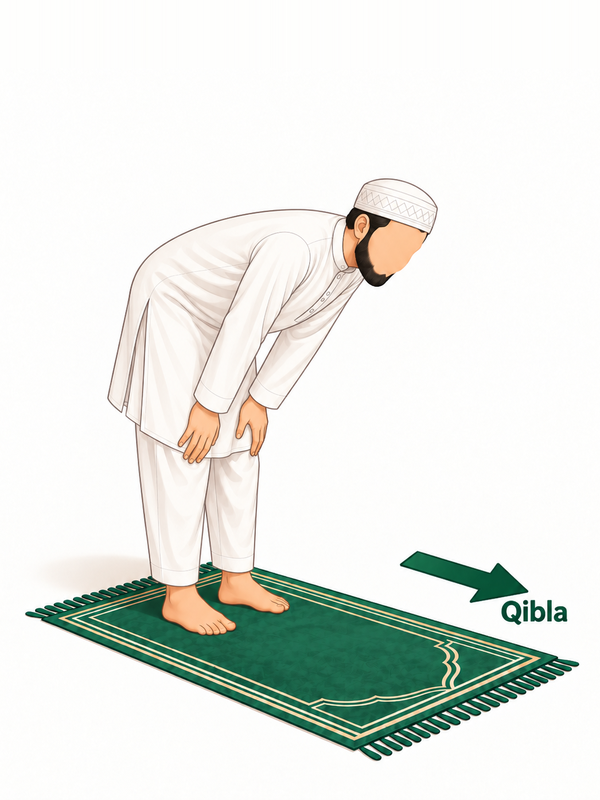
Back straight, hands on the knees, glorifying the Most Great
Ar-rukū'
Say Allahu Akbar and bow, placing your hands on your knees with your back level. Stay still for a moment and glorify your Lord: Subhana Rabbiyal 'Azim — "Glory be to my Lord, the Most Great".
Bowing is how people have always shown respect. In salah, we bow to Allah alone.
He also told of God's Messenger saying to them, “Pray as you have seen me prayer, and when the time for prayer comes one of you should call the adhan for you and the oldest of you should act as imam.”* * In this tradition the plural is used throughout; in the preceding the dual is used, two persons being referred to. (Bukhari and Muslim.)
Étape 11 sur 17
Rising fully and standing still for a moment
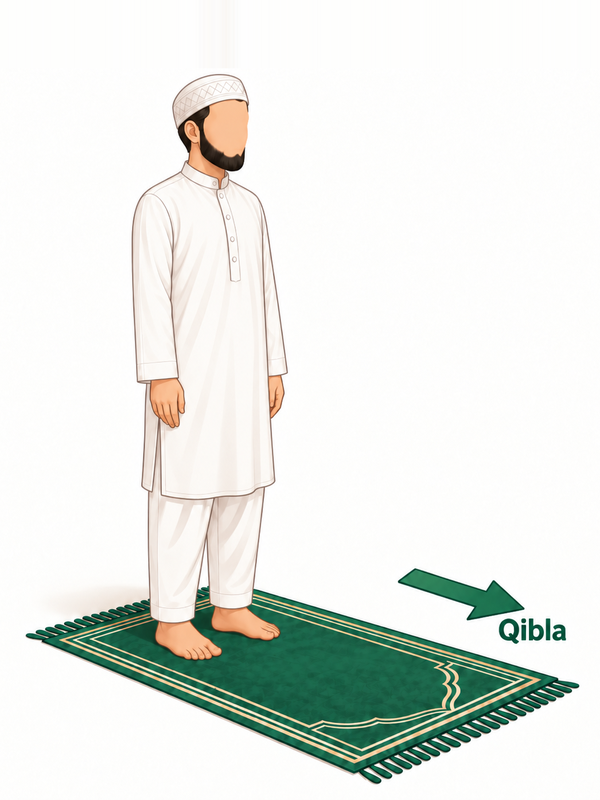
Al-qawmah
Rise from the bow saying Sami' Allahu liman hamidah — "Allah hears the one who praises Him" — and, once upright, Rabbana wa lakal-hamd — "Our Lord, and to You belongs all praise". Stand fully straight and still before going down.
A common mistake is to rush from bowing straight into prostration. Pausing here is part of praying calmly.
Étape 12 sur 17
Forehead and nose on the ground — the closest a servant comes to his Lord
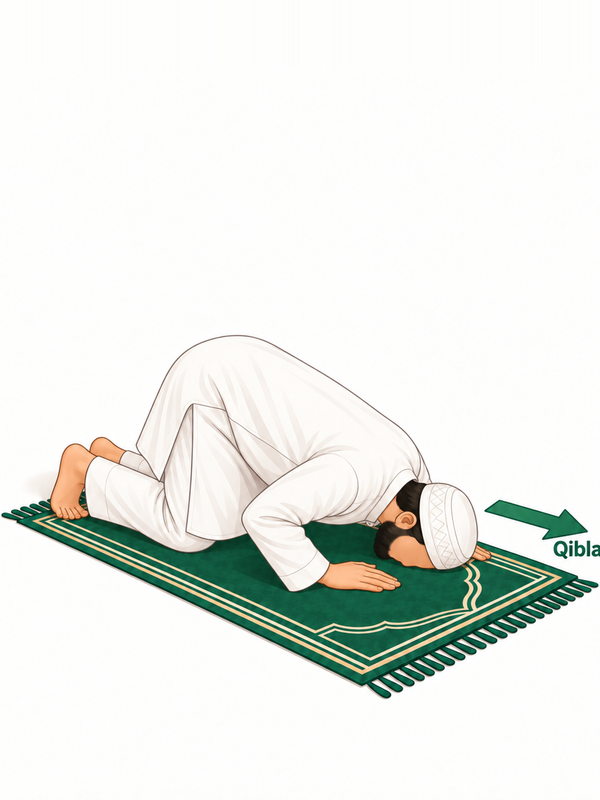
As-sujūd
Say Allahu Akbar and go down, placing your forehead and nose, both palms, both knees and the toes of both feet on the ground. Glorify your Lord: Subhana Rabbiyal A'la — "Glory be to my Lord, the Most High".
Placing the highest part of your body on the ground is the deepest expression of humility. Many people find this the most peaceful moment of the prayer; it is a time to ask Allah for what you need.
كَلَّا لَا تُطِعْهُ وَٱسْجُدْ وَٱقْتَرِب ۩
19Nay, Obey not thou him. But prostrate thyself, and draw near (unto Allah).
Ibn ‘Abbas said that when the Prophet recited, “Glorify the name of thy most high Lord,” (Al-Quran; 87) he said, “Glory be to my Lord most high.” Ahmad and Abu Dawud transmitted it.
Étape 13 sur 17
A short, calm sitting asking for forgiveness
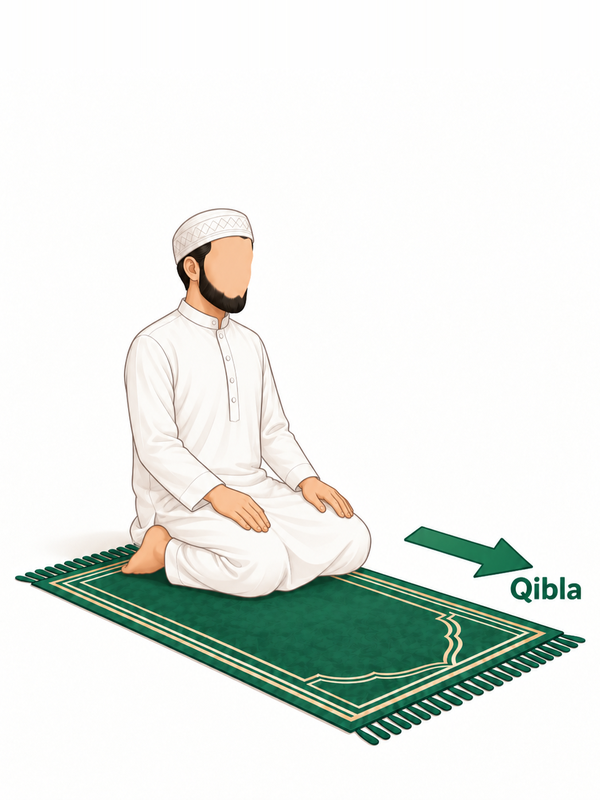
Al-jalsah bayna as-sajdatayn
Rise from the first prostration saying Allahu Akbar and sit upright for a moment, asking Rabbighfir li — "My Lord, forgive me". Then make the second prostration exactly like the first. Two prostrations complete the rak'ah.
Étape 14 sur 17
Greeting Allah, His Prophet ﷺ and His righteous servants, and bearing witness
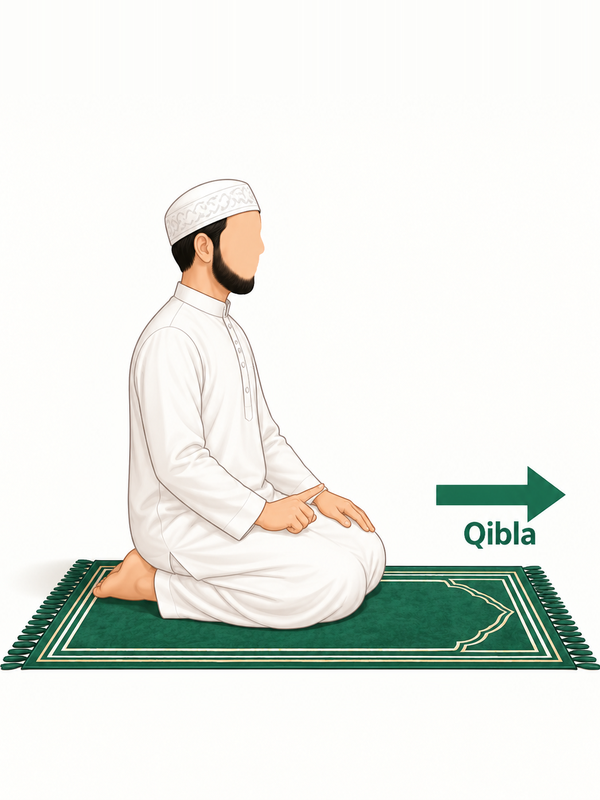
At-tashahhud
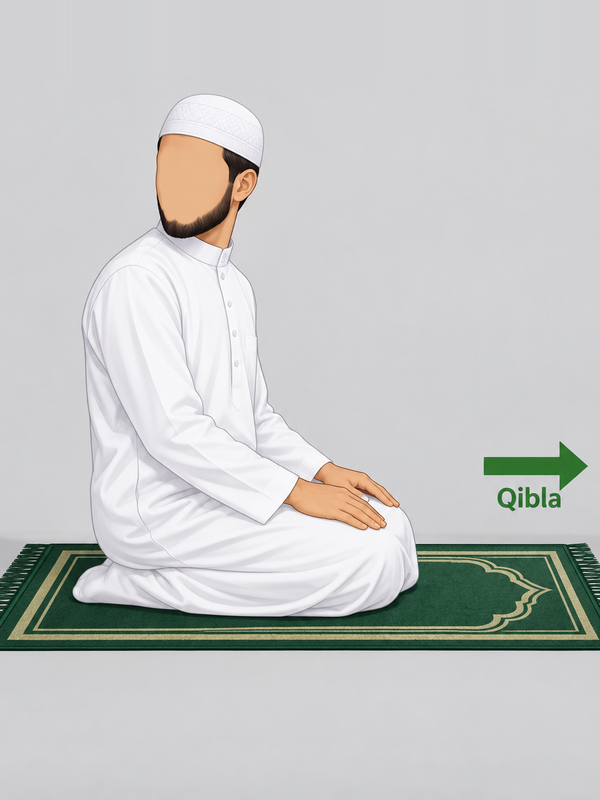
After every two rak'ahs you sit and recite the tashahhud, beginning At-tahiyyatu lillah — "All greetings are for Allah". It sends peace upon the Prophet ﷺ and upon all Allah's righteous servants, and ends with the testimony of faith. While saying the testimony, the index finger of the right hand points.
In a prayer of three or four rak'ahs, the first sitting is short: you recite the tashahhud only and stand up again. In the final sitting the tashahhud is followed by blessings on the Prophet ﷺ and a supplication.
‘Abdallah b. Mas'ud said: When we prayed with the Prophet we said,* “Peace be to God before it is supplicated for His servants; peace be to Gabriel; peace be to Michael; peace be to so and so.” When the Prophet finished he turned his face to us and said: Do not say, “Peace be to God”, for God Himself is Peace. When one of you sits during the prayer he should say, “The adorations of the tongue, acts of worship and all good things are due to God. Peace be upon you, O Prophet, and God’s mercy and blessings. Peace be upon us and upon God’s upright servants (for when he says that it reaches every upright servant in heaven and earth). I testify that there is no god but God, and I testify that Muhammad is His servant and Messenger.” Then he may choose any supplication which pleases him and offer it. * I.e. at the tashahhud. (Bukhari and Muslim.)
Ibn ‘Umar said that when God’s Messenger sat at the tashahhud1 he placed his left hand on his left knee and his right hand on his right knee, counted fifty-three on his knuckles,2 and pointed with the forefinger. A version says that when he sat during the prayer he placed his hands on his knees and raised his right finger which is next to the thumb making supplication in this way, while keeping his left hand spread out on his left knee. 1. Tashahhud means to say the words in the prayers beginning with at-tahiyat lillah. Cf. Chapter 9a 2. This refers to a method of counting on the fingers. In the position indicated the forefinger is full out and the thumb and other fingers are clenched. Muslim transmitted it.
Étape 15 sur 17
The Ibrahimic blessings in the final sitting
As-salāh 'alan-nabiyy
In the final sitting, after the tashahhud, you ask Allah to send blessings upon the Prophet Muhammad ﷺ and his family as He blessed Ibrahim and his family. It joins every prayer to the long line of prophets and to the love Muslims have for the Messenger ﷺ.
إِنَّ ٱللَّهَ وَمَلَٰٓئِكَتَهُۥ يُصَلُّونَ عَلَى ٱلنَّبِىِّ ۚ يَٰٓأَيُّهَا ٱلَّذِينَ ءَامَنُوا۟ صَلُّوا۟ عَلَيْهِ وَسَلِّمُوا۟ تَسْلِيمًا
56Lo! Allah and His angels shower blessings on the Prophet. O ye who believe! Ask blessings on him and salute him with a worthy salutation.
Étape 16 sur 17
Asking Allah for the good of this world and the next
Ad-du'ā'
Before ending the prayer, it is recommended to make a short supplication. A well-loved one comes from the Quran: "Our Lord, give us good in this world and good in the Hereafter, and protect us from the punishment of the Fire." Many people also seek refuge in Allah from the four things the Prophet ﷺ taught.
وَمِنْهُم مَّن يَقُولُ رَبَّنَآ ءَاتِنَا فِى ٱلدُّنْيَا حَسَنَةًۭ وَفِى ٱلْءَاخِرَةِ حَسَنَةًۭ وَقِنَا عَذَابَ ٱلنَّارِ
201And of them (also) is he who saith: "Our Lord! Give unto us in the world that which is good and in the Hereafter that which is good, and guard us from the doom of Fire."
Abu Huraira reported God’s Messenger as saying, “When one of you finishes the last tashahhud he should seek refuge in God from four things: the punishment in jahannam, the punishment in the grave, the trial of life and death, and the evil of the antichrist.” Muslim transmitted it.
Étape 17 sur 17
Turning to the right and to the left with a greeting of peace
At-taslīm
Turn your head to the right saying As-salamu 'alaykum wa rahmatullah — "Peace and the mercy of Allah be upon you" — and then to the left. The prayer that began with "Allah is the Greatest" ends by wishing peace on those around you.
Dans le respect des écoles
Les quatre écoles s'accordent sur la forme de la prière et suivent, sur certains détails, des récits différents et bien fondés. Continuez à prier comme on vous l'a enseigné.
Most Muslims place the right hand over the left while standing. Where the hands rest differs.
Sahl b. Sa'd said that the people received command that a man should place the right hand on the left forearm in prayer. Bukhari transmitted it.
Everyone raises the hands with the opening takbir. Whether they are raised again at other points differs.
In the prayers recited aloud, you may notice some imams say Bismillahir-Rahmanir-Rahim aloud and others do not.
Everyone says Ameen ("O Allah, answer") after Al-Fatihah. Whether it is said aloud in the loud prayers differs.
When you pray in congregation, what you recite yourself depends on the school you follow.
Two ways of sitting are taught: iftirāsh, sitting on the left foot with the right foot upright, and tawarruk, sitting on the ground with the left foot brought out under the right leg.
All schools point the right index finger during the tashahhud, affirming that Allah is One. When and how differs.
Ibn ‘Umar said that when God’s Messenger sat at the tashahhud1 he placed his left hand on his left knee and his right hand on his right knee, counted fifty-three on his knuckles,2 and pointed with the forefinger. A version says that when he sat during the prayer he placed his hands on his knees and raised his right finger which is next to the thumb making supplication in this way, while keeping his left hand spread out on his left knee. 1. Tashahhud means to say the words in the prayers beginning with at-tahiyat lillah. Cf. Chapter 9a 2. This refers to a method of counting on the fingers. In the position indicated the forefinger is full out and the thumb and other fingers are clenched. Muslim transmitted it.
‘Abdallah b. az-Zubair said that when God’s Messenger sat making supplication he placed his right hand on his right thigh and his left hand on his left thigh, pointed with his forefinger, placed his thumb on his middle finger, and covered his knee with the palm of his left hand. Muslim transmitted it.
After the second prostration of the first and third rak'ahs, some people sit for a moment before standing up (the jalsat al-istirāḥah).
Witr ("odd") is the prayer that closes the night's prayers. Its status and shape differ more than any other prayer between the schools.
'Ali (bin Abu Talib) (May Allah be pleased with him) reported: The Witr prayer is not obligatory as the prescribed Salat (prayers), but the Messenger of Allah (ﷺ) observed it as his regular practice (Sunnah). He (ﷺ) said, "Allah is Witr (single, odd) and loves what is Witr. So perform Witr prayer. O followers of Qur'an, observe Witr (prayer)."
Ibn 'Umar (May Allah be pleased with them) reported: The Prophet (ﷺ) said, "Salat during the night should consist of pairs of but if you fear that morning is near, then pray one Rak'ah as Witr."
You may hear an imam make a supplication standing in the second rak'ah of Fajr.
Outils
De belles pages épurées à garder près de votre tapis de prière pendant que vous apprenez.
Mémorisé sur cet appareil. Créez un compte gratuit pour le retrouver partout.