
نماز قدم بہ قدم
نماز کا ہر مرحلہ، مختصر وضاحت کے ساتھ۔
-
Preparing for prayer Al-isti'dad lis-salah
Before you begin, make sure your body, your clothes and the place where you will pray are clean. Cover yourself modestly, as you would when standing before someone you deeply respect. Many people keep a prayer mat for this, but any clean surface will do.
Take a moment to put your phone away and settle your mind. The prayer is a meeting with Allah; arriving calmly is part of praying well.
-
Purification (wudu) At-tahārah
The Quran describes the washing that prepares a believer for prayer: the face, the arms to the elbows, wiping the head and the feet to the ankles. This is wudu. If you still have wudu from an earlier prayer, you do not need to repeat it.
The Wudu Learning Center walks you through every step with illustrations.
-
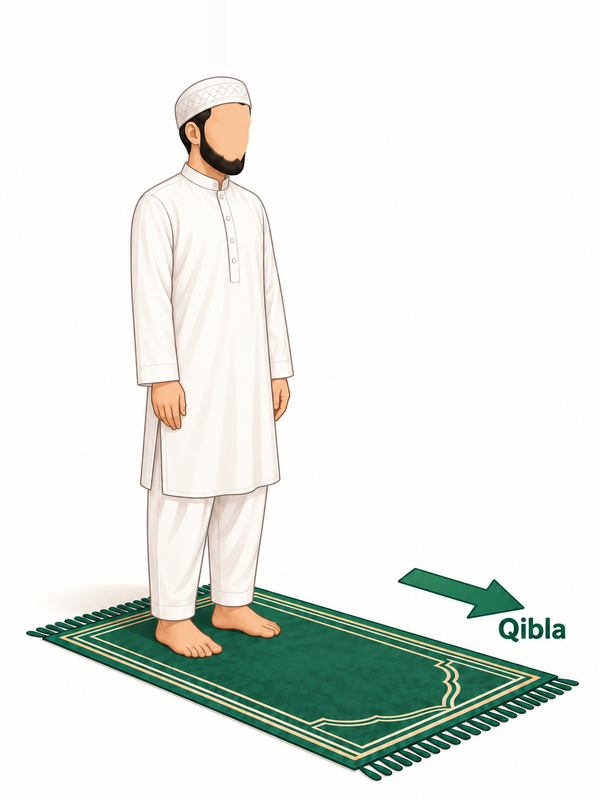
Intention (niyyah) An-niyyah
The intention is made in the heart: you know which prayer you are praying (for example, the two fard rak'ahs of Fajr) and that you are praying it for Allah. There is no set wording you must say aloud.
Intention turns a set of movements into worship. It is also a moment to remind yourself why you are standing here.
-
Facing the Qiblah Istiqbāl al-qiblah
Muslims everywhere face the same direction in prayer: towards the Kaaba in Makkah. It is a beautiful picture of unity — millions of people, in every country, turning to one point.
If you are unsure of the direction, use the Qiblah finder, a compass app or ask someone local. Doing your honest best is what is asked of you.
-
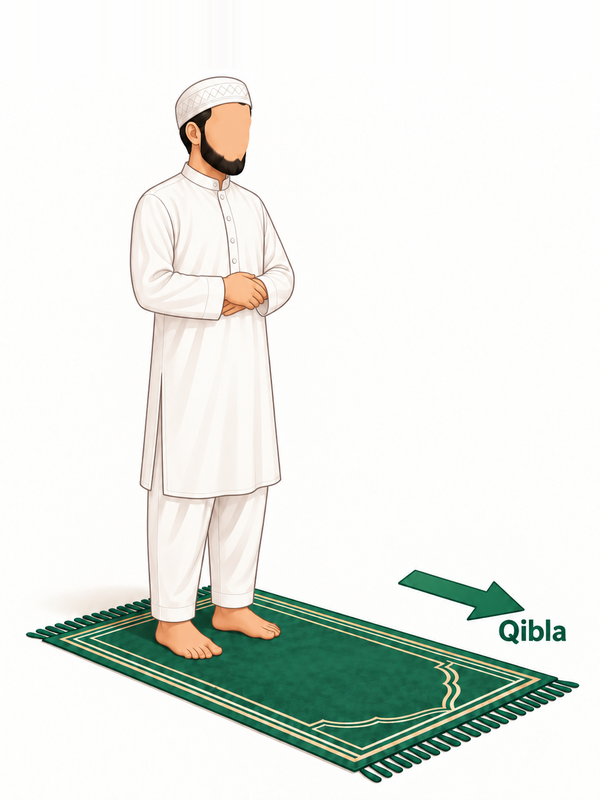
Standing (qiyam) Al-qiyām
Stand upright and still, feet comfortably apart, looking down towards the place where your forehead will rest in prostration. Standing is a posture of humility and readiness: you are a servant standing before your Lord.
Someone who cannot stand may pray sitting, and someone who cannot sit may pray lying down; the prayer adapts to what each person can do.
-
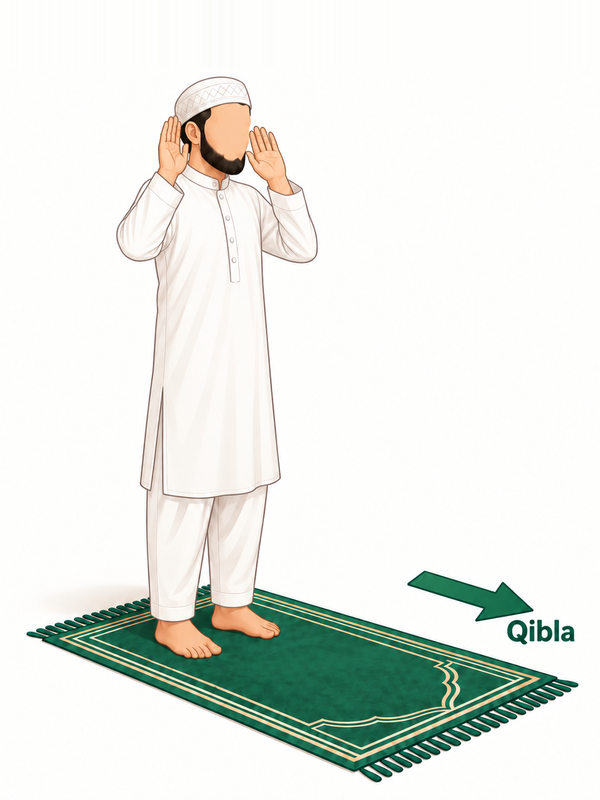
The opening takbir Takbīrat al-iḥrām
Raise your hands and say Allahu Akbar, "Allah is the Greatest". This first takbir is called the takbir of entering into sanctity (iḥrām): from this moment ordinary talk, eating and turning away are set aside until the prayer ends.
Whatever is on your mind, Allah is greater. Saying it as you begin is a way of putting the world behind you.
-
The opening supplication Du'ā' al-istiftāḥ
After the opening takbir, many Muslims say a short opening supplication praising Allah, then seek refuge in Allah from Satan and say Bismillah before Al-Fatihah. Several wordings were taught; the walkthrough shows a common one.
-
Al-Fatihah Al-Fātiḥah
Al-Fatihah, the first surah of the Quran, is recited in every rak'ah of every prayer. In seven short verses it praises Allah, remembers the Day of Judgement, declares that we worship Him alone and ask Him alone for help, and asks to be guided on the straight path.
Learning its meaning changes how the prayer feels: each time you stand, you are having the same heartfelt conversation.
-
Recitation after Al-Fatihah Qirā'at as-sūrah
In the first two rak'ahs, another passage of the Quran is recited after Al-Fatihah — often a short surah such as Al-Ikhlas. In the third and fourth rak'ahs of the obligatory prayers only Al-Fatihah is recited.
Begin with the short surahs you know. Each new surah you memorise is a gift you can bring to every prayer.
-
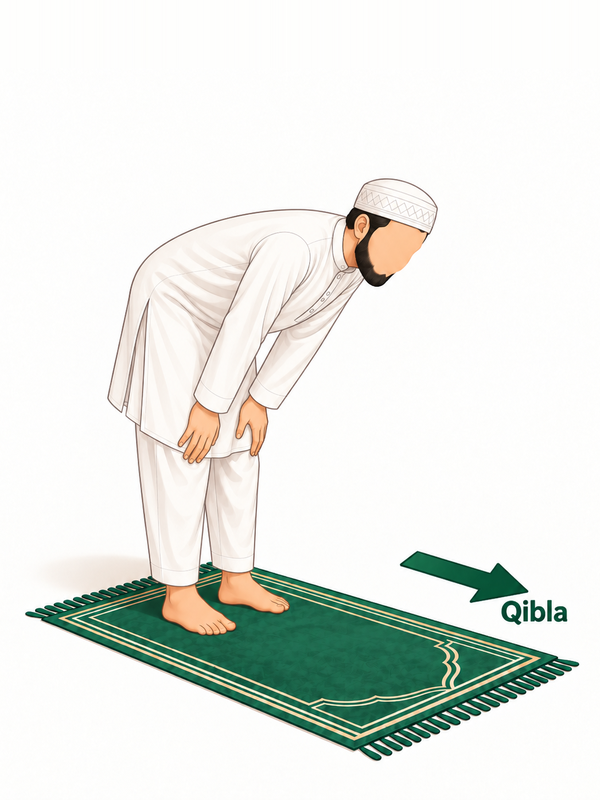
Bowing (ruku) Ar-rukū'
Say Allahu Akbar and bow, placing your hands on your knees with your back level. Stay still for a moment and glorify your Lord: Subhana Rabbiyal 'Azim — "Glory be to my Lord, the Most Great".
Bowing is how people have always shown respect. In salah, we bow to Allah alone.
-
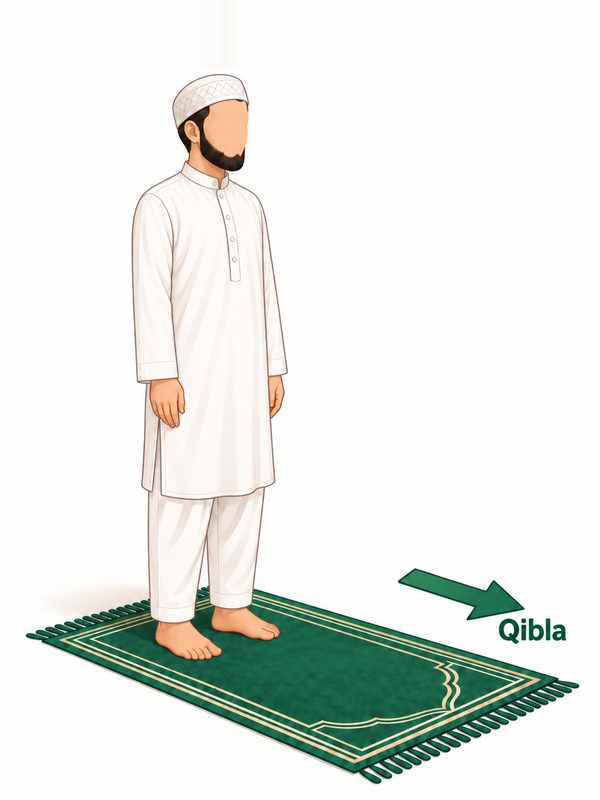
Standing up from bowing (qawmah) Al-qawmah
Rise from the bow saying Sami' Allahu liman hamidah — "Allah hears the one who praises Him" — and, once upright, Rabbana wa lakal-hamd — "Our Lord, and to You belongs all praise". Stand fully straight and still before going down.
A common mistake is to rush from bowing straight into prostration. Pausing here is part of praying calmly.
-
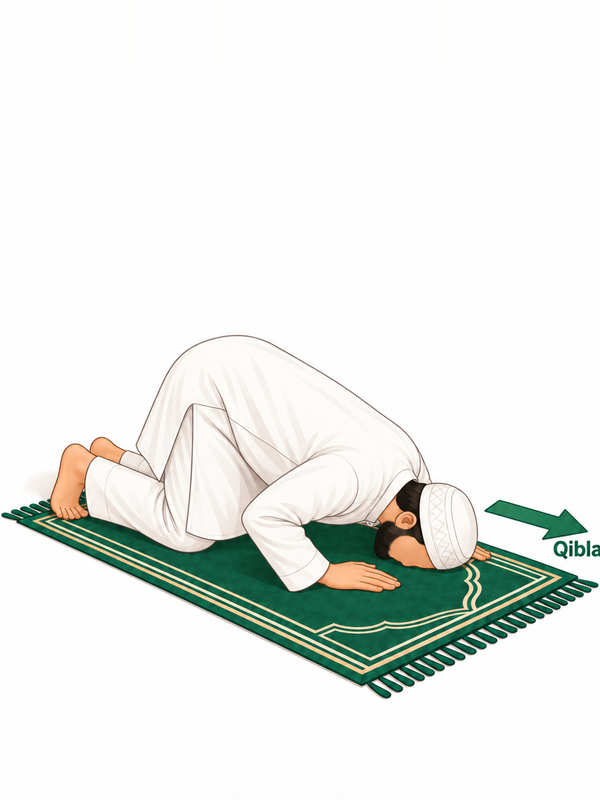
Prostration (sujud) As-sujūd
Say Allahu Akbar and go down, placing your forehead and nose, both palms, both knees and the toes of both feet on the ground. Glorify your Lord: Subhana Rabbiyal A'la — "Glory be to my Lord, the Most High".
Placing the highest part of your body on the ground is the deepest expression of humility. Many people find this the most peaceful moment of the prayer; it is a time to ask Allah for what you need.
-
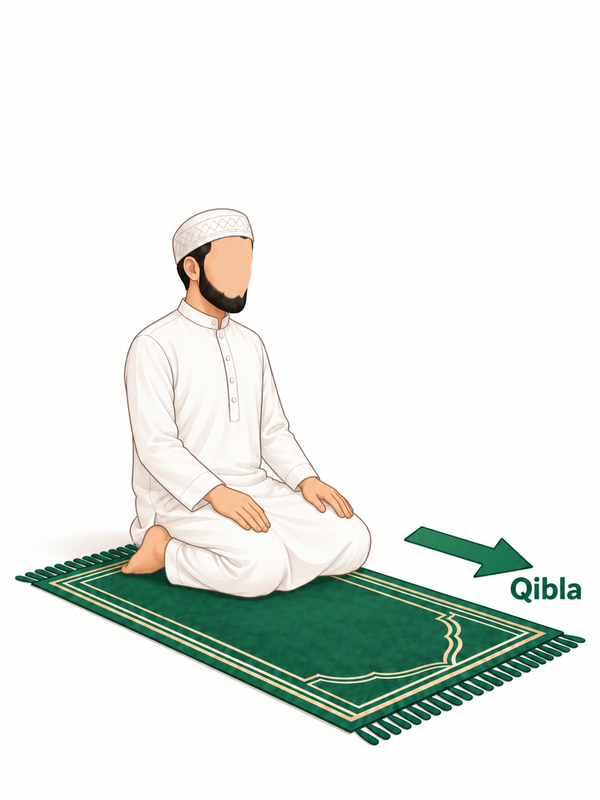
Sitting between the two prostrations (jalsah) Al-jalsah bayna as-sajdatayn
Rise from the first prostration saying Allahu Akbar and sit upright for a moment, asking Rabbighfir li — "My Lord, forgive me". Then make the second prostration exactly like the first. Two prostrations complete the rak'ah.
-
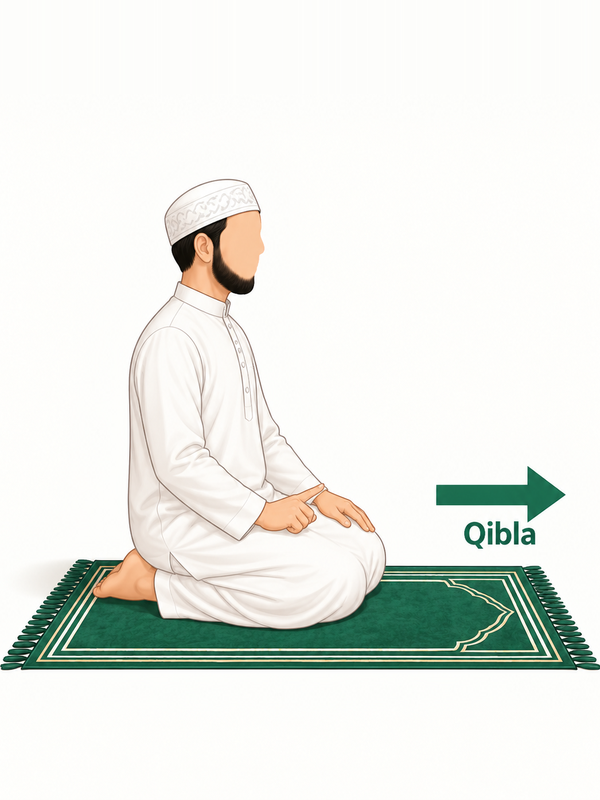
The tashahhud At-tashahhud
After every two rak'ahs you sit and recite the tashahhud, beginning At-tahiyyatu lillah — "All greetings are for Allah". It sends peace upon the Prophet ﷺ and upon all Allah's righteous servants, and ends with the testimony of faith. While saying the testimony, the index finger of the right hand points.
In a prayer of three or four rak'ahs, the first sitting is short: you recite the tashahhud only and stand up again. In the final sitting the tashahhud is followed by blessings on the Prophet ﷺ and a supplication.
-
Sending blessings upon the Prophet ﷺ As-salāh 'alan-nabiyy
In the final sitting, after the tashahhud, you ask Allah to send blessings upon the Prophet Muhammad ﷺ and his family as He blessed Ibrahim and his family. It joins every prayer to the long line of prophets and to the love Muslims have for the Messenger ﷺ.
-
A supplication before ending Ad-du'ā'
Before ending the prayer, it is recommended to make a short supplication. A well-loved one comes from the Quran: "Our Lord, give us good in this world and good in the Hereafter, and protect us from the punishment of the Fire." Many people also seek refuge in Allah from the four things the Prophet ﷺ taught.
-
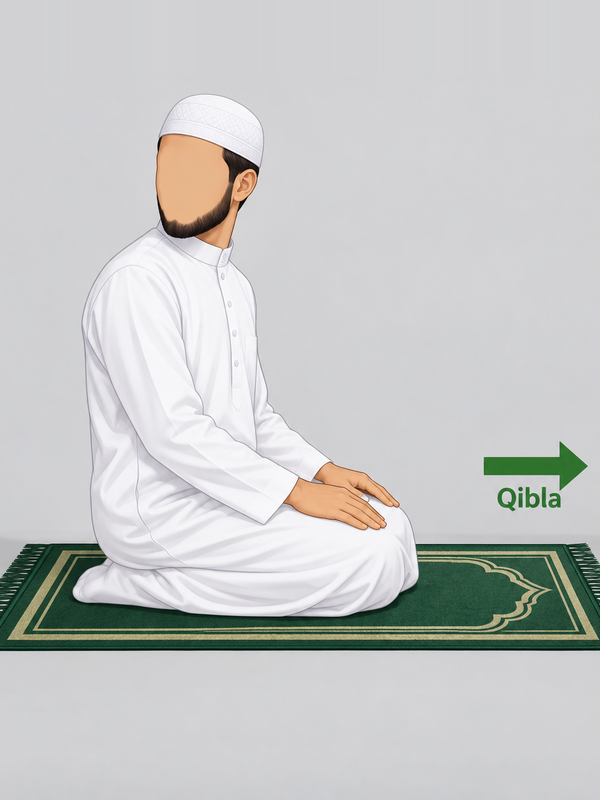
Ending the prayer (taslim) At-taslīm
Turn your head to the right saying As-salamu 'alaykum wa rahmatullah — "Peace and the mercy of Allah be upon you" — and then to the left. The prayer that began with "Allah is the Greatest" ends by wishing peace on those around you.
Islamic Portal کے لیے آسان زبان میں لکھی گئی وضاحتیں۔