
Islamic History
From the first prophet to a faith of two billion
Walk through the story of Islam: the prophets sent to humanity from Adam to Muhammad ﷺ, the life of the Prophet, how Islam travelled with merchants and scholars across oceans and deserts, and the discoveries Muslims gave the world.
- prophets named in the Quran
- 25
- moments in the Seerah
- 17
- countries on the spread map
- 99
- inventions and discoveries
- 20
Four journeys
Choose where to begin
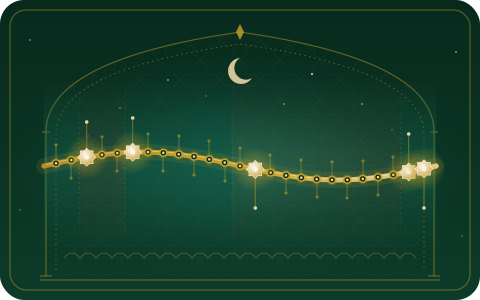 Timeline of the Prophets
The twenty-five prophets named in the Quran on one beautiful timeline. Open any of them to see their era, their people, their place and what the Quran says about them.
25 prophets
Explore
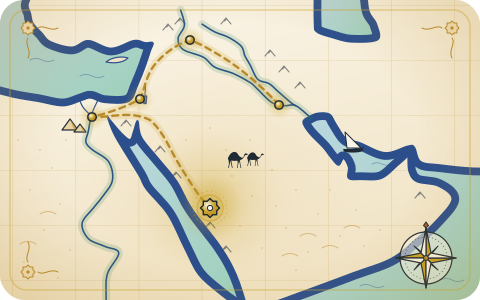 The Journey of the Prophets
Follow a golden path across the ancient world from Adam to Muhammad ﷺ. The map glides from prophet to prophet while the story is told — and read aloud if you wish.
From Adam to Muhammad ﷺ
Explore
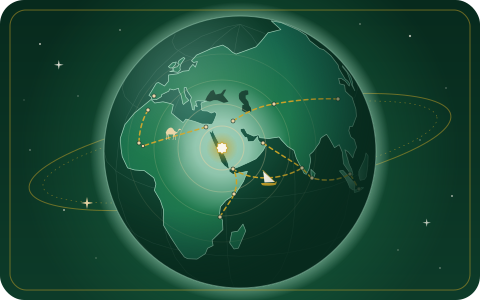 The Seerah & the Spread of Islam
The life of the Prophet ﷺ from the Year of the Elephant to the Farewell Hajj, then fourteen centuries on a map: watch the world turn green as Muslims settle on every continent.
99 countries on the map
Explore
 Inventions & Discoveries
Algebra, optics, hospitals, universities, astrolabes and the elephant clock — illustrated, dated and sourced, on a winding timeline or a spinning globe.
20 inventions and discoveries
Explore
Fourteen centuries
From the Year of the Elephant to today
- c. 570 CE The Year of the Elephant and the Prophet's birth Makkah
- c. 595 CE Marriage to Khadijah Makkah
- c. 610 CE The first revelation in the Cave of Hira Cave of Hira, Jabal al-Nour, Makkah
- c. 613 CE Preaching openly in Makkah Makkah
- c. 615 CE The migration to Abyssinia Aksum, Abyssinia (Ethiopia)
- c. 619 CE The Year of Sorrow Makkah and Ta'if
- c. 621 CE The Night Journey and Ascension (Isra and Mi'raj) Makkah to Jerusalem
- 621–622 CE The Pledges of al-Aqabah Al-Aqabah, near Mina, Makkah
- 622 CE The Hijrah to Madinah Makkah to Madinah (Quba)
- 624 CE The Battle of Badr Badr, south-west of Madinah
- 625 CE The Battle of Uhud Mount Uhud, Madinah
- 627 CE The Battle of the Trench (Khandaq) Madinah
- 628 CE The Treaty of Hudaybiyyah Al-Hudaybiyyah, near Makkah
- 628 CE Khaybar Khaybar
- c. 629 CE Arab traders on India's Malabar coast Kodungallur, Kerala, India
- 630 CE The Opening of Makkah Makkah
- 632–633 CE The Arabian Peninsula united Madinah, Arabia
- 632–750 CE The early caliphates and a slow conversion Damascus, the Umayyad capital
- 632 CE The Farewell Hajj Mount Arafat, near Makkah
- 632 CE The passing of the Prophet ﷺ Madinah
- c. 651 CE An envoy to Tang China Chang'an (Xi'an), China
- 711 CE Al-Andalus begins Gibraltar (Jabal Tariq)
- 711–713 CE Sindh and the Indus valley Debal (Banbhore), Sindh, Pakistan
- c. 750 CE Mosques on the Swahili coast Shanga, Pate Island, Kenya
- 751 CE Talas and the Silk Road Talas River, near Taraz, Kazakhstan
- 819–999 CE The Samanids and learning in Bukhara Bukhara, Uzbekistan
- 827–1091 CE Muslim Sicily Palermo, Sicily
- 851 CE Muslim merchants in Guangzhou Guangzhou (Canton), China
- 922 CE Volga Bulgaria and Ibn Fadlan Bolghar, on the Volga, Russia
- c. 1068 CE West Africa and the Saharan trade Koumbi Saleh, Mauritania (Ghana Empire)
- 1077–1308 CE Anatolia and the Seljuks of Rum Konya, Turkey
- c. 1200 CE Moinuddin Chishti and the Sufis of India Ajmer, Rajasthan, India
- c. 1267–1297 CE Samudera Pasai, Sumatra Pasai, Aceh, Sumatra, Indonesia
- 1313–1341 CE Özbeg Khan and the Golden Horde Sarai, lower Volga, Russia
- 1324–1325 CE Mansa Musa's Hajj and Timbuktu's scholars Timbuktu, Mali
- c. 1350–1478 CE Muslim gravestones at Trowulan, Java Trowulan, East Java, Indonesia
- 1352 CE Bengal: traders, Sufis and a sultanate Bengal delta
- 1380 CE Sulu and the first mosque in the Philippines Simunul, Tawi-Tawi, Philippines
- c. 1400–1511 CE The Malacca Sultanate Malacca, Malaysia
- c. 1404 CE The Wali Songo of Java Gresik, East Java, Indonesia
- 1463 CE The Balkans: Bosnia and Albania Sarajevo, Bosnia and Herzegovina
- 1492 CE The fall of Granada Granada, Spain
- 1522 CE Enslaved African Muslims in the Americas Hispaniola, Caribbean
- 1609–1614 CE The expulsion of the Moriscos Spain to North Africa
- c. 1845–1939 CE Indian and Javanese Muslims in the Caribbean Trinidad, Guyana and Suriname
- c. 1945 CE New communities in Europe and North America Western Europe and North America
- 2020 CE Islam today Worldwide
Gifts to the world
A taste of the inventions
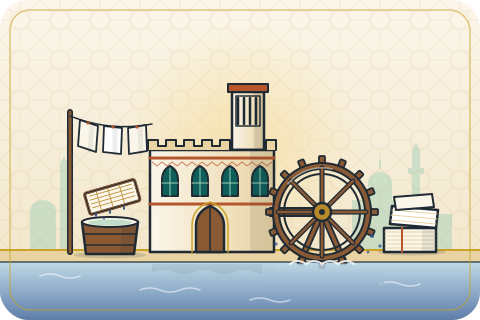 c. 794 CE
Paper-Making in Baghdad
Papermakers of Abbasid Baghdad
 c. 800 CE
Jabir and Arabic Alchemy
Jabir ibn Hayyan (the Jabirian corpus)
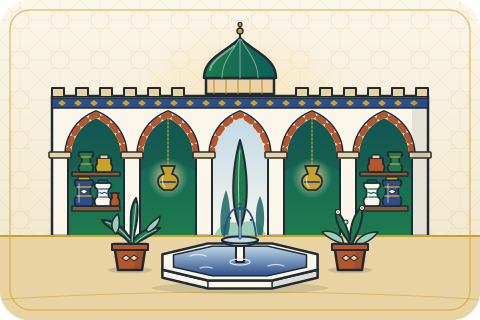 c. 805 CE
The Bimaristan Hospitals
Abbasid Baghdad; later Ahmad ibn Tulun, Nur al-Din and Sultan Qalawun
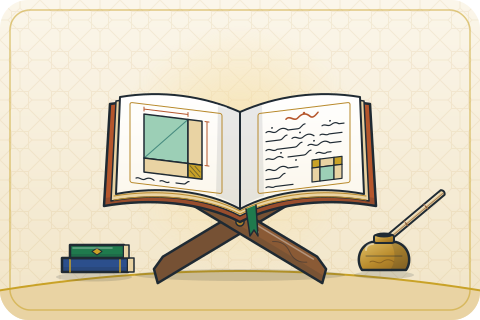 c. 820 CE
Al-Jabr: The Book of Algebra
Muhammad ibn Musa al-Khwarizmi
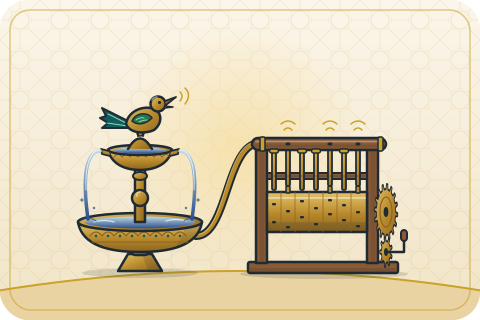 c. 850 CE
The Book of Ingenious Devices
The Banu Musa: Muhammad, Ahmad and al-Hasan ibn Musa ibn Shakir
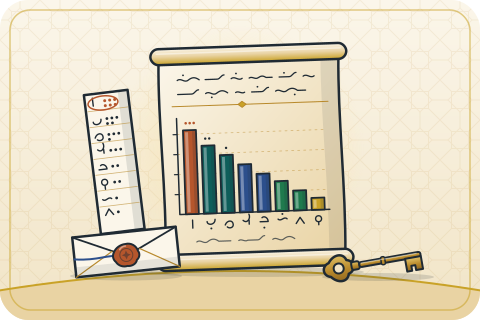 c. 850 CE
Breaking Codes by Counting Letters
Abu Yusuf Ya'qub ibn Ishaq al-Kindi
Our approach
How we tell this story
History is told here with care: what is known is dated and sourced, and what is uncertain is labelled as such.
- Dates come from cited sources. Where none exists we say the date is unknown or approximate rather than guess.
- Quran verses are quoted from the site's stored Quran text, cited by surah and ayah.
- Every card names its sources so you can read further and check for yourself.
- The spread map shows where Muslims have lived in significant numbers — people, not empires.
What next
See every feature
Where to go from here
- Seerah & History Atlas An interactive map of the places of the seerah and Islamic history.
- Prophets The stories of the prophets, a timeline and a journey map.
- Muslim inventions Discoveries and inventions of Muslim scholars and makers.
- Muslims around the world Communities, mosques and traditions across the world.