
0 guardado
Entra en la escena
A voice from the mountainside
A traveller sees a fire on a mountain and goes towards it. There he is addressed by his Lord, and the speech uses the pronoun “I” with great weight.
Del Corán
I am Allah
إِنَّنِىٓ أَنَا ٱللَّهُ لَآ إِلَٰهَ إِلَّآ أَنَا۠ فَٱعْبُدْنِى وَأَقِمِ ٱلصَّلَوٰةَ لِذِكْرِىٓ﴿14﴾
14 Lo! I, even I, am Allah, There is no Allah save Me. So serve Me and establish worship for My remembrance.
Mira
Ten pronouns, five pairs
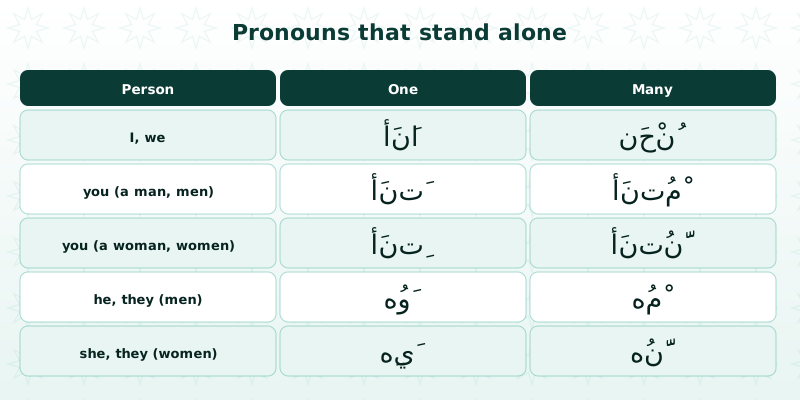
Anā I, naḥnu we; anta you (a man), antum you (men); anti you (a woman), antunna you (women); huwa he, hum they; hiya she, hunna they (women).
Arabic says “you” differently to a man, a woman, two or many: the pronoun itself tells you who is meant.
Toca el lugar Tap the spot
Tap “he”.
Ver la respuesta
Huwa: he, or it. It opens al-Ikhlas after qul.
Mira
Watch: huwa in al-Ikhlas
Palabra por palabra
Word by word
- قُلْ qul to say · قول
- هُوَ huwa he, it
- ٱللَّهُ allāhu Allah, God: the proper name of the One God
- أَحَدٌ aḥadun one; anyone; (with a negative) no one · أحد
Say: He is Allah, the One!
Lee
Huwa in al-Ikhlas
In al-Ikhlas, huwa comes straight after qul: the answer to a question about who your Lord is.
A pronoun can carry deep respect: “He” needs no other name to be known.
Lee
We, of Allah
Allah often says naḥnu, We, of Himself, as in 15:9.
The “We” of majesty
Arabic uses “we” for one speaker of greatness. Scholars of language call it the plural of majesty; it never means more than one god, as the many verses with “I” and “He is One” make clear.
Une Match
Match the pronoun to its meaning
- anā I
- naḥnu we
- antum you (many)
- hum they
- hiya she
Ver la respuesta
Anā is I, nahnu we, antum you many, hum they and hiya she. Ten pronouns cover every person.
Elige Check
Naḥnu, We, used by Allah of Himself, means…
Ver la respuesta
A plural of greatness, never of number, as al-Ikhlas makes plain.
Verdadero o falso True or false?
Arabic has different words for “you” to a man and to a woman.
Ver la respuesta
True. Anta is you to a man and anti to a woman; antum and antunna for groups.
Lección terminada
Pronouns that stand alone
Has añadido una página a un mushaf cuyas páginas pasan.
Lo que aprendiste
- Anā, naḥnu, anta, antum, huwa, hum, hiya: pronouns that stand alone.
- hechos
- 0
- bien a la primera
- 0
- para repasar
- 0
Tu obra · Pruébalo hoy
In al-Ikhlas tonight, pause on huwa and on aḥad.
Lo que guardaste
Inicia sesión para guardar tu progreso en todos tus dispositivos.