
Phase 1 — Who leads after the Prophet ﷺ?
From Madinah to three continents
- 9 min
- Free — no signup needed
A small city, a wide world
A small city, a wide world
In 632 the Muslims ruled only Arabia. By 656, twenty-five years later, the caliph in Madinah was sending governors to Egypt, Sham (Syria and Palestine), Iraq and much of Persia.
No one planned an empire on that scale. It grew out of wars with two great powers on Arabia’s borders.
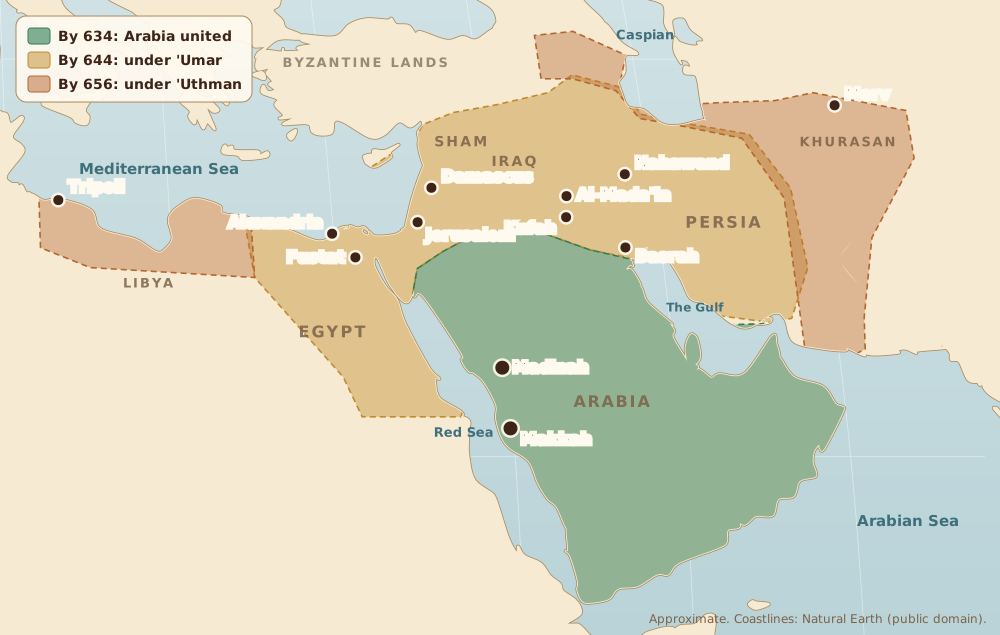
Watch: the lands open, 632 to 656
The lands open
Why so fast? Historians differ

First, holding Arabia together
When the Prophet ﷺ died, many tribes stopped paying zakat, and some followed men who claimed to be prophets, such as Musaylimah in al-Yamamah. Abu Bakr refused to let anyone keep the prayer and drop the zakat.
In about a year Arabia was united again. Many who had memorised the Quran fell at al-Yamamah in 12 AH, and that loss led to the Quran being gathered.
Check
Two battles that changed the map
Under ’Umar two battles decided everything, both in about 15 AH (636 CE; reports differ on the exact year of the second). At Yarmuk in Sham the Byzantine army was broken, and Damascus and Jerusalem followed. At al-Qadisiyyah in Iraq the Persian army fell, and soon the Persian capital, Ctesiphon.
After that, the old powers could not stop the advance.
Which caliph?
Find the city
Fill the gap
Why so fast?
Historians differ on why the lands opened so fast: tired empires, the justice of the newcomers, faith. Which reason do you think mattered most, and why?
Private: kept only in this browser, never sent to us.
Common mistakes
For your life
Abu Bakr would not split the religion into the easy part and the costly part. Check yourself: is there a duty you keep and one you quietly skip, such as zakat on savings or a debt you owe? Put the skipped one right this month.
The lesson in three lines
Keep it
In one line: In about twenty-five years the caliphate reached from Egypt to Persia.
Try it today: Look at a map today and find Fustat, Damascus and Kufah.