
0 kept
Step inside
A calendar on the fridge
A calendar full of fasts
Ramadan, three vowed days, six of Shawwal, ʿArafah and the white days: one calendar, many kinds of fast.
Look
A calendar full of fasts

Nadia’s calendar has Ramadan, three days she vowed when her son was ill, six days of Shawwal, some Mondays, and the make-up days she still owes. “Are these all the same?” she wonders.
They are not. Each kind of fast has its own weight and its own rules.
Find them
The kinds of fast
Tap the picture to find each part. Each one opens a card.
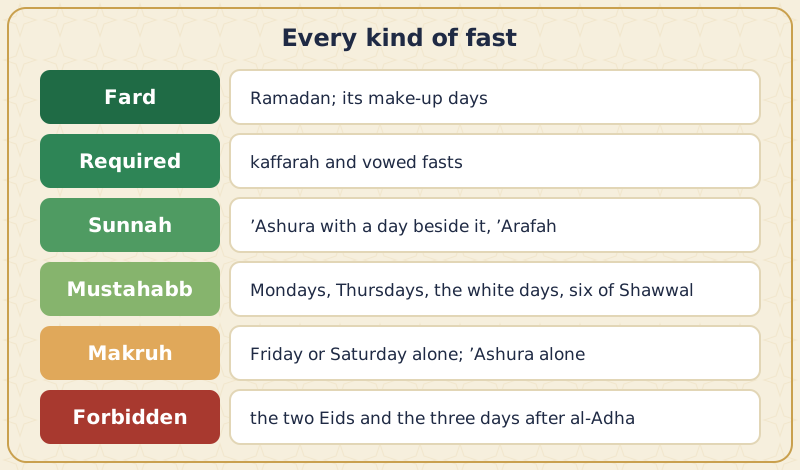
- Fard Ramadan, and making up missed Ramadan days.
- Required Kaffarah fasts and vowed fasts. Some fiqh books call these fard, others wajib; either way they must be done.
- Sunnah ’Ashura with the day before or after it; ’Arafah for those not on Hajj.
- Mustahabb Mondays and Thursdays, the 13th to 15th of each month, six days of Shawwal.
- Makruh Singling out a Friday or a Saturday alone; ’Ashura alone; fasting every single day.
- Forbidden The two Eid days and the three days after Eid al-Adha.
From the hadith
No fast on the two Eids
وَعَنْ أَبِي سَعِيدٍ الْخُدْرِيِّ قَالَ: قَالَ رَسُولُ اللَّهِ صَلَّى اللَّهُ عَلَيْهِ وَسَلَّمَ: " لَا صَوْم فِي يَوْمَيْنِ: الْفطر وَالضُّحَى "
He reported God’s messenger as saying, “No fast is to be observed on two days, al-Fitr and al-Adha.* *In this tradition I have used the Arabic words, but have translated them in the preceding tradition. In the preceding tradition an-nahr is used where al-Adha is used here. Al-Adha means literally the victims. (Bukhari and Muslim.)
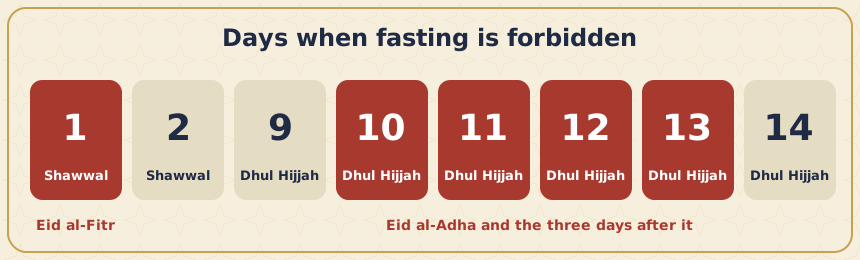
Tap the spot Days not to fast
Tap a day on which you may fast.
Show the answer
9 Dhul Hijjah, the day of ’Arafah, is a sunnah fast for those not on Hajj. The red days are forbidden.
Read
A calendar of loved fasts

- Six days of Shawwal, after Eid.
- 'Arafah, the 9th of Dhul-Hijjah, for those not on Hajj.
- 'Ashura, the 10th of Muharram, with the 9th or the 11th.
- The "white days", the 13th, 14th and 15th of each lunar month.
- Mondays and Thursdays.
Read
Disliked ways of fasting
Some fasts are allowed but disliked:
- singling out Friday or Saturday alone for a voluntary fast (join it to a day before or after);
- fasting every day of the year without a break;
- joining two days with no food at night.
Look
Why this matters

The kind of fast decides the rules: when the intention must be made, what happens if it breaks, and whether it must be made up. The rest of this course follows each one. Ramadan itself, sehri, iftar and what breaks the fast in daily life are taught in The Ramadan Fasting course in the Ramadan and the Islamic Year path.
Match
Name the kind
Match each one with its pair.
- A missed Ramadan day Fard
- A fast you vowed Required
- ’Arafah, not on Hajj Sunnah
- Monday Mustahabb
- Eid al-Fitr Forbidden
Show the answer
Every fast in Nadia’s calendar has its place.
Sort it
Which kind?
Sort each fast.
Fard
- A missed Ramadan day
Required (wajib)
- A fast you vowed
Sunnah or mustahabb
- ʿArafah, when not on Hajj
- Six days of Shawwal
Forbidden
- The day of Eid al-Fitr
- The days of tashriq, 11 to 13 Dhul Hijjah
Reveal
Common mistakes
Think of the right answer first, then flip each card.
- "Fasting any day is always rewarded." Not on the Eids and the days of tashreeq; and some ways are disliked.
- "'Ashura alone is the Sunnah." Add the 9th or the 11th with it.
- "A vowed fast is like a voluntary one." Once its condition happens, it is required.
- "Fasting every day is the best." Fasting without any break is disliked; the loved pattern has rest days.
Think about it
Pause and think
Which voluntary fast could you add this year? Which day of the week would suit you?
Only you can see this. It is kept on this device.
Lesson finished
Every kind of fast
You added a key to a set of keys collected.
What you learnt
- Fard: Ramadan and its make-up. Required: vows and kaffarah.
- Sunnah and loved: Shawwal, 'Arafah, 'Ashura, white days, Mondays and Thursdays.
- Forbidden: the two Eids and the days of tashreeq.
- done
- 0
- right first time
- 0
- to review
- 0
Your deed · Try it today
Mark the fasts you owe or want to keep this year on your calendar.
What you kept
Sign in to keep your progress on every device.