
0 kept
Step inside
10 am at the office
A late decision
You realise you have eaten nothing since dawn. “I’ll count this as a fast,” you think. Can you?
Look
The late decision

At 10 am Omar realises he has not eaten or drunk anything since dawn. “I’ll fast today,” he decides. Will it count? It depends on which fast he means.
From the hadith
An intention before dawn
عَن حَفْصَةَ رَضِيَ اللَّهُ عَنْهَا قَالَتْ: قَالَ رَسُولُ اللَّهِ صَلَّى اللَّهُ عَلَيْهِ وَسَلَّمَ: «مَنْ لَمْ يَجْمَعِ الصِّيَامَ قَبْلَ الْفَجْرِ فَلَا صِيَامَ لَهُ» . رَوَاهُ التِّرْمِذِيُّ وَأَبُو دَاوُدَ وَالنَّسَائِيُّ وَالدَّارِمَيُّ وَقَالَ أَبُو دَاوُد: وَقفه على حَفْصَة معمر والزبيدي وَابْنُ عُيَيْنَةَ وَيُونُسُ الَأَيْلِيُّ كُلُّهُمْ عَنِ الزُّهْرِيِّ
Hafsa reported God’s messenger as saying, “He who does not before dawn express his intention of fasting is not credited with it.” Tirmidhi, Abu Dawud, Nasa’i and Darimi transmitted it. Abu Dawud said that Ma'mar, az-Zubaidi, Ibn ‘Uyaina and Yunus al-Aili, all of whom got it on Zuhri’s authority, traced it no farther back than Hafsa.
Look
How it is read

The intention is in the heart; eating sehri for the fast is itself an intention. The scholars apply this hadith to fasts that are not tied to a day. For fasts tied to their day, other reports allow a later intention.
Look
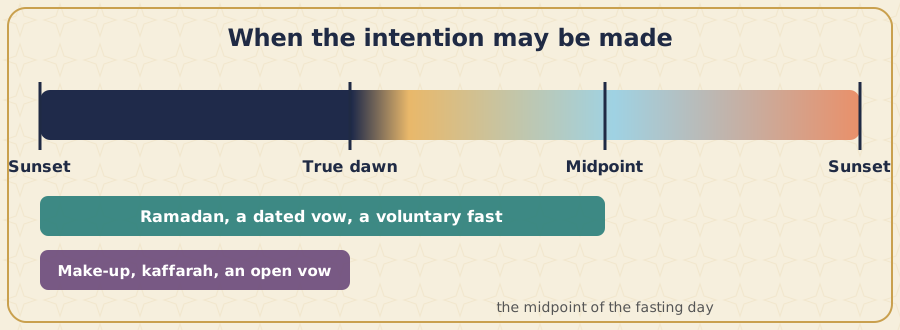
The two windows
Look
Two windows

- Ramadan, a vow for a named date, and voluntary fasts: intend any time from sunset until before the midpoint of the fasting day, if you have not eaten since dawn.
- Make-up of Ramadan, kaffarah, a vow with no date, and making up a broken voluntary fast: intend at night, before true dawn, and name which fast it is.
Tap the spot The latest time
Tap the latest time to intend a voluntary fast.
Show the answer
Before the midpoint between true dawn and sunset, if nothing has been eaten since dawn.
Read
Sehri and the dawn line

Eating sehri is a Sunnah with blessing, even a date and water. Delaying it towards dawn is also Sunnah.
The fast starts at true dawn, the start of Fajr's time. Many timetables show an earlier "imsak" a few minutes before: that is a margin of caution, not a new rule. Stop eating by Fajr's time at the latest.
Read
No switching after dawn
Omar began the day without any intention, then at 10 am intended a make-up. It does not count as a make-up: a make-up, kaffarah or general vow needs its intention at night, before dawn.
His fast can still count as a voluntary one, if he has not eaten. So the habit to build: on the night before a make-up day, say in your heart "tomorrow I fast to make up a day of Ramadan".
Sort it
Which window?
Sort each fast by when its intention must be made.
Any time until before the midpoint of the day
- A Ramadan fast
- A voluntary fast
- A vow for a named date
At night, before true dawn
- Making up a Ramadan day
- A kaffarah fast
- A vow with no date
Choose Omar at 10 am
Omar intends at 10 am to make up a Ramadan day. Then:
Show the answer
A make-up fast must be intended before dawn. His fast today can be a voluntary one; he makes up the day another time.
True or false True or false?
In Ramadan, even an unclear intention “to fast” counts as the Ramadan fast.
Show the answer
For a resident adult in Ramadan, any intention to fast counts as Ramadan.
Reveal
Common mistakes
Think of the right answer first, then flip each card.
- "Make-up fasts can be intended by midday." Make-up, kaffarah and general vows need the intention at night.
- "Imsak is when the fast starts." The fast starts at true dawn; imsak is a margin before it.
- "I must say the intention aloud." It is in the heart. Eating sehri for the fast is already an intention.
- "Skipping sehri is better." Sehri is a Sunnah with blessing.
Think about it
Pause and think
Which fast are you planning next, and when will you make its intention?
Only you can see this. It is kept on this device.
Lesson finished
The intention, fast by fast
You added a key to a set of keys collected.
What you learnt
- Ramadan, a named vow and voluntary fasts: intend before the midpoint of the day.
- Make-up, kaffarah and general vows: intend at night.
- Sehri is a blessed Sunnah; stop at true dawn.
- done
- 0
- right first time
- 0
- to review
- 0
Your deed · Try it today
Before your next make-up fast, make the intention at night and name it.
What you kept
Sign in to keep your progress on every device.