
0 kept
Step inside
A child at a masjid class
In the masjid after Asr, a teacher points at one letter and says it three ways: ba, bi, bu. The letter did not change. The mark did.
Look
Marks give the sound
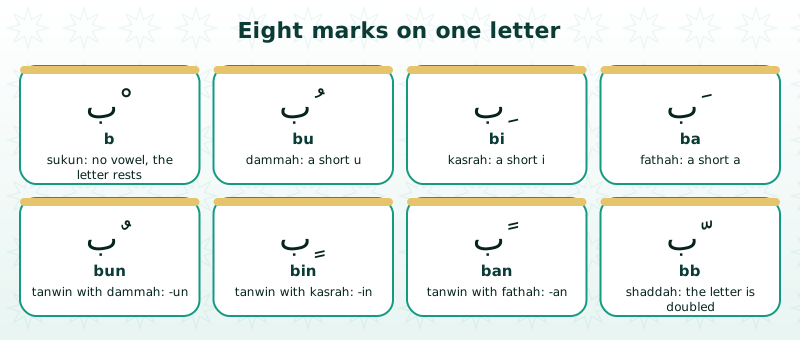
The letters are mostly consonants. Small marks above and below add the vowel: fathah for a, kasrah for i, dammah for u. Sukun means rest; shaddah doubles; tanwin adds an n at the end.
In English we write the vowels as letters. In the mushaf they sit on top as marks.
Tap the spot Tap the spot
Tap the card where the letter rests with no vowel.
Show the answer
The small circle is sukun: the letter is said with no vowel after it.
Tap the spot Tap the spot
Tap the card where the letter is doubled.
Show the answer
The small w-shape is shaddah: say the letter twice, once resting and once with its vowel.
Read
Rest, double, and the n at the end
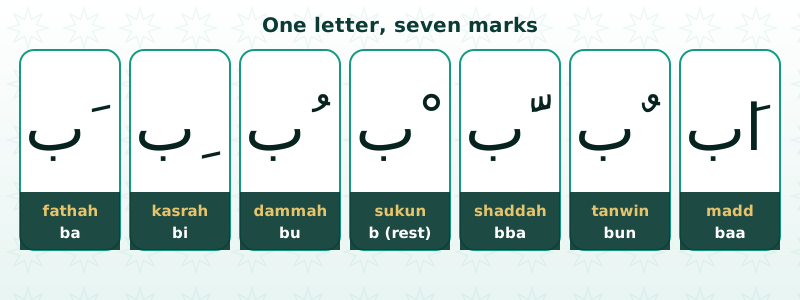
Three marks do more than add a vowel:
- Sukun means rest: stop the letter with no vowel, like the b in "cab".
- Shaddah doubles: say the letter once at rest, then again with its vowel. ʿAllama is ʿal-la-ma.
- Tanwin, a doubled vowel at the end of a word, adds an n: -an, -in, -un.
Go deeper: stopping on a word
When you stop at the end of a verse, the last vowel goes quiet. Tanwin -un and -in drop away, -an becomes a long ā, and a round ta is said as h. That is why a reciter says raḥīm at a stop, not raḥīmun.
Listen Listen and choose
Listen: which mark do you hear on ba?
Show the answer
Bi: a kasrah, the small stroke under the letter, gives a short i.
Memory game
Memory pairs
Find the pairs.
- fathah a short a
- kasrah a short i
- dammah a short u
- sukun no vowel
- shaddah doubled
- tanwin -an, -in, -un
Read
Why the marks matter for meaning
One mark can change a word. ʿalima is he knew; ʿullima is he was taught; ʿallama, with a shaddah, is he taught. You will meet all three in this path.
So reading the marks carefully is the first step of understanding, not only of reciting.
Listen Listen and choose
Listen: which word do you hear?
Show the answer
ʿAllama, he taught: the lam is held and said twice, because of its shaddah. ʿAlima, he knew, has no shaddah.
Choose Check
Which mark turns ʿalima (he knew) into ʿallama (he taught)?
Show the answer
Shaddah doubles the lam: ʿal-lama. A doubled middle letter often means making someone else do it.
From the Quran
Read it mark by mark
بِسْمِ ٱللَّهِ ٱلرَّحْمَٰنِ ٱلرَّحِيمِ قُلْ هُوَ ٱللَّهُ أَحَدٌ﴿1﴾ ٱللَّهُ ٱلصَّمَدُ﴿2﴾ لَمْ يَلِدْ وَلَمْ يُولَدْ﴿3﴾ وَلَمْ يَكُن لَّهُۥ كُفُوًا أَحَدٌۢ﴿4﴾
1 Say: He is Allah, the One!
2 Allah, the eternally Besought of all!
3 He begetteth not nor was begotten.
4 And there is none comparable unto Him.
Word by word
Word by word
- قُلْ qul to say · قول
- هُوَ huwa he, it
- ٱللَّهُ allāhu Allah, God: the proper name of the One God
- أَحَدٌ aḥadun one; anyone; (with a negative) no one · أحد
Say: He is Allah, the One!
Read
Try it on al-Ikhlas
Look at the surah above. Find a sukun, a shaddah and a tanwin. Say each word slowly, letter by letter, with its mark.
Then listen to a reciter and follow with your finger.
Listen Hear it
Listen: which letter is this?
Show the answer
Baa: one dot below. Put a fathah on it and it is ba, a kasrah bi, a dammah bu.
Read
For your life
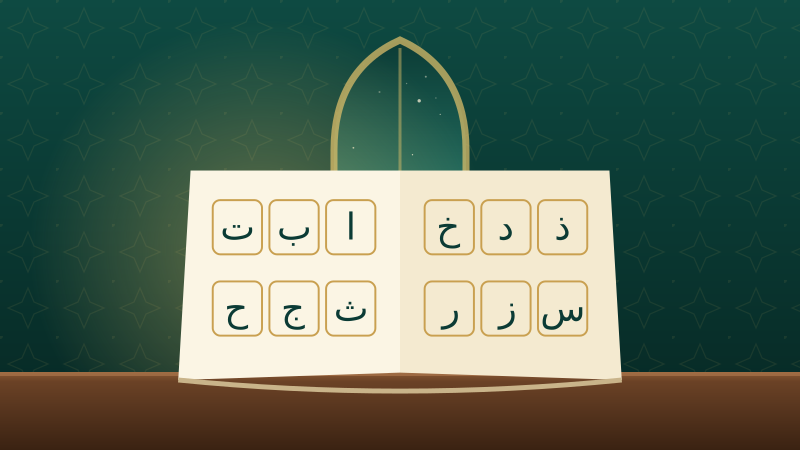
Sound it out, then speed up. Point at each letter, say it with its mark, then join two or three together. Speed comes by itself.
One line a day, read aloud, is enough. Use the Qaida's recordings here for single letters and words, and a teacher or a trusted reciter for the Quran itself.
Reveal
Common mistakes
Think of the right answer first, then flip each card.
- Reading fathah, kasrah and dammah all as "a" Three marks, three sounds: a, i and u.
- Skipping the shaddah Hold the letter: it is said twice.
- Saying the n of tanwin when you stop At a stop, -un and -in go quiet, and -an becomes ā.
Read
A moment for the heart

Generations of teachers passed these sounds on, mouth to ear, from the first reciters to the teacher in your local masjid.
Each time you read a mark with care, you join that chain, one mark at a time.
Reveal
In short
Answer each one in your head first, then tap to check.
- Which mark gives a short i? Kasrah, under the letter.
- What does a shaddah do? Doubles the letter: it is said twice.
- What happens to tanwin at a stop? -un and -in drop; -an becomes a long ā.
Lesson finished
The eight marks
You added a page to a mushaf whose pages turn.
What you learnt
- The marks add the vowels, and a single mark can change the meaning.
- done
- 0
- right first time
- 0
- to review
- 0
Your deed · Try it today
Sound out al-Ikhlas one letter and one mark at a time, then listen and compare.
What you kept
Sign in to keep your progress on every device.