
0 guardado
Entra en la escena

The people of Nuh, long ago
A statue to remember
An ark on dark water, wind over the sand and houses cut into red rock: three peoples, one pattern. It begins with statues.
Mira
A statue to remember
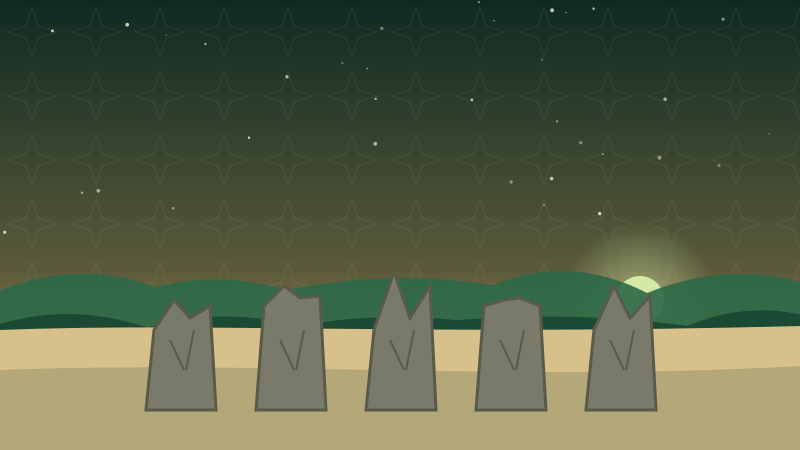
Long after Adam (’alayhis-salam), there lived some very righteous men. When they died, people missed them. Someone suggested: let us make statues of them, so we remember their goodness.
At first nobody worshipped the statues. But generations passed, the reason was forgotten, and people began to pray to them. This summary comes from a report of Ibn ’Abbas in Sahih al-Bukhari. It is how idol worship began.
Mira
Small steps away

Think how this happens today. A grave is visited to remember a good person. Then people ask the dead for help. Then they bow. Each step looks small. The end is shirk.
The names of those statues are in the Quran: Wadd, Suwa’, Yaghuth, Ya’uq and Nasr. Into this world Allah sent Nuh (’alayhis-salam), the first messenger to a people who had turned to idols.
Palabra por palabra
The idols of Nuh’s people
- وَقَالُوا۟ waqālū to say · قول
- لَا lā no, not; (before a command) do not
- تَذَرُنَّ tadharunna leave! (yadharu: to leave, to leave alone) · وذر
- ءَالِهَتَكُمْ ālihatakum god, deity; one who is worshipped · أله
- وَلَا walā no, not; (before a command) do not
- تَذَرُنَّ tadharunna leave! (yadharu: to leave, to leave alone) · وذر
- وَدًّۭا waddan
- وَلَا walā no, not; (before a command) do not
- سُوَاعًۭا suwāʿan
- وَلَا walā no, not; (before a command) do not
- يَغُوثَ yaghūtha
- وَيَعُوقَ wayaʿūqa
- وَنَسْرًۭا wanasran
And they have said: Forsake not your gods. Forsake not Wadd, nor Suwa', nor Yaghuth and Ya'uq and Nasr.
Clasifica
Sound, or a step away?
Sort each way of honouring the righteous dead.
Sound
- Making dua for the righteous dead
- Visiting graves to remember death
A step towards shirk
- Building statues of them to remember them
- Asking the dead to grant your needs
Ordena
How the idols came
Ponlos en el orden correcto.
- Righteous men die and are missed
- Statues are made to remember them
- Generations pass and the reason is forgotten
- People worship the statues
- Allah sends Nuh to call them back
Ver la respuesta
Shirk rarely starts as shirk. It starts as a small step that later generations misunderstand.
Verdadero o falso Check
The first idols were made to be worshipped from the very beginning.
Ver la respuesta
According to Ibn ’Abbas, they were made to remember righteous men. Worship came later, when the reason was forgotten.
Lee
Five names that became idols

Al-Bukhari reports from Ibn ’Abbas that Wadd, Suwa’, Yaghuth, Ya’uq and Nasr were the names of righteous men of Nuh’s people. Memorials were set up for them; generations later, they were worshipped.
Much later, Arab tribes gave the same names to their own idols.
Go deeper: graves and the Sunnah
Visiting graves to remember death and pray for the dead is Sunnah. Asking the dead for what only Allah can give, or building over graves to venerate them, is what the scholars warn against.
Revelar
Common mistakes
Flip each card: what people often get wrong, and what is right.
- “Idol worship began with evil people.” It began with good intentions: honouring righteous men. Small steps led to shirk.
- “Shirk only means bowing to statues.” It is giving any worship to other than Allah: dua, sacrifice, vows, trust.
- “The statues were the whole problem.” The root was hearts turning to someone other than Allah.
Lee
Doors the Sunnah closed
The Sunnah closed the doors that led Nuh’s people astray: no images set up for veneration, graves kept simple, and dua made to Allah directly.
These are not harsh rules. They are fences around tawhid.
Lee
For your life
Make your duas directly to Allah, in your own words. You need no one standing between you and Him.
And when you honour good people, follow their example; never turn to them in worship.
Piénsalo
A heart moment
Is there anything you lean on more than Allah: a person, money, a lucky charm? Turn that reliance back to Him today.
Solo tú puedes verlo. Se guarda en este dispositivo.
Lee
The lesson in three lines
Idols began with memorials for righteous men, which later generations worshipped. Five of their names are in the Quran. The Sunnah closes the doors that lead there.
Lección terminada
Where idols began
Has añadido una época a una línea a través de las épocas, de Adán a Muhammad ﷺ.
Lo que aprendiste
- Idol worship began with small steps from honouring the righteous.
- hechos
- 0
- bien a la primera
- 0
- para repasar
- 0
Tu obra · Pruébalo hoy
Keep every dua today for Allah alone.
Lo que guardaste
Inicia sesión para guardar tu progreso en todos tus dispositivos.