
0 محفوظ
ادخل المشهد
Peeling an orange
You peel an orange: skin, pith, then the fruit. Arabic words come wrapped the same way: little words in front, endings behind, the root inside.
انظر
Take off what was added
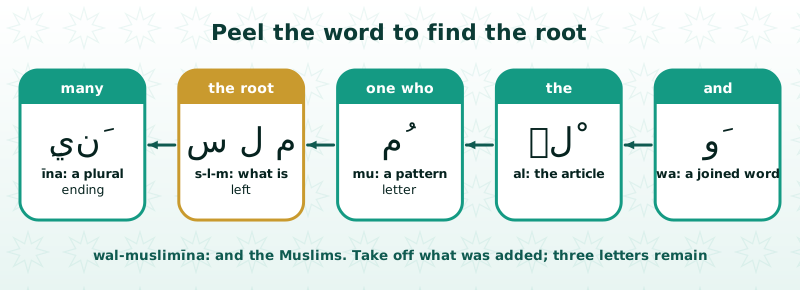
Wal-muslimīna, and the Muslims, has five pieces: wa (and), al (the), mu (the one who), the root s-l-m, and īna (a plural ending). Peel the extras and three letters remain.
Most words you meet have one or two extras, not four.
المس المكان Tap the spot
Tap the piece that is the root.
أظهر الإجابة
S-l-m is what is left when wa, al, mu and īna are taken away.
ابنِها
Build it
Build the word: and the Muslims
wa (and) al (the) mu (one who) s-l-m (root) īna (many)
اقرأ
The place, the doer, the done-to

A few patterns come back again and again:
- ma- at the start, a place: masjid, the place of sujud; maktab, a desk or office.
- -ā-i-, the doer: kātib, a writer; ʿālim, a scholar.
- ma- … -ū-, the done-to: maktūb, written.
اقرأ
The usual extras
- In front: wa (and), fa (so), bi (with), li (for), al (the), and the letters of the present tense (ya, ta, na, a).
- Behind: endings for who (-ū, -na, -tu), for many (-ūna, -īna, -āt), and pronouns (-hu, -hum, -ka, -nā).
Go deeper: the present tense letters
A present verb starts with one of four letters that tell you who: ya-, he; ta-, she or you; na-, we; a-, I. So naʿbudu is we worship, and aʿūdhu is I seek refuge. Peel the first letter, and the root is next.
كلمة كلمة
Word by word
- ٱهْدِنَا ihdinā to guide, to show the way · هدي
- ٱلصِّرَٰطَ aṣ-ṣirāṭa path, road (a wide, clear way) · صرط
- ٱلْمُسْتَقِيمَ al-mustaqīma straight, upright · قوم
Show us the straight path,
اختر Check
Ihdinā, guide us: which letters are the root?
أظهر الإجابة
The i- is the command’s opening sound, -nā is “us”, and the ya hides in the short command form: h-d-y.
صنّف
Added piece or root?
Sort each piece: is it added around a root, or is it the root itself?
added piece
- al- (the)
- wa- (and)
- -hum (them)
- -ūna (many)
root letters
- ʿ-b-d
- h-d-y
- k-t-b
استمع Listen and choose
Listen to the word. What is its root?
أظهر الإجابة
Madrasah, a school: ma- is the place, -ah is the ending, and d-r-s, studying, is the root. A school is the place of study.
انظر
Six words to practise
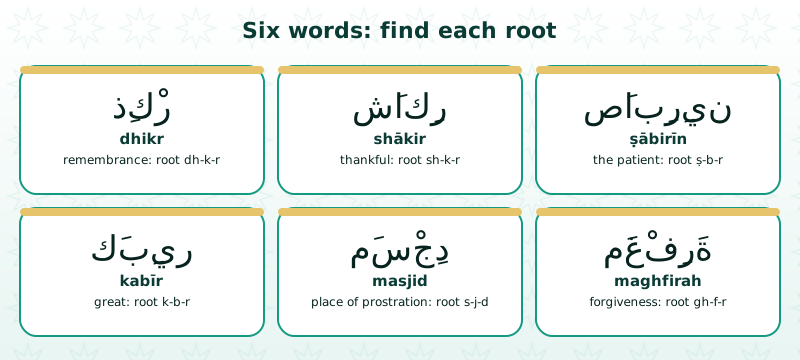
Peel each word and find its root before you check the card.
المس المكان Tap the spot
Tap the word whose root is s-j-d, to prostrate.
أظهر الإجابة
Masjid, the place of prostration: the ma- pattern gives a place.
صح أم خطأ True or false?
In wal-muslimīna, the wa is part of the root.
أظهر الإجابة
Wa, and, is a separate word joined to the front. The root is s-l-m.
اقرأ
For your life

Words you already use peel the same way: masjid (s-j-d), madrasah (d-r-s), muʾmin (a-m-n), kitāb and maktab (k-t-b).
Try it on names you know: Aḥmad, Maḥmūd and Ḥāmid all share ḥ-m-d, praise. A minute of peeling a day, and new words stop looking like walls.
اكشف
Common mistakes
Think of the right answer first, then flip each card.
- Counting mu- or ma- as part of the root They are added: muslim is s-l-m, masjid is s-j-d.
- Peeling too much Stop when three letters are left (four in a few rare roots).
- Forgetting the hidden weak letter Only two left? A waw or ya may be hiding.
اقرأ
A moment for the heart
Ihdinā, guide us: you ask it at least seventeen times a day.
Now you can see its root inside it, h-d-y, guidance. Next time, ask knowing exactly what you are asking for.
اكشف
In short
Answer each one in your head first, then tap to check.
- In wal-muslimīna, which letters are the root? S-l-m.
- What does ma- at the start of a word often mean? A place: masjid, the place of sujud.
- What is the root of ihdinā? H-d-y, guiding.
انتهى الدرس
Peel the word to find the root
أضفت صفحة إلى مصحف تُقلَّب صفحاته.
ما تعلّمته
- Peel the front, peel the end, look inside: three letters are the root.
- منجزة
- 0
- صحيح من أول مرة
- 0
- للمراجعة
- 0
عملك · جرّبه اليوم
Take three words from al-Fatihah and peel each one to its root, then check it on a word-by-word screen.
ما حفظته
سجّل الدخول لتحفظ تقدّمك على كل أجهزتك.