
0 محفوظ
ادخل المشهد
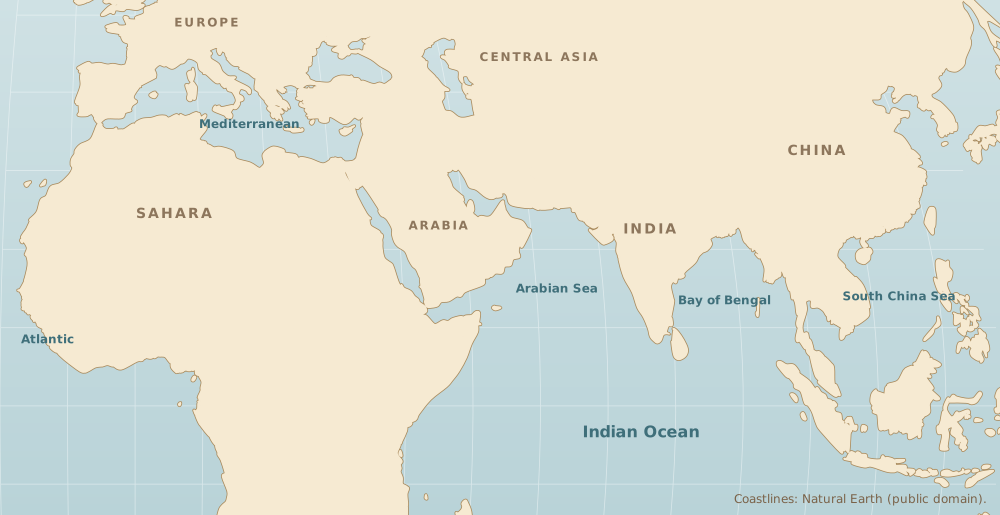
From Tangier to China
Tangier, 1325
The map of the old world from Tangier to China. A young scholar leaves home for Hajj and will travel, on and off, for twenty-nine years.
انظر
Tangier, 1325

A young scholar of twenty-one leaves home to make the Hajj. His name is Ibn Battuta. He will not come home for twenty-four years.
He travelled perhaps 120,000 kilometres, and he could do it because the Muslim world was joined by one faith, one law and the Arabic language. Everywhere, there were mosques, judges and guesthouses.
الطريق
The travels of Ibn Battuta, 1325–1354
- Tangier, 1325 He sets out for Makkah.
- Cairo The greatest city he had seen.
- Damascus He studies and joins the Hajj caravan.
- Makkah The first of several Hajjs.
- Baghdad Still recovering from the Mongols.
- Kilwa Down the Swahili coast.
- Delhi Years as a judge for the sultan.
- The Maldives Judge again, on the islands.
- China He meets Muslim merchants in Chinese ports.
- Al-Andalus After returning home, he visits Granada.
- Mali His last journey, across the Sahara.
He dictated his travels on his return. They are one of our best windows on the Muslim world of the 14th century.
كلمة كلمة
Invite with wisdom
- ٱدْعُ udʿu to call, to call upon, to pray to, to invite · دعو
- إِلَىٰ ilā to, towards, until
- سَبِيلِ sabīli way, path, road · سبل
- رَبِّكَ rabbika Lord: the one who owns, nurtures, provides for and cares for · ربب
- بِٱلْحِكْمَةِ bilḥikmati judgement, ruling; wisdom · حكم
- وَٱلْمَوْعِظَةِ walmawʿiẓati
- ٱلْحَسَنَةِ al-ḥasanati good, beautiful · حسن
- وَجَٰدِلْهُم wajādilhum to argue, to dispute · جدل
- بِٱلَّتِى billatī
- هِىَ hī she, it
- أَحْسَنُ aḥsanu best, better, most beautiful · حسن
- إِنَّ inna indeed, truly (adds certainty to a sentence)
- رَبَّكَ rabbaka Lord: the one who owns, nurtures, provides for and cares for · ربب
- هُوَ huwa he, it
- أَعْلَمُ aʿlamu knows best, more knowing · علم
- بِمَن biman who, whoever, the one who
- ضَلَّ ḍalla to go astray, to lose the way; (adalla) to lead astray · ضلل
- عَن ʿan from, away from; about
- سَبِيلِهِۦ sabīlihī way, path, road · سبل
- وَهُوَ wahuwa he, it
- أَعْلَمُ aʿlamu knows best, more knowing · علم
- بِٱلْمُهْتَدِينَ bilmuhtadīna
Call unto the way of thy Lord with wisdom and fair exhortation, and reason with them in the better way. Lo! thy Lord is Best Aware of him who strayeth from His way, and He is Best Aware of those who go aright.
انظر
What this verse teaches

The verse teaches that the way we invite matters as much as the message, and that guidance is in Allah’s hands.
The Sufi teachers of Asia and Africa lived this. Mu’in al-Din Chishti (died 1236) taught in Ajmer in India. Baha’ al-Din Naqshband (died 1389) taught in Bukhara. In Java, the Wali Songo, the nine saints, are remembered for teaching Islam in the local language and culture.
اقرأ
One world, one law

Ibn Battuta could cross three continents because the Muslim world shared much. Scholars spoke Arabic, judges knew the same fiqh, and lodges called zawiyas fed and housed travellers.
He was a scholar, so rulers gave him work: he served as a judge in Delhi and in the Maldives.
Go deeper: how his book was written
Back in Morocco he dictated his travels to a scholar, Ibn Juzayy, in Fez. Historians think some passages were borrowed from earlier writers or remembered loosely, years after the journeys.
اختر Check
What work did Ibn Battuta do in Delhi and the Maldives?
أظهر الإجابة
A trained scholar of the Maliki school, he was made a qadi where he stayed.
اقرأ
The Sufi teachers at their best

The great Sufi teachers of Asia and Africa taught people to purify the heart, remember Allah often and serve others, always within the shari’ah.
Their lodges fed the poor of every faith. In many villages, people first met Islam at a teacher’s kitchen door.
خمّن
Ibn Battuta’s road
About how far did Ibn Battuta travel in his twenty-nine years on the road?
أظهر الإجابة
120000 km About 120,000 km, by most estimates: further than anyone before the age of steam.
صِل
Match the teacher to the place
صِل كل واحد بما يناسبه.
- Ibn Battuta Tangier to China
- Mu’in al-Din Chishti Ajmer, India
- Baha’ al-Din Naqshband Bukhara
- The Wali Songo Java
أظهر الإجابة
Ibn Battuta travelled from Tangier to China, Mu'in al-Din Chishti taught in Ajmer, Baha' al-Din Naqshband in Bukhara, and so on. Travellers and teachers carried Islam far.
رتّب
Put Ibn Battuta’s stops in order
رتّبها بالترتيب الصحيح.
- Tangier
- Cairo
- Makkah
- Delhi
- China
- Mali
أظهر الإجابة
Tangier, Cairo, Makkah, Delhi, China, then Mali. Ibn Battuta's travels covered twenty-nine years and three continents.
اكشف
Common mistakes
Flip each card: what people often get wrong, and what is right.
- “Sufism is outside the shari’ah.” The great Sufi teachers held that the path is worthless without it.
- “Ibn Battuta travelled as a tourist.” He travelled as a pilgrim and scholar, often working as a judge.
- “Every tale in his book is exact.” Some parts are doubted by historians.
اقرأ
For your life
When you travel, take your faith with you. Carry a small prayer mat and a qiblah compass, look up the nearest masjid, and learn the travel rules: from about 78 km, shorten the four-rak’ah prayers to two, unless you plan to stay fifteen days or more.
فكّر في الأمر
A heart moment
Who opened their door to you when you were a stranger? Make a dua for them.
لا يراه أحد غيرك، ويُحفظ على هذا الجهاز.
اكشف
The lesson in three lines
Sum up the lesson in your own words first, then tap to check.
- The lesson in one line Scholars, Sufis and travellers like Ibn Battuta carried Islam across the old world. A shared language, law and hospitality made the journeys possible. The Sufi teachers at their best invited with wisdom, dhikr and service.
انتهى الدرس
Scholars, Sufis and travellers
أضفت قرنًا إلى خريطة تتغيّر حدودها.
ما تعلّمته
- Scholars, Sufis and travellers carried Islam with wisdom and good character.
- منجزة
- 0
- صحيح من أول مرة
- 0
- للمراجعة
- 0
عملك · جرّبه اليوم
Invite someone to good today with wisdom and a kind word.
ما حفظته
سجّل الدخول لتحفظ تقدّمك على كل أجهزتك.