
0 رکھا
منظر میں آئیں
A kitchen, ten minutes before ʿAsr
A question at the sink
A knife slips while you chop onions, and a drop of blood runs down your finger. You have wudu. Is it broken?
دیکھیں
A question at the sink

Yusuf cuts his finger while cooking. A drop of blood runs down. He has wudu and Asr is in ten minutes. Does he need a new wudu?
Questions like this come up every day. The knowledge that answers them is called fiqh.
دیکھیں
Shariah and fiqh

The Shariah is the path Allah set out for us in the Quran and the Sunnah. Fiqh (literally “understanding”) is the scholars’ careful understanding of that path, turned into clear rulings.
The Shariah is perfect. Fiqh is human effort to understand it, done with great care by people of knowledge.
ترتیب دیں
Shariah or fiqh?
Sort each one.
The Shariah: the path Allah set
- The command to pray, in the Quran
- Allah’s law as He revealed it
Fiqh: the scholars’ understanding of it
- The Hanafi ruling that flowing blood breaks wudu
- A detailed ruling worked out from a verse and a hadith
- Rulings on which the schools differ
حدیث سے
Understanding is a gift
وعن معاوية رضي الله عنه قال: قال رسول الله صلى الله عليه وسلم : "من يرد الله به خيرًا يفقه في الدين" ((متفق عليه))
Mu'awiyah (May Allah be pleased with him) reported: The Messenger of Allah said, "When Allah wishes good for someone, He bestows upon him the understanding of Deen."
دیکھیں
What this hadith teaches

Deep understanding of the religion is a sign that Allah wants good for a person. Learning fiqh is not dry rule-reading. It is a way of loving Allah by doing what He asks, the way He asks it.
قرآن سے
Some must specialise
۞ وَمَا كَانَ ٱلْمُؤْمِنُونَ لِيَنفِرُوا۟ كَآفَّةًۭ ۚ فَلَوْلَا نَفَرَ مِن كُلِّ فِرْقَةٍۢ مِّنْهُمْ طَآئِفَةٌۭ لِّيَتَفَقَّهُوا۟ فِى ٱلدِّينِ وَلِيُنذِرُوا۟ قَوْمَهُمْ إِذَا رَجَعُوٓا۟ إِلَيْهِمْ لَعَلَّهُمْ يَحْذَرُونَ﴿122﴾
122 And the believers should not all go out to fight. Of every troop of them, a party only should go forth, that they (who are left behind) may gain sound knowledge in religion, and that they may warn their folk when they return to them, so that they may beware.
لفظ بہ لفظ
Word by word
- وَمَا wamā not (negation)
- كَانَ kāna to be, was; (kana yaf'al) used to do · كون
- ٱلْمُؤْمِنُونَ al-muʾminūna believer · أمن
- لِيَنفِرُوا۟ liyanfirū
- كَآفَّةًۭ kāffatan
- فَلَوْلَا falawlā if not for; why not?
- نَفَرَ nafara
- مِن min from, of, out of, some of
- كُلِّ kulli all, every, each · كلل
- فِرْقَةٍۢ firqatin
- مِّنْهُمْ minhum from, of, out of, some of
- طَآئِفَةٌۭ ṭāʾifatun
- لِّيَتَفَقَّهُوا۟ liyatafaqqahū
- فِى fī in, inside; about, concerning
- ٱلدِّينِ ad-dīni religion, way of life; also judgement and recompense · دين
- وَلِيُنذِرُوا۟ waliyundhirū to warn · نذر
- قَوْمَهُمْ qawmahum people, nation, a community · قوم
- إِذَا idhā when, whenever; (idhan) then, in that case
- رَجَعُوٓا۟ rajaʿū to return, to go back · رجع
- إِلَيْهِمْ ilayhim to, towards, until
- لَعَلَّهُمْ laʿallāhum so that perhaps, that you may
- يَحْذَرُونَ yaḥdharūna
And the believers should not all go out to fight. Of every troop of them, a party only should go forth, that they (who are left behind) may gain sound knowledge in religion, and that they may warn their folk when they return to them, so that they may beware.
دیکھیں
Not everyone a scholar

This verse shows that a group in every community should study the religion deeply and teach the rest. You do not need to become a mufti. You need to know your daily rulings well and know whom to ask.
Yusuf’s answer, by the way: in the Hanafi school, blood that flows beyond the wound breaks wudu. A spot that stays on the cut does not.
پڑھیں
Fiqh before lunch

By midday an ordinary Muslim has met a dozen fiqh questions without noticing: is my wudu still there after that nap, how many rak'ahs is Dhuhr, may I eat this sandwich, is this deal at work fair, what do I say when I sneeze?
Fiqh is not a subject for libraries. It is the map of an ordinary day, so that each part of it pleases Allah.
پڑھیں
What you must learn, and what the community learns

Some knowledge is a duty on you (farḍ 'ayn): the basics of belief, purity, salah and fasting, and, when they apply to you, zakat, the rules of your trade, and marriage when you marry.
Other knowledge is a duty on the community (farḍ kifāyah): enough scholars, muftis and teachers. If some do it, the rest are free; if none do, all are at fault.
ترتیب دیں
Must I learn it?
Sort each piece of knowledge for Yusuf, a 30-year-old shopkeeper, married, with savings.
A duty on Yusuf himself
- How to make wudu and pray
- The rules of buying and selling
- How to work out his zakat
A duty on the community
- Training as a mufti
- The detailed law of inheritance cases
چنیں Check your understanding
What is fiqh?
جواب دکھائیں
Fiqh means understanding. It is the scholars’ careful reading of the Quran and Sunnah, turned into rulings you can live by.
صحیح یا غلط True or false?
Every Muslim must become a mufti.
جواب دکھائیں
A group in each community studies deeply (9:122). Everyone else learns what they need daily and asks qualified people for the rest.
پڑھیں
Where to learn it
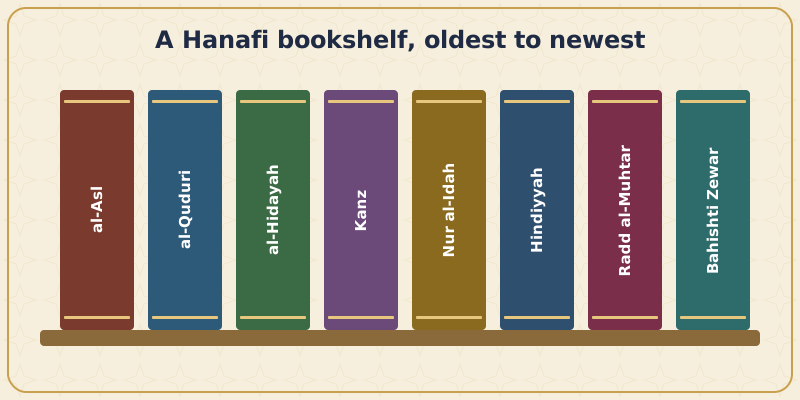
Learn fiqh from a teacher where you can: an imam, a madrasah evening class, a scholar you trust. Use a trusted book for daily life; for Hanafis, Bahishti Zewar has been that book for generations.
Courses like this one give you the map. A teacher answers your own questions. Be careful with random videos and posts: you do not know who is teaching, or which school.
ظاہر کریں
Common mistakes
Think of the right answer first, then flip each card.
- "Fiqh is for scholars only." The fiqh of your own life is a duty on you: purity, prayer, fasting, your work.
- "The Shariah and fiqh are the same thing." The Shariah is Allah's path; fiqh is the scholars' understanding of it in rulings.
- "I'll just work it out from the Quran myself." Rulings need the Sunnah and the scholars' method. Learn from a teacher and a school.
- "If a scholar differs, the religion is unclear." Fiqh differs in details for honest reasons. The Shariah's core is clear.
سبق مکمل
What fiqh is
آپ نے اضافہ کیا: ایک چابی — چابیوں کا ایک گچھا جو جمع ہوتا ہے.
آپ نے کیا سیکھا
- The Shariah is the path; fiqh is its rulings, understood by scholars.
- Every day is full of small fiqh questions.
- Personal duty: the fiqh of your own life. Communal duty: enough scholars.
- مکمل
- 0
- پہلی بار میں درست
- 0
- دہرانے کے لیے
- 0
آپ کا عمل · آج آزمائیں
Write down one everyday question you have about your worship, and ask your imam this week.
جو آپ نے رکھا
سائن اِن کریں تاکہ آپ کی پیش رفت ہر ڈیوائس پر محفوظ رہے۔