
0 رکھا
منظر میں آئیں
Makkah, about three years before the Hijrah
The year of sorrow
Two lamps go out in one year: the uncle who protected him, and the wife who believed him first.
دیکھیں
Abu Talib

Soon after the boycott ended, Abu Talib fell ill. For forty years he had raised and protected his nephew, refusing every demand to hand him over. On his deathbed the Prophet ﷺ begged him to say the words of faith. The sound reports say he died on the religion of his fathers.
The pain of it is still felt in the Quran.
لفظ بہ لفظ
Guidance is from Allah alone
- إِنَّكَ innaka indeed, truly (adds certainty to a sentence)
- لَا lā no, not; (before a command) do not
- تَهْدِى tahdī to guide, to show the way · هدي
- مَنْ man who, whoever, the one who
- أَحْبَبْتَ aḥbabta
- وَلَٰكِنَّ walākinna but, however
- ٱللَّهَ allāha Allah, God: the proper name of the One God
- يَهْدِى yahdī to guide, to show the way · هدي
- مَن man who, whoever, the one who
- يَشَآءُ yashāʾu to will, to wish · شيأ
- وَهُوَ wahuwa he, it
- أَعْلَمُ aʿlamu knows best, more knowing · علم
- بِٱلْمُهْتَدِينَ bilmuhtadīna
Lo! thou (O Muhammad) guidest not whom thou lovest, but Allah guideth whom He will. And He is Best Aware of those who walk aright.
پڑھیں
You cannot guide whom you love

This verse tells the Prophet ﷺ that he cannot guide whomever he loves; Allah guides whom He wills. The sound collections link it to Abu Talib.
Many Muslims have a parent, a brother or a friend who has not accepted Islam. This verse is a comfort: your duty is to love them, pray for them and show the truth. Guidance itself belongs to Allah.
دیکھیں
Khadijah

Within a short time, days or weeks by different reports, Khadijah (radiyallahu ’anha) died too, at about sixty-five. She had been the first to believe, had spent her wealth on the cause, and had shared the hunger of the valley. She was buried at al-Ma’la.
Later writers named it ’Am al-Huzn, the Year of Sorrow. In about 619 he lost his protector outside the home and his support within it.
اس پر غور کریں
A heart moment
He lost the uncle who shielded him and the wife who believed in him first, within weeks. Think of someone you have lost. What did they give you that you still carry? Make a dua for them now.
یہ صرف آپ دیکھ سکتے ہیں۔ یہ اسی ڈیوائس پر محفوظ ہے۔
حدیث سے
A house in Paradise
عن أبي إبراهيم- ويقال أبو محمد، ويقال أبو معاوية- عبد الله بن أبي أوفى رضي الله عنه أن رسول الله صلى الله عليه وسلم بشر خديجة، رضي الله عنها، ببيت في الجنة من قصب ، لا صخب فيه ولا نصب. ((متفق عليه)) .
'Abdullah bin Abu Aufa (May Allah be pleased with him) reported: Messenger of Allah (ﷺ) gave glad tidings to Khadijah (May Allah be pleased with her) about a palace of hollowed pearls in Jannah, free from noise and toil..
پڑھیں
Grief, the Prophet’s way

He grieved openly for those he loved. Years later, when his small son Ibrahim died, he wept, and taught that tears and a sad heart are a mercy. What we hold back is any word of complaint against Allah.
In Islam you may cry and feel the loss. Wailing, tearing clothes and striking yourself are what is forbidden.
Go deeper: mourning and condolence
Mourning a relative is for up to three days; a widow keeps an 'iddah, a waiting period, of four months plus ten days. Visiting the family to give condolence is a sunnah, best within the first three days, and so is sending them food, because they are too sad to cook.
ظاہر کریں
Common mistakes
Flip each card: what people often get wrong, and what is right.
- “Crying for the dead shows weak faith.” He wept for those he lost. Only complaint against Allah, and wailing, are wrong.
- “Khadijah died years after Abu Talib.” Within days or weeks, by the different reports, both in about 619.
- “‘The Year of Sorrow’ is a name from the Quran.” Later writers gave the year that name.
پڑھیں
Why the year was dangerous
Abu Talib's death was not only a sorrow. It took away the protection of the clan. Abu Lahab became the head of Banu Hashim and, the reports say, soon withdrew it.
Now Quraysh harmed him more openly. Once someone threw dust on his head in the street; his daughter washed it off in tears, and he comforted her.
ترتیب دیں
What each gave him
Sort each to Abu Talib or Khadijah (radiyallahu ’anha).
Abu Talib
- Raised him from the age of eight
- Refused to hand him over to Quraysh
Khadijah
- The first to believe in him
- Spent her wealth on the call
- Comforted him when he came home trembling
جگہ کو چھوئیں Where she was buried
Tap al-Ma’la, the cemetery where Khadijah was buried.
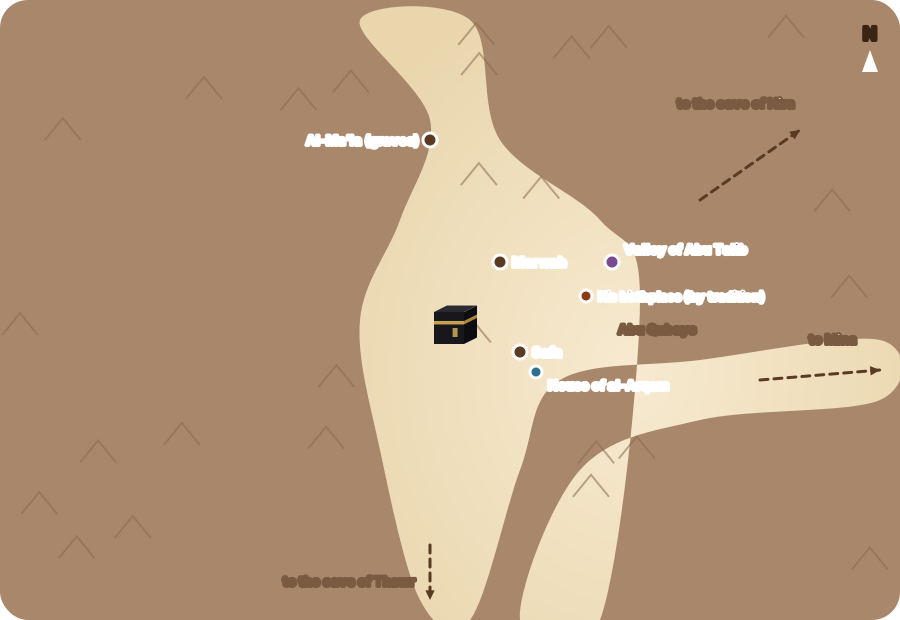
جواب دکھائیں
Al-Ma’la is in the north of the old valley of Makkah.
ملائیں
The two losses
ہر ایک کو اس کے جوڑے سے ملائیں۔
- Abu Talib His uncle and protector for forty years
- Khadijah His wife and first believer
- al-Ma’la The cemetery of Makkah
- ’Am al-Huzn The Year of Sorrow
جواب دکھائیں
About 619: the year he lost his two great supports.
چنیں Check
Why was Abu Talib’s death dangerous for the Prophet ﷺ, not only sad?
جواب دکھائیں
In a clan society, protection was everything. With Abu Talib gone, Quraysh grew bolder.
پڑھیں
For your life

When you lose someone, there is still much you can do for them: make dua, give charity on their behalf, pay their debts, keep up their good friendships.
And when someone else is grieving, go to them. Sit with them, bring food, and say little. Your presence is the gift.
ظاہر کریں
The lesson in three lines
Sum up the lesson in your own words first, then tap to check.
- The lesson in one line In about 619 Abu Talib died, and soon after Khadijah (radiyallahu 'anha). He lost his protector outside the home and his support within it. He grieved with tears, and carried on.
سبق مکمل
Two losses
آپ نے اضافہ کیا: سفر کا ایک مرحلہ — عرب کے پار ایک سفر.
آپ نے کیا سیکھا
- He lost his protector and his first believer in one year, yet carried on.
- مکمل
- 0
- پہلی بار میں درست
- 0
- دہرانے کے لیے
- 0
آپ کا عمل · آج آزمائیں
Make dua today for someone you have lost, and do one good deed on their behalf.
جو آپ نے رکھا
سائن اِن کریں تاکہ آپ کی پیش رفت ہر ڈیوائس پر محفوظ رہے۔