
0 رکھا
منظر میں آئیں
Lights out
Lights out, phone down, and a worry still running. The last two surahs of the Quran are the ones the Prophet ﷺ turned to for protection. Tonight, read them knowing every word.
دیکھیں
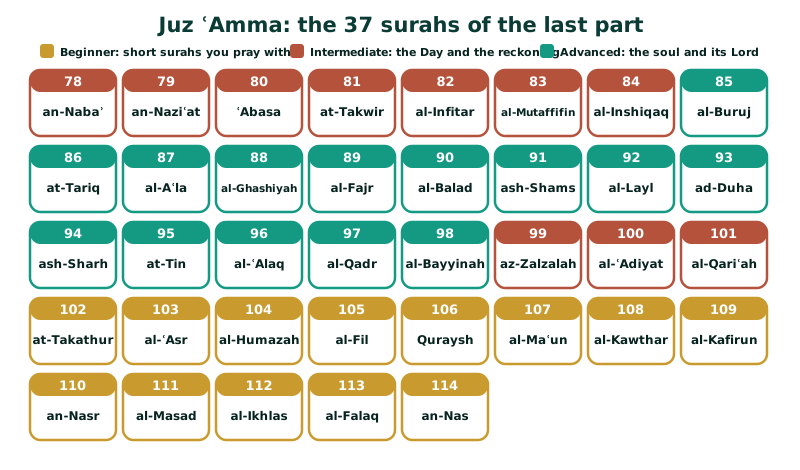
Juz ʿAmma at a glance
اندازہ لگائیں
How many surahs?
Juz ʿAmma runs from surah 78 to surah 114. How many surahs is that?
جواب دکھائیں
37 surahs Thirty-seven surahs, from an-Nabaʾ (78) to an-Nas (114): most are short, and many are the ones people pray with.
قرآن سے
An-Nas
بِسْمِ ٱللَّهِ ٱلرَّحْمَٰنِ ٱلرَّحِيمِ قُلْ أَعُوذُ بِرَبِّ ٱلنَّاسِ﴿1﴾ مَلِكِ ٱلنَّاسِ﴿2﴾ إِلَٰهِ ٱلنَّاسِ﴿3﴾ مِن شَرِّ ٱلْوَسْوَاسِ ٱلْخَنَّاسِ﴿4﴾ ٱلَّذِى يُوَسْوِسُ فِى صُدُورِ ٱلنَّاسِ﴿5﴾ مِنَ ٱلْجِنَّةِ وَٱلنَّاسِ﴿6﴾
1 Say: I seek refuge in the Lord of mankind,
2 The King of mankind,
3 The god of mankind,
4 From the evil of the sneaking whisperer,
5 Who whispereth in the hearts of mankind,
6 Of the jinn and of mankind.
دیکھیں
The key words

Aʿūdhu, I seek refuge. Rabb, Lord; malik, King; ilāh, God: three Names, each joined to an-nās, people. Al-waswās: the whisperer, from a root that repeats w-s.
Every word on these cards is one you have met in this path.
جگہ کو چھوئیں Tap the spot
Tap the whisperer.
جواب دکھائیں
Al-waswās, from w-s-w-s, the whisperer who whispers again and again.
سنیں Listen and choose
Listen: this word opens an-Nas, al-Falaq and al-Ikhlas. Which is it?
جواب دکھائیں
Qul: say! Each of the three surahs opens with a command to say these words, so you say them as your own.
دیکھیں
Watch: refuge, word by word
لفظ بہ لفظ
Word by word
- قُلْ qul to say · قول
- أَعُوذُ aʿūdhu
- بِرَبِّ birabbi Lord: the one who owns, nurtures, provides for and cares for · ربب
- ٱلنَّاسِ an-nāsi people, mankind · نوس
Say: I seek refuge in the Lord of mankind,
پڑھیں
Three Names, three pairs
An-Nas calls on Allah by three Names, each joined to people: Lord of people, King of people, God of people. Each Name widens the shelter: the One who cares, the One who rules, the One who is worshipped.
Then min sharri, from the evil of, names what you need shelter from.
Go deeper: the grammar
Each pair is an iḍafah: two nouns joined, "Lord of people". Aʿūdhu is a present verb, and its a- at the start means I. Min sharri is min, from, with sharr, evil, joined to whatever follows it.
ملائیں Match
Match the word to its grammar
- aʿūdhu present verb: I seek refuge
- rabbi n-nās iḍafah: Lord of people
- min preposition: from
- al-waswās noun from a four-letter root
جواب دکھائیں
All grammar you have learned, in one short surah.
قرآن سے
Al-Falaq
بِسْمِ ٱللَّهِ ٱلرَّحْمَٰنِ ٱلرَّحِيمِ قُلْ أَعُوذُ بِرَبِّ ٱلْفَلَقِ﴿1﴾ مِن شَرِّ مَا خَلَقَ﴿2﴾ وَمِن شَرِّ غَاسِقٍ إِذَا وَقَبَ﴿3﴾ وَمِن شَرِّ ٱلنَّفَّٰثَٰتِ فِى ٱلْعُقَدِ﴿4﴾ وَمِن شَرِّ حَاسِدٍ إِذَا حَسَدَ﴿5﴾
1 Say: I seek refuge in the Lord of the Daybreak
2 From the evil of that which He created;
3 From the evil of the darkness when it is intense,
4 And from the evil of malignant witchcraft,
5 And from the evil of the envier when he envieth.
پڑھیں
Al-Falaq: four evils, one refuge
Al-Falaq repeats min sharri four times, naming four kinds of harm, from all of creation down to the envier. Falaq is the splitting of daybreak: light breaking through.
Listen for min sharri each time; each one is a door closed.
چنیں Check
In al-Falaq, how many times is “min sharri” said?
جواب دکھائیں
Four times: four evils are named, each with min sharri.
حدیث سے
Verses without equal
وعن عقبة بن عامر رضي الله عنه أن رسول الله صلى الله عليه وسلم قال : " ألم ترَ آيات أنزلت هذه الليلة لم يرَ مثلهن قط ؟ قل أعوذ برب الفلق، وقل أعوذ برب الناس ".((رواه مسلم)).
'Uqbah bin 'Amir (May Allah be pleased with him) reported: The Messenger of Allah (ﷺ) said: "Do you not know that last night certain Ayat were revealed the like of which there is no precedence. They are: 'Say: I seek refuge with (Allah) the Rubb of the daybreak' (Surah 113), and 'Say: I seek refuge with (Allah) the Rubb of mankind' (Surah 114)."
پڑھیں
For your life

When to recite them: with al-Ikhlas, these two are the Sunnah before sleep and after each prayer. Before sleep, many recite all three, blow lightly into the hands, and wipe them over the body.
Recite them over your children, when you are afraid or unwell, and before a journey. Say them slowly: they are a request, not a spell.
Go deeper: reciting over the sick
Reading these surahs over someone who is ill, and duas whose words are understood, is from the Sunnah. Charms with writing nobody can read, or that call on anyone besides Allah, are not.
ظاہر کریں
Common mistakes
Think of the right answer first, then flip each card.
- Reciting them only in an emergency They are for every night and after every prayer.
- Racing through min sharri Each one names a harm: pause and mean it.
- Treating the words like a spell Protection is from Allah; recite with trust in Him.
پڑھیں
A moment for the heart

Lights out, and the worry is still running. You do not have to fight it alone.
Three Names, one refuge: say them slowly, and hand the night to the Lord of people.
ظاہر کریں
In short
Answer each one in your head first, then tap to check.
- What does aʿūdhu mean? I seek refuge.
- Which three Names does an-Nas use? Rabb, Malik and Ilāh: the Lord, King and God of people.
- When is it Sunnah to recite these surahs? Before sleep and after each prayer.
سبق مکمل
An-Nas and al-Falaq
آپ نے اضافہ کیا: ایک صفحہ — مصحف جس کے صفحے پلٹتے ہیں.
آپ نے کیا سیکھا
- Aʿūdhu, three Names in iḍafah, and min sharri: refuge, from every side.
- مکمل
- 0
- پہلی بار میں درست
- 0
- دہرانے کے لیے
- 0
آپ کا عمل · آج آزمائیں
Before sleep tonight, recite al-Falaq and an-Nas slowly, hearing each Name and each min sharri.
جو آپ نے رکھا
سائن اِن کریں تاکہ آپ کی پیش رفت ہر ڈیوائس پر محفوظ رہے۔