
0 رکھا
منظر میں آئیں
The prayer hall, just after the iqamah
Valid, but not whole
A summer Dhuhr. One man prays with his sleeves rolled to the elbow, another cracks his knuckles in the sitting, a third keeps glancing up at the clock. Every one of their prayers counts. So what is wrong?
پڑھیں
Breaks it, or only spoils it?
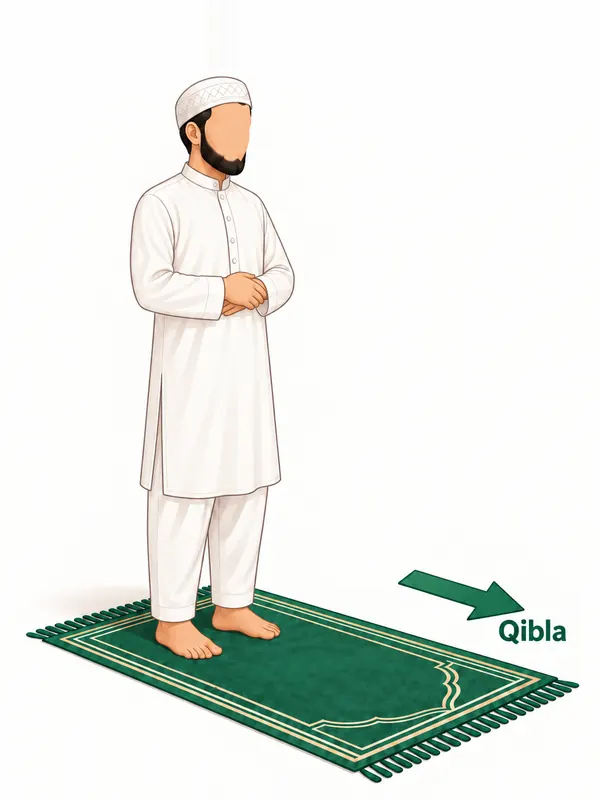
Between "valid" and "broken" lies a third group: the makrūh acts, disliked in the prayer.
- Makrūh taḥrīmī: close to forbidden. The prayer counts, but it is wajib to pray it again while its time remains.
- Makrūh tanzīhī: lighter. The prayer counts and need not be repeated, but its reward and its beauty are less.
پڑھیں
Disliked: the clothes
- Rolling up the sleeves or the trouser legs before praying, or holding the clothes off the ground in sujood.
- Letting a shawl or sheet hang loose from the head or shoulders without wrapping it.
- Praying in scruffy clothes you would not wear to meet people, when you have better.
- Covering the mouth and nose without need.
- For men, praying with the hair tied up in a bun.
پڑھیں
Disliked: the body

- Cracking the knuckles or interlacing the fingers.
- Putting the hands on the hips.
- Turning the face to look around (turning the chest breaks the prayer).
- Looking up at the sky or the ceiling.
- Yawning without trying to hold it back or covering the mouth.
- For men, laying the forearms flat on the ground in sujood.
- Closing the eyes, unless it truly helps you focus.
چنیں Which one breaks it?
Four men pray Asr. Whose prayer is broken, not just disliked?
جواب دکھائیں
Turning the chest away from the qiblah loses a condition, so Yahya prays again. The others did disliked acts: their prayers count, with less reward.
ترتیب دیں
Breaks it, disliked, or fine?
Sort each act by its ruling.
Breaks the prayer
- Turning the chest away from the qiblah
- Saying "one minute" to a caller
Disliked (makruh)
- Turning the face to look around
- Cracking the knuckles in the sitting
- Praying with sleeves rolled up to the elbow
Fine
- Wiping sweat from the forehead once
پڑھیں
Disliked: where you pray, and what you face
- Facing a picture of a living being on the wall in front of you, or above your head.
- Facing a person who is looking at you, or praying where people pass in front.
- Praying in the bathroom, in the middle of a road, or facing a grave.
- Praying with a distraction in front: a screen playing, a decorated mat you keep reading.
پڑھیں
Passing in front, and the sutrah
Walking in front of someone praying, close to them, is a serious sin for the one who passes, as the hadith below warns. Wait, or walk around behind.
So the one praying in an open place, alone or as imam, sets up a sutrah: an object about a forearm high, a short distance in front, such as a bag or a chair. People may then pass beyond it. The imam's sutrah serves the whole congregation.
حدیث سے
Better to wait
وَعَن أبي جهيم قَالَ: قَالَ رَسُولُ اللَّهِ صَلَّى اللَّهُ عَلَيْهِ وَسلم: «لَوْ يَعْلَمُ الْمَارُّ بَيْنَ يَدَيِ الْمُصَلِّي مَاذَا عَلَيْهِ لَكَانَ أَنْ يَقِفَ أَرْبَعِينَ خَيْرًا لَهُ مِنْ أَنْ يَمُرَّ بَيْنَ يَدَيْهِ» . قَالَ أَبُو النَّضر: لَا أَدْرِي قَالَ: «أَرْبَعِينَ يَوْمًا أَوْ شَهْرًا أَو سنة»
Abu Juhaim reported God’s Messenger as saying, ‘‘If one who passes in front of a man who is praying knew the responsibility he incurs, to stand still for forty would be better for him than to pass in front of him.” Abun Nadr said, “I do not know whether he said forty days, or months, or years.” (Bukhari and Muslim.)
صحیح یا غلط True or false?
If someone is praying in an open hall with a bag set in front of him as a sutrah, you may walk past on the far side of the bag.
جواب دکھائیں
The sutrah marks the edge of his place of prayer. Passing beyond it is allowed; passing between him and it is not.
پڑھیں
Hungry, tired, or needing the toilet

Starting a prayer while holding back the toilet is close to forbidden. If time allows, go first, make wudu, then pray. If it comes on during the prayer and time remains, break it and start again afterwards.
The same applies, more lightly, when food you want is served and you are hungry, or you are so sleepy you do not know what you are saying. Deal with the need, then pray with a present heart, as long as the time allows.
آپ کیا کریں گے؟
The meeting room
At work, the only free room for Asr has a large poster of smiling staff on the wall facing the qiblah. What do you do?
- Pray facing it; the prayer countsIt would count, but facing a picture of living beings is disliked. There is a better way.
- Cover it, or stand so it is not in front of youRight. A coat over it, or a spot where it is behind you, keeps the prayer free of the dislike.
پڑھیں
If you did something disliked
A makrūh taḥrīmī act, such as starting while holding back the toilet: the prayer counts, but repeat it while the time remains.
A makrūh tanzīhī act, such as a yawn not held back: nothing to repeat. Just leave it next time.
Never let fear of the dislikes become whispering. They are for beautifying a prayer, not for doubting it.
Go deeper: how the scholars tell the two apart
Close to forbidden means: avoid it, and repeat the prayer if it happened. Lighter means: avoid it, but nothing is repeated. The lists in this lesson are the commonly taught ones from Nur al-Idah and Bahishti Zewar.
ظاہر کریں
Common mistakes
Think of the right answer first, then flip each card.
- "A disliked act breaks the prayer." Almost never. It takes from the reward. Only those close to forbidden mean praying again in the time.
- "Closing my eyes is always better for focus." The Sunnah is eyes open, looking at the place of sujood. Close them only if something in front keeps distracting you.
- "I can walk in front of him; he is only praying nafl." Passing close in front of anyone praying is a serious sin, fard or nafl. Wait or go around.
- "Holding back the toilet shows patience." It is close to forbidden in the prayer. Go first, then pray with a calm body.
اس پر غور کریں
Pause and think
Which one of these habits creeps into your own prayer? Rolled sleeves, a glance at the clock, a crack of the knuckles? Choose one to leave behind.
یہ صرف آپ دیکھ سکتے ہیں۔ یہ اسی ڈیوائس پر محفوظ ہے۔
سبق مکمل
Disliked in salah: the makruh acts
آپ نے اضافہ کیا: ایک رکعت — جائے نماز جو رکعت بہ رکعت بھرتی ہے.
آپ نے کیا سیکھا
- Makruh tahrimi: close to forbidden; the prayer is repeated in its time.
- Makruh tanzihi: lighter; the prayer stands, its reward is less.
- Clothes rolled up, knuckles cracked, eyes to the sky, a picture in front: disliked.
- مکمل
- 0
- پہلی بار میں درست
- 0
- دہرانے کے لیے
- 0
آپ کا عمل · آج آزمائیں
Before your next prayer, roll down your sleeves, empty your hands, put away your phone and face a plain wall.
جو آپ نے رکھا
سائن اِن کریں تاکہ آپ کی پیش رفت ہر ڈیوائس پر محفوظ رہے۔