
0 رکھا
منظر میں آئیں
A farm in the hills at dawn
“It’s only chicken”
A quiet farmyard at first light. “It’s chicken, so it’s fine,” a friend said yesterday. Is it?
دیکھیں
“It’s chicken, so it’s fine”

Nadia’s classmate offers her a chicken wrap. “It’s not pork, so it’s halal, right?” Nadia hesitates. A halal animal still has to be slaughtered the halal way.
دیکھیں
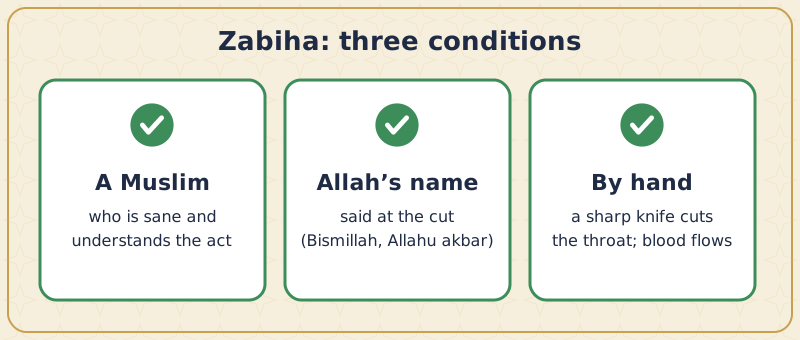
Three conditions
دیکھیں
1. A Muslim slaughterer

The one who slaughters is a sane Muslim who understands what he is doing, man or woman. This is the standard this course follows. (Lesson eight looks at supermarket and kosher meat.)
قرآن سے
Eat what Allah’s name was said over
فَكُلُوا۟ مِمَّا ذُكِرَ ٱسْمُ ٱللَّهِ عَلَيْهِ إِن كُنتُم بِـَٔايَٰتِهِۦ مُؤْمِنِينَ﴿118﴾
118 Eat of that over which the name of Allah hath been mentioned, if ye are believers in His revelations.
لفظ بہ لفظ
Word by word
- فَكُلُوا۟ fakulū to eat · أكل
- مِمَّا mimmā from, of, out of, some of
- ذُكِرَ dhukira to remember, to mention; (dhakkara) to remind · ذكر
- ٱسْمُ usmu name · سمو
- ٱللَّهِ allāhi Allah, God: the proper name of the One God
- عَلَيْهِ ʿalayhi on, upon, over; against; (with a duty) incumbent on
- إِن in if; (in some verses) not
- كُنتُم kuntum to be, was; (kana yaf'al) used to do · كون
- بِـَٔايَٰتِهِۦ biʾāyātihī sign, proof; a verse of the Quran · أيي
- مُؤْمِنِينَ muʾminīna believer · أمن
Eat of that over which the name of Allah hath been mentioned, if ye are believers in His revelations.
قرآن سے
Do not eat what it was not said over
وَلَا تَأْكُلُوا۟ مِمَّا لَمْ يُذْكَرِ ٱسْمُ ٱللَّهِ عَلَيْهِ وَإِنَّهُۥ لَفِسْقٌۭ ۗ وَإِنَّ ٱلشَّيَٰطِينَ لَيُوحُونَ إِلَىٰٓ أَوْلِيَآئِهِمْ لِيُجَٰدِلُوكُمْ ۖ وَإِنْ أَطَعْتُمُوهُمْ إِنَّكُمْ لَمُشْرِكُونَ﴿121﴾
121 And eat not of that whereon Allah's name hath not been mentioned, for lo! it is abomination. Lo! the devils do inspire their minions to dispute with you. But if ye obey them, ye will be in truth idolaters.
دیکھیں
2. Allah’s name at the cut

He says Bismillah, Allahu akbar as he cuts each animal.
- If he deliberately leaves Allah’s name out, the meat is haram.
- If he forgets, the meat is halal.
حدیث سے
Let the blood flow, with Allah’s name
وَعَن رَافع بن خديج قَالَ: قُلْتُ: يَا رَسُولَ اللَّهِ إِنَّا لَاقُوا الْعَدُوَّ غَدًا وَلَيْسَتْ مَعَنَا مُدًى أَفَنَذْبَحُ بِالْقَصَبِ؟ قَالَ: " مَا أَنْهَرَ الدَّمَ وَذُكِرَ اسْمُ اللَّهِ فَكُلْ لَيْسَ السِّنَّ وَالظُّفُرَ وَسَأُحَدِّثُكَ عَنْهُ: أَمَّا السِّنُّ فَعَظْمٌ وَأَمَّا الظُّفُرُ فَمُدَى الْحَبَشِ " وَأَصَبْنَا نَهْبَ إِبِلٍ وَغَنَمٍ فَنَدَّ مِنْهَا بِعِيرٌ فَرَمَاهُ رَجُلٌ بِسَهْمٍ فَحَبَسَهُ فَقَالَ رَسُولُ اللَّهِ صَلَّى اللَّهُ عَلَيْهِ وَسَلَّمَ: «إِنَّ لِهَذِهِ الْإِبِلِ أَوَابِدَ كَأَوَابِدِ الْوَحْشِ فَإِذَا غَلَبَكُمْ مِنْهَا شَيْءٌ فَافْعَلُوا بِهِ هَكَذَا»
Rafi‘ b. Khadij told that he said, “Messenger of God, we shall meet the enemy tomorrow and we have no knives; may we kill animals with canes?”* He replied, “When God’s name is mentioned you may eat what is killed by anything which causes the blood to flow, except tooth and claw. I shall tell you about it. The tooth is a bone and the claw is the knife of the Abyssinians.” We got some camels and sheep as booty, and when one of the camels ran away a man shot an arrow at it and prevented it from escaping, whereupon God’s messenger said, “Among camels there are some which bolt like wild animals, so when any of them get the better of you do thus to them.” (Bukhari and Muslim.)
پڑھیں
3. The cut
The throat has four vessels: the windpipe, the food pipe and the two jugular veins. Abu Hanifah held that cutting at least three of the four is enough. The blood must flow out. The animal is alive when cut.
پڑھیں
Mercy at the knife
Zabiha is also a way of mercy. The Sunnah:
- a sharp knife, sharpened out of the animal's sight;
- do not slaughter one animal in front of another;
- lay it down gently, give it water, do not drag it;
- do not cut the spinal cord or start skinning until it is completely still.
پڑھیں
Forgot to say Bismillah?
- Allah's name forgotten by mistake: the meat is halal. Forgetting is forgiven.
- Allah's name left on purpose: the meat is haram, as the verse forbids.
دیکھیں
Watch: a Zabiha, in order
ترتیب دیں
A Zabiha, in order
انہیں صحیح ترتیب میں لگائیں۔
- A sane Muslim takes a sharp knife
- He lays the animal down gently, facing the qiblah
- He says Bismillah, Allahu akbar
- He cuts at least three of the four vessels
- He lets the blood flow out fully
جواب دکھائیں
Facing the qiblah is sunnah; the name of Allah and the cut are conditions.
ترتیب دیں
Zabiha, or not?
Sort each case by the rules.
Zabiha: halal
- A Muslim hand-slaughters, saying Bismillah, Allahu akbar
- A Muslim forgets to say Allah’s name, by mistake
- Three of the four vessels are cut, and the blood flows
Not Zabiha
- A Muslim deliberately leaves out Allah’s name
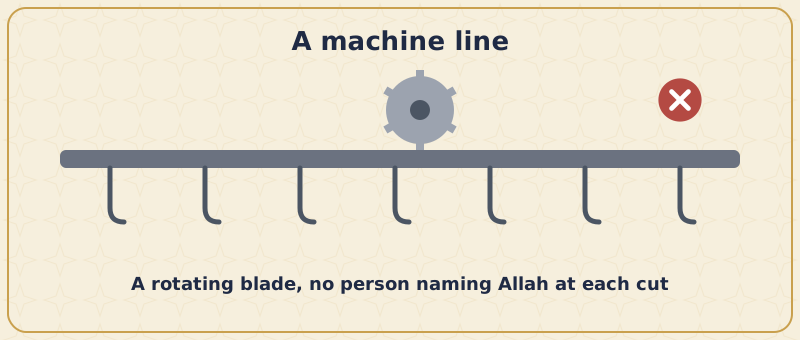
- A machine blade cuts, with a recording of Bismillah playing
- Stunned until it died, then cut
چنیں Which picture is Zabiha?
Which picture shows a Zabiha slaughter?
جواب دکھائیں
A Muslim, Allah’s name at the cut, by hand. A rotating blade with nobody naming Allah at each cut is not accepted by most scholars.
ظاہر کریں
Common mistakes
Think of the right answer first, then flip each card.
- "Chicken is always halal; it's not pork." Chicken is a halal kind. It is halal meat only if slaughtered as Zabiha.
- "If the butcher forgot Bismillah, it's haram." Forgotten by mistake, it is halal. Left on purpose, it is haram.
- "Only men may slaughter." A Muslim woman's slaughter is fully valid.
- "Once the vessels are cut, skin it at once." Wait until it is completely still. Haste is disliked.
سبق مکمل
Zabiha: the conditions
آپ نے اضافہ کیا: ایک چابی — چابیوں کا ایک گچھا جو جمع ہوتا ہے.
آپ نے کیا سیکھا
- Three conditions: a sane Muslim, Allah's name at the cut, three of the four vessels cut.
- Forgotten Bismillah: halal. Left on purpose: haram.
- Mercy: a sharp knife, out of sight of others, wait until it is still.
- مکمل
- 0
- پہلی بار میں درست
- 0
- دہرانے کے لیے
- 0
آپ کا عمل · آج آزمائیں
Ask your butcher today how the meat you buy is slaughtered.
جو آپ نے رکھا
سائن اِن کریں تاکہ آپ کی پیش رفت ہر ڈیوائس پر محفوظ رہے۔