
0 رکھا
منظر میں آئیں
A masjid at Fajr
The first words of every prayer
Fajr. The imam raises his hands, the rows go still, and the same seven verses begin, as they have every dawn for fourteen centuries.
قرآن سے
Al-Fatihah
بِسْمِ ٱللَّهِ ٱلرَّحْمَٰنِ ٱلرَّحِيمِ﴿1﴾ ٱلْحَمْدُ لِلَّهِ رَبِّ ٱلْعَٰلَمِينَ﴿2﴾ ٱلرَّحْمَٰنِ ٱلرَّحِيمِ﴿3﴾ مَٰلِكِ يَوْمِ ٱلدِّينِ﴿4﴾ إِيَّاكَ نَعْبُدُ وَإِيَّاكَ نَسْتَعِينُ﴿5﴾ ٱهْدِنَا ٱلصِّرَٰطَ ٱلْمُسْتَقِيمَ﴿6﴾ صِرَٰطَ ٱلَّذِينَ أَنْعَمْتَ عَلَيْهِمْ غَيْرِ ٱلْمَغْضُوبِ عَلَيْهِمْ وَلَا ٱلضَّآلِّينَ﴿7﴾
1 In the name of Allah, the Beneficent, the Merciful.
2 Praise be to Allah, Lord of the Worlds,
3 The Beneficent, the Merciful.
4 Master of the Day of Judgment,
5 Thee (alone) we worship; Thee (alone) we ask for help.
6 Show us the straight path,
7 The path of those whom Thou hast favoured; Not the (path) of those who earn Thine anger nor of those who go astray.
دیکھیں
Seven verses, three parts
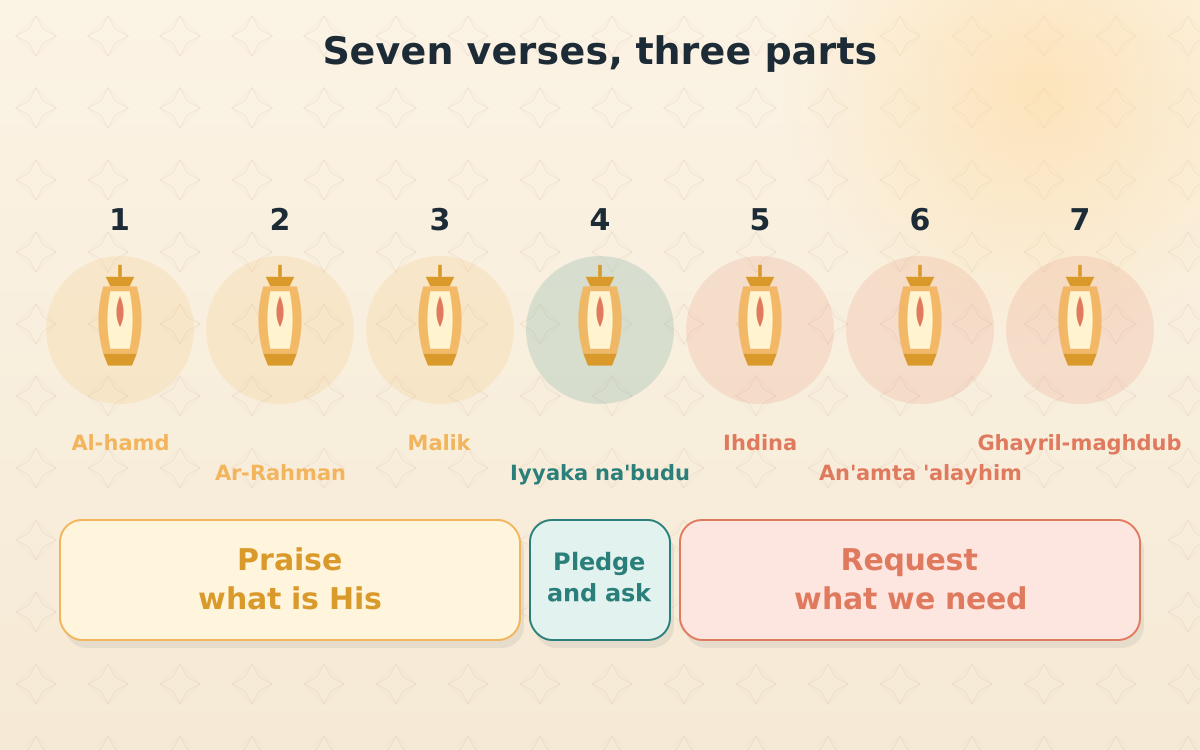
Ma‘arif al-Qur’an notes that al-Fatihah has seven verses. The first three praise Allah. The last three ask Him for something. The one in the middle does both: it is praise and a request at once.
Keep this shape in mind. Every time you pray, you move from praise, to a promise, to asking.
تفسیر
“Seven verses, three parts” in the commentary
ٱلْحَمْدُ لِلَّهِ رَبِّ ٱلْعَٰلَمِينَ﴿2﴾
2 Praise be to Allah, Lord of the Worlds,
The screens before this one tell Ma‘arif al-Qur’an’s commentary on this verse in our own words. Open it to read the commentary itself.
تفسیر پڑھیں Ma'arif al-Qur'an · مفتی محمد شفیع
Ma'arif al-Qur'an معارف القرآن
مفتی محمد شفیع · انگریزی ایڈیشن، مفتی محمد تقی عثمانی کی نگرانی میں نظرثانی شدہ
یہ تفسیر انگریزی میں ہے۔
تفسیر لوڈ ہو رہی ہے…
حدیث سے
The greatest surah
عن أبي سعيد رافع بن المعلى رضي الله عنه قال : قال لي رسول الله صلى الله عليه وسلم :"ألا أعلمك أعظم سورة في القرآن قبل أن تخرج من المسجد؟ فأخذ بيدي ، فلما أردنا أن نخرج قلت : يا رسول الله إنك قلت لأعلمنك أعظم سورة في القرآن ؟ قال: "الحمد لله رب العالمين هي السبع المثاني، والقرآن العظيم الذي أوتيته ". ((رواه البخاري)).
Abu Sa'id Ar-Rafi' bin Al-Mu'alla (May Allah be pleased with him) reported: The Messenger of Allah (ﷺ) said, "Shall I teach you the greatest Surah in the Qur'an before you leave the mosque?" Then he (ﷺ), took me by the hand, and when we were about to step out, I reminded him of his promise to teach me the greatest Surah in the Qur'an. He (ﷺ) said, "It is 'Alhamdu lillahi Rabbil 'Alamin (i.e., Surat Al-Fatihah) which is As-Sab' Al-Mathani (i.e., the seven oft- repeated Ayat) and the Great Qur'an which is given to me."
پڑھیں
What this hadith teaches
In this stored hadith the Prophet ﷺ tells a companion that al-Fatihah is the greatest surah of the Quran, the seven oft-repeated verses. It is short enough for a child, and deep enough for a lifetime.
اندازہ لگائیں
Estimate
Praying the five fard prayers alone, how many times a day do you recite al-Fatihah at the least?
جواب دکھائیں
17 times The five fard prayers have 17 rak‘ahs (2, 4, 4, 3, 4), and al-Fatihah is recited in each, wajib in the first two and sunnah in the rest. Add witr and the sunnah prayers and it is well over 30 times a day.
جگہ کو چھوئیں Find the middle
Tap the lamp that is both praise and request.
جواب دکھائیں
The fourth: the pledge of worship and of asking. Ma‘arif calls it the hinge where the two halves join.
وقت کی لکیر
Where al-Fatihah sits in time
-
Early Makkah
Revealed
Most scholars say al-Fatihah came in Makkah, among the first complete surahs. Some say it was revealed a second time in Madinah.
-
Before the Hijrah
The five prayers
When the five daily prayers were made fard, al-Fatihah became part of every rak‘ah.
-
Today
In every mushaf
It opens the written Quran, which is why it is called the Opening and the mother of the Book.
اس پر غور کریں
Reflect
Which part of al-Fatihah do you usually rush? Write one line about what you would like to feel when you reach it.
یہ صرف آپ دیکھ سکتے ہیں۔ یہ اسی ڈیوائس پر محفوظ ہے۔
پڑھیں
Living with it
You recite al-Fatihah in every rak'ah of every prayer, at least seventeen times a day. It is also read as a cure over the sick. Deed: recite it slowly once today outside the prayer, thinking of its three parts.
ظاہر کریں
Common mistakes
Think of the right answer first, then flip each card.
- "It is just the opening." It is the greatest surah, recited in every rak'ah.
- "I know it, so nothing to learn." Its meaning grows each time you reflect.
سبق مکمل
The mother of the Book
آپ نے اضافہ کیا: ایک صفحہ — مصحف جس کے صفحے پلٹتے ہیں.
آپ نے کیا سیکھا
- The greatest surah.
- Recited in every rak'ah.
- Recite it slowly once today.
- مکمل
- 0
- پہلی بار میں درست
- 0
- دہرانے کے لیے
- 0
آپ کا عمل · آج آزمائیں
In your next salah, pause for one breath after the fourth verse and mean the promise.
جو آپ نے رکھا
سائن اِن کریں تاکہ آپ کی پیش رفت ہر ڈیوائس پر محفوظ رہے۔