
0 رکھا
منظر میں آئیں

Mount Thawr, 622
A cave in the dark
The mouth of a cave on a dark mountain, the stars above. Two men are inside while the search goes past.
پڑھیں
Two men leave by night
In 622 CE Quraysh plotted to kill the Prophet ﷺ. He came to Abu Bakr’s house at an unusual hour and said that Allah had given permission to emigrate.
Abu Bakr (radiyallahu ’anhu) wept for joy that he would be his companion. He had two camels ready, fed for months, waiting for this night.
دیکھیں
Watch: The road to Madinah
راستہ
The road to Madinah
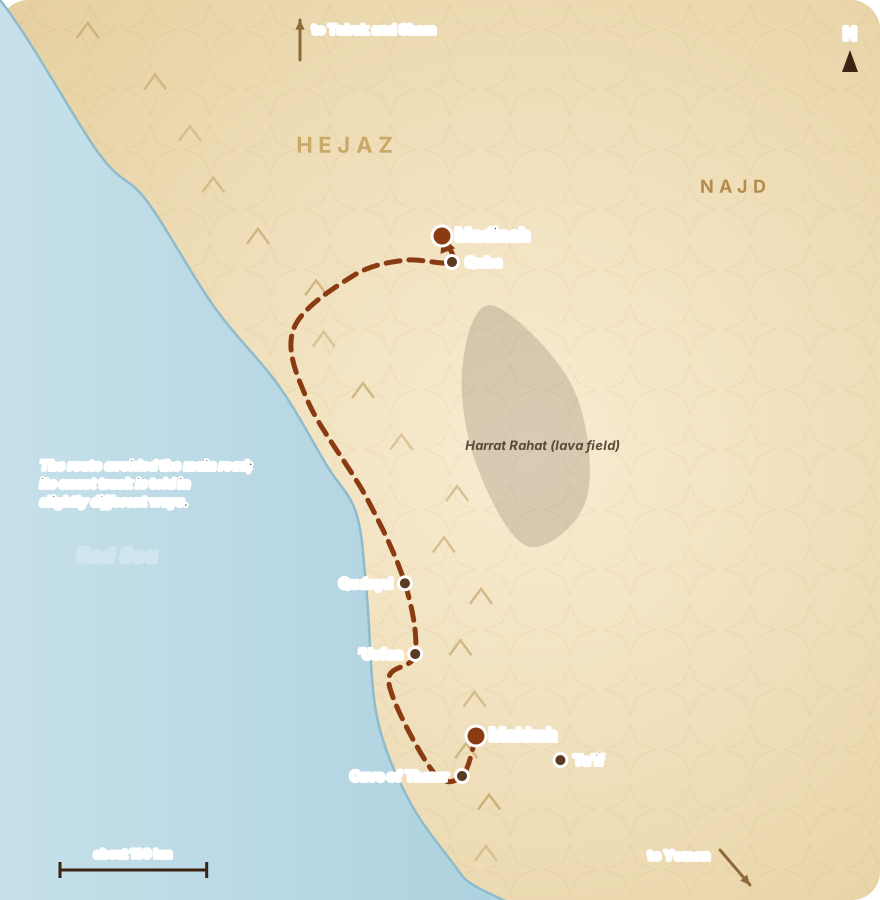
- Makkah They left by night, heading south first to throw off the trackers.
- The cave of Thawr Three nights hiding in a mountain cave south of Makkah.
- The coast road A guide led them north on a road few travellers used.
- Quba The believers of Madinah welcomed them at the edge of the city.
- Madinah The new home of Islam.
The Seerah course “Isra and Mi’raj and the Hijrah” walks this journey in full.
لفظ بہ لفظ
The two in the cave
- إِلَّا illā except, but, only
- تَنصُرُوهُ tanṣurūhu to help, to give victory · نصر
- فَقَدْ faqad (with a past verb) has already, certainly; (with a present verb) sometimes
- نَصَرَهُ naṣarahu to help, to give victory · نصر
- ٱللَّهُ allāhu Allah, God: the proper name of the One God
- إِذْ idh when (in the past); (and remember) when
- أَخْرَجَهُ akhrajahu to go out, to come out; (akhraja) to bring out · خرج
- ٱلَّذِينَ alladhīna those who (masculine plural)
- كَفَرُوا۟ kafarū to disbelieve, to reject; (with ni'ma) to be ungrateful · كفر
- ثَانِىَ thānī
- ٱثْنَيْنِ ithnayni
- إِذْ idh when (in the past); (and remember) when
- هُمَا humā
- فِى fī in, inside; about, concerning
- ٱلْغَارِ al-ghāri
- إِذْ idh when (in the past); (and remember) when
- يَقُولُ yaqūlu to say · قول
- لِصَٰحِبِهِۦ liṣāḥibihī
- لَا lā no, not; (before a command) do not
- تَحْزَنْ taḥzan to grieve, to be sad · حزن
- إِنَّ inna indeed, truly (adds certainty to a sentence)
- ٱللَّهَ allāha Allah, God: the proper name of the One God
- مَعَنَا maʿanā with, together with
- فَأَنزَلَ faʾanzala to send down, to reveal · نزل
- ٱللَّهُ allāhu Allah, God: the proper name of the One God
- سَكِينَتَهُۥ sakīnatahū
- عَلَيْهِ ʿalayhi on, upon, over; against; (with a duty) incumbent on
- وَأَيَّدَهُۥ waʾayyadahū
- بِجُنُودٍۢ bijunūdin soldiers, hosts · جند
- لَّمْ lam did not (makes the following verb past and negative)
- تَرَوْهَا tarawhā to see; (in a question: a-ra'ayta) have you considered? · رأي
- وَجَعَلَ wajaʿala to make, to place, to appoint · جعل
- كَلِمَةَ kalimata word · كلم
- ٱلَّذِينَ alladhīna those who (masculine plural)
- كَفَرُوا۟ kafarū to disbelieve, to reject; (with ni'ma) to be ungrateful · كفر
- ٱلسُّفْلَىٰ as-suflā
- وَكَلِمَةُ wakalimatu word · كلم
- ٱللَّهِ allāhi Allah, God: the proper name of the One God
- هِىَ hī she, it
- ٱلْعُلْيَا al-ʿulyā
- وَٱللَّهُ wallāhu Allah, God: the proper name of the One God
- عَزِيزٌ ʿazīzun Almighty, honoured, unbeatable · عزز
- حَكِيمٌ ḥakīmun All-Wise, wise · حكم
If ye help him not, still Allah helped him when those who disbelieve drove him forth, the second of two; when they two were in the cave, when he said unto his comrade: Grieve not. Lo! Allah is with us. Then Allah caused His peace of reassurance to descend upon him and supported him with hosts ye cannot see, and made the word of those who disbelieved the nethermost, while Allah's Word it was that became the uppermost. Allah is Mighty, Wise.
حدیث سے
In the cave
الثامن: عن أبي بكر الصديق رضي الله عنه عن عبد الله بن عثمان بن عامر بن عمر بن كعب بن سعد بن تيم بن مرة بن كعب بن لؤي بن غالب القرشي التيمي رضي الله عنه - وهو وأبوه وأمه صحابة، رضي الله عنهم- قال: نظرت إلى أقدام المشركين ونحن في الغار وهم على رؤوسنا فقلت يارسول الله لو أن أحدهم نظر تحت قدمية لأبصرنا. فقال: " ما ظنك يا أبا بكر باثنين الله ثالثهما" ((متفق عليه)) .
Abu Bakr As-Siddiq (May Allah be pleased with him) said: When Messenger of Allah (ﷺ) and I were in the cave of Thaur and I saw the feet of the polytheists who were above us at the mouth of the cave (on the eve of the Emigration), I submitted: "O Messenger of Allah! If one of them were to look down below his feet, he would see us". He (ﷺ) said, "O Abu Bakr! What do you think of two whose third is Allah"..
پڑھیں
Never alone
In the cave Abu Bakr feared for the Prophet ﷺ, not for himself. The answer he heard calmed him: Allah was with them. The verse honours him as the Prophet’s ﷺ companion.
When we are afraid, this is the lesson: do your part, as they did with camels, a guide and a hiding place, then trust Allah fully.
ظاہر کریں
Myth or fact?
Decide, then flip each card.
- In the cave, Abu Bakr feared for his own life. Myth. His fear in the cave was for the Prophet ﷺ, not for himself, and he was reassured that Allah was with them.
- His whole household served the Hijrah. Fact. Asma’ brought food, ’Abdullah brought news, and ’Amir ibn Fuhayrah grazed sheep to cover their tracks.
- They went straight north towards Yathrib. Myth. They went south to Thawr first, where no one would look.
ملائیں
A family that served the Hijrah
ہر ایک کو اس کے جوڑے سے ملائیں۔
- Asma’ bint Abi Bakr Carried food to the cave; called “she of the two belts”
- ’Abdullah ibn Abi Bakr Brought the news of Makkah each night
- ’Amir ibn Fuhayrah Grazed sheep over their tracks and brought milk
- ’Abdullah ibn Urayqit The hired guide who knew the desert roads
جواب دکھائیں
His whole household took part. Asma’ tore her waist-belt in two to tie the food bag, so she earned her title.
جگہ کو چھوئیں Find the cave
Tap the cave of Thawr on the map.

جواب دکھائیں
Thawr is south of Makkah, the opposite way from Madinah. The pursuers looked north.
پڑھیں
Three nights in Thawr

They hid in the cave of Thawr for three nights. Abu Bakr’s son ’Abdullah spent the nights near them and slipped back to Makkah before dawn with the news. His freed servant ’Amir ibn Fuhayrah grazed a flock nearby and brought them milk.
A skilled guide, ’Abdullah ibn Urayqit, waited with the camels until the search died down.
Go deeper: the guide
The guide was not a Muslim, yet he was trusted with the camels and the secret road because he was skilled and honest. Trusting Allah never meant refusing honest help from others. They hired the best guide they could find.
ظاہر کریں
Common mistakes
Flip each card: what people often get wrong, and what is right.
- “The Hijrah was a sudden escape.” It was carefully planned: camels fed for months, a guide hired, a hiding place, food and news each night.
- “Trusting Allah means not making plans.” They planned every detail and then trusted Allah completely. The two go together.
- “The pursuers caught up and seized them.” Suraqah ibn Malik did reach them, but his horse sank in the sand again and again. He asked for safety and turned back.
پڑھیں
The road after the cave
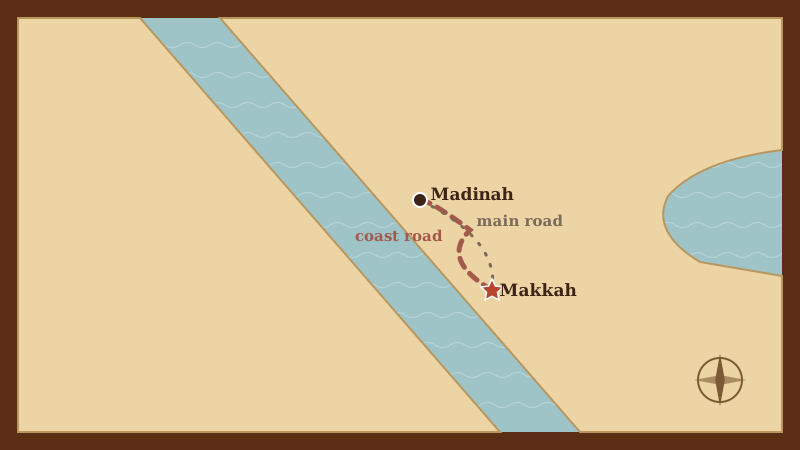
After three nights they left the cave and took a little-used road west to the coast, then north. The biographies tell that Abu Bakr rode sometimes ahead and sometimes behind, guarding his friend from every side.
When people on the road asked who his companion was, he answered that he was a guide showing him the way. It was true: the way to Allah.
Go deeper: the dates
Many reports say they reached Quba on a Monday in Rabi’ al-Awwal, about two weeks after leaving Makkah. The exact days differ between the reports.
پڑھیں
For your life

When you face something frightening, a move, an operation, a hard conversation, follow the Hijrah: plan carefully, ask skilled people for help, then hand the outcome to Allah.
Fear is not a lack of faith. Abu Bakr was afraid in the cave. What matters is where fear sends you: to Allah.
اس پر غور کریں
A heart moment
When did Allah last bring you through something you thought you could not get through? Spend a quiet moment thanking Him for it, as Abu Bakr must have thanked Him at Quba.
یہ صرف آپ دیکھ سکتے ہیں۔ یہ اسی ڈیوائس پر محفوظ ہے۔
پڑھیں
The lesson in three lines
Abu Bakr planned the Hijrah with his whole household and a hired guide. In the cave of Thawr for three nights, Allah was with them. Careful planning and full trust went hand in hand.
سبق مکمل
The companion in the cave
آپ نے اضافہ کیا: ایک ستارہ — ستاروں کا جھرمٹ جو روشن ہوتا ہے، ہر شخص کا ایک ستارہ.
آپ نے کیا سیکھا
- Abu Bakr was the companion in the cave, with Allah as the third.
- مکمل
- 0
- پہلی بار میں درست
- 0
- دہرانے کے لیے
- 0
آپ کا عمل · آج آزمائیں
When you are afraid for someone you love today, make dua for them by name.
جو آپ نے رکھا
سائن اِن کریں تاکہ آپ کی پیش رفت ہر ڈیوائس پر محفوظ رہے۔