
0 kept
Step inside
Fajr's iqamah has started
You walk into the masjid for Fajr as the iqamah begins, and you have not prayed the two sunnah. Do you pray them now? Join the imam? Pray them after?
Look

Sunnah prayers have a few rules of their own. Here they are.
They follow the same steps as a fard, so there is little new to learn. But a few details differ: what you recite, how the four-rak'ah sunnahs sit, where they are best prayed, and which ones can be made up if missed.
Look
How a sunnah differs from a fard
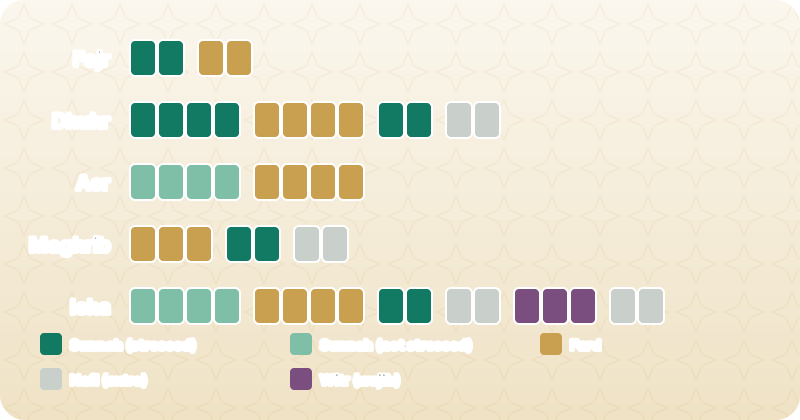
- A surah follows al-Fatihah in every rak'ah.
- The intention is simply "the sunnah of Dhuhr", "the sunnah of Fajr".
- The stressed four (before Dhuhr and Jumu'ah) are prayed like a four-rak'ah fard, with a short first sitting.
- In the unstressed four (before Asr and Isha), many scholars teach adding the salawat in the first sitting and starting the third rak'ah with the thana.
- Recited quietly, except at night, where it may be aloud.
Read
Four-rak'ah sunnahs: two kinds
- The stressed fours (before Dhuhr, before and after Jumu'ah) are prayed like a fard: in the first sitting the tashahhud only, and the third rak'ah starts straight with al-Fatihah.
- The unstressed fours (before Asr and Isha) are like two prayers joined: in the first sitting you may add the salawat and dua, and the third rak'ah may begin with the thana.
From the hadith
Pray your extra prayers at home
عن زيد بن ثابت رضي الله عنه أن النبي صلى الله عليه وسلم قال: "صلوا أيها الناس في بيوتكم، فإن الصلاة صلاة المرء في بيته إلا المكتوبة". ((متفق عليه))
Zaid bin Thabit (May Allah be pleased with him)reported: The Prophet (ﷺ) said, "O people! perform your (voluntary) Salat (prayers) in your homes because the best Salat of a man is the one he performs at home, except the obligatory Salat."
Read
Where, and how far from the fard

Sunnahs and nafl are best at home, as the hadith above teaches: the house is filled with prayer and the children see it. If going home would mean missing them, pray them in the masjid.
When you pray a sunnah right after the fard, move a little from your place, or turn, so the two prayers are clearly separate.
What would you do?
Fajr: the iqamah is called
You arrive as the Fajr iqamah begins. You have not prayed the sunnah. If you pray it quickly, will you still catch the imam in the final sitting?
- Yes, I can still catch himThen pray the sunnah, but not in the rows.
- No, I would miss the whole jama'ahThen join the imam. Leave the sunnah: you may not make it up before sunrise.
Look
Making up the sunnah of Fajr

- If you missed both the sunnah and the fard of Fajr, make up both after sunrise and before midday.
- If you prayed the fard but missed the sunnah, Imam Abu Hanifa held it is not made up; Imam Muhammad said you may pray it after sunrise, before midday.
- Other sunnahs are not made up once their time has gone, except the four before Dhuhr, which may be prayed after the fard.
Read
Which sunnahs are made up
Most missed sunnahs are not made up: their time has gone with the prayer. Two are exceptions:
- Fajr's two: if missed together with the fard, both are made up after sunrise and before midday. Missed alone, many scholars allow them after sunrise, before midday.
- Dhuhr's four before: if the fard was prayed first, pray them after it, after its two sunnahs.
Read
Between the sunnah and the fard
Try not to talk, eat or do business between a sunnah and the fard it belongs to. The sunnah still counts, but its reward is less, as the two are meant to sit together.
After the two sunnahs of Fajr at home, the Prophet ﷺ would lie down a little on his right side before going out for the fard, as the hadith below tells.
From the hadith
A rest on the right side
عن عائشة رضي الله عنها قالت: كان النبي صلى الله عليه وسلم إذا صلى ركعتي الفجر، اضطجع على شقه الأيمن. ((رواه البخاري)).
'Aishah (May Allah be pleased with her) reported: When the Prophet (ﷺ) had performed two Rak'ah before the Fajr prayer, he would lie down on his right side..
Put in order
Dhuhr with its sunnahs
Put these in the right order.
- 4 sunnah
- 4 fard
- 2 sunnah
- 2 nafl (optional)
Show the answer
Four before, four fard, two after, and two extra if you wish.
Fill the gap Fill the gap
In a sunnah or nafl prayer, a surah is added after al-Fatihah in ______.
Show the answer
Every rak'ah of witr, sunnah and nafl has a surah after al-Fatihah.
Reveal
Common mistakes
Think of the right answer first, then flip each card.
- "I pray the sunnah in the same spot, right after the salam." Move a little or turn first, so the sunnah is separate from the fard.
- "I make up every sunnah I miss." Only Fajr's two and Dhuhr's four before have a make-up.
- "Sunnahs are only al-Fatihah after the first two rak'ahs." In every rak'ah of a sunnah a surah follows al-Fatihah.
- "All four-rak'ah sunnahs are the same." The stressed fours are like a fard in their sittings; the unstressed fours have more freedom.
Think about it
Pause and think
Which sunnah could you move from the masjid to your home, so your family sees you pray?
Only you can see this. It is kept on this device.
Lesson finished
Praying a sunnah correctly
You added a rak'ah to a prayer mat that fills, rak'ah by rak'ah.
What you learnt
- A surah after al-Fatihah in every rak'ah of a sunnah.
- Stressed fours sit like a fard; unstressed fours may add the salawat and the thana.
- Best at home; move a little from the place of the fard.
- done
- 0
- right first time
- 0
- to review
- 0
Your deed · Try it today
Pray one sunnah prayer at home today, as the Prophet ﷺ loved to.
What you kept
Sign in to keep your progress on every device.