
0 kept
Step inside
The first words
You raise your hands and say Allāhu akbar: "Allah is greater". With those words the world is put behind you. This is the takbīr al-taḥrīmah, the takbir that makes ordinary actions forbidden until the salam.
Look

Everything you say after it comes from the Quran or from what the Prophet ﷺ taught. Here it is, in order.
Nothing in the prayer is improvised. Each word has a place, a ruling and a meaning, and the opening few seconds set the tone for all that follows. Learn the order once, then learn what each line means, and your first takbir will never feel automatic again.
Read
The opening takbir
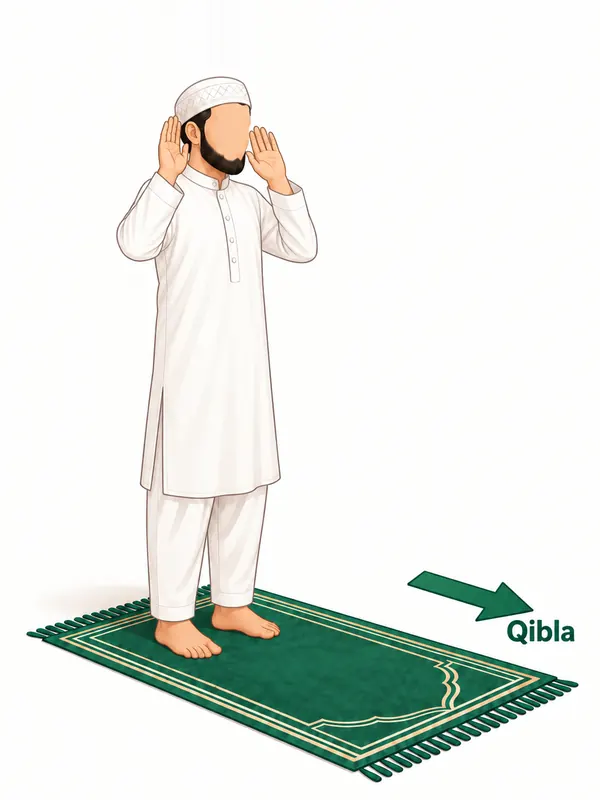
The prayer begins with Allāhu akbar, the takbīr at-taḥrīmah: after it, talking, eating and turning away are forbidden until the salam. It is fard, and in a fard prayer it is said standing.
Say it clearly. Stretching the first vowel ("Ā-llāh") or the last ("akbār") changes the meaning, and the scholars warn it can spoil the prayer. Men raise the hands with the thumbs near the earlobes; women to the shoulders.
Dua
The opening praise (thana)
At the beginning of prayer (Thanā')
سُبْحَانَكَ اللَّهُمَّ وَبِحَمْدِكَ، وَتَبَارَكَ اسْمُكَ، وَتَعَالَى جَدُّكَ، وَلَا إِلَهَ غَيْرُكَ
SubḥānakaLlāhumma wa biḥamdik, wa tabārakasmuK, wa ta'ālā jadduk, wa lā ilāha ghayruk
Glory be to You O Allāh and all praise, blessed is Your name, exalted is Your majesty, and there is no god but You.
Reveal
What the thana means
Think about it first, then open the card.
- What is this dua for? Before asking for anything, you praise. The thana is pure praise of Allah and His majesty, said before a single request. It is said quietly, by the imam, the follower and the one praying alone, in the first rak'ah only.
Read
The thana: who says it, and when
The thana is Sunnah in the first rak'ah of every prayer. The imam says it, the one praying alone says it, and the follower says it too, quietly, as long as the imam has not started reciting aloud.
Forgot it? Carry on: no sajdah sahw is needed for a Sunnah. A latecomer who joins while the imam is reciting aloud leaves it and listens.
Look
Seeking refuge and Bismillah
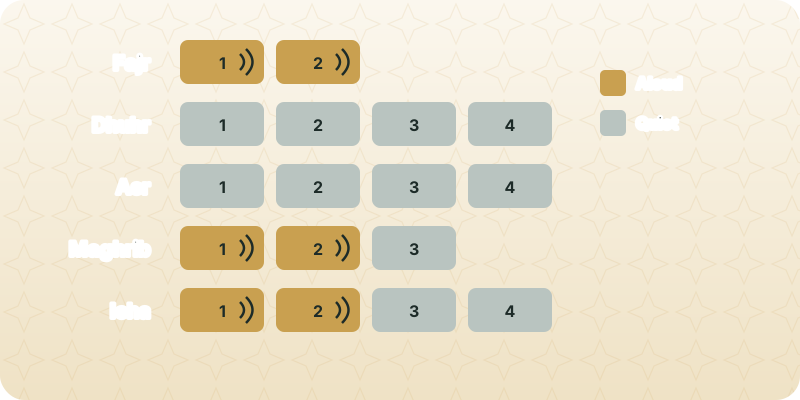
- Ta'awwudh: seeking refuge with Allah from Shaytan, quietly, before reciting, in the first rak'ah. It belongs to recitation, so the silent follower does not say it.
- Basmalah: Bismillāhir-Raḥmānir-Raḥīm, quietly, before al-Fatihah in every rak'ah.
Read
Bismillah, quietly
Say Bismillāhir-raḥmānir-raḥīm quietly before al-Fatihah in every rak'ah. It is a verse of the Quran that separates the surahs, not a verse of al-Fatihah. So it is never said aloud in the prayer, even by an imam in Fajr.
Between al-Fatihah and the surah it may be said, but it is not a Sunnah there.
Go deeper: where the schools differ
The Shafi'i school counts Bismillah as part of al-Fatihah and recites it aloud in the loud prayers. Both are valid ways inside Islam; pray behind either imam with a peaceful heart.
From the Quran
Al-Fatihah, the Opening
بِسْمِ ٱللَّهِ ٱلرَّحْمَٰنِ ٱلرَّحِيمِ﴿1﴾ ٱلْحَمْدُ لِلَّهِ رَبِّ ٱلْعَٰلَمِينَ﴿2﴾ ٱلرَّحْمَٰنِ ٱلرَّحِيمِ﴿3﴾ مَٰلِكِ يَوْمِ ٱلدِّينِ﴿4﴾ إِيَّاكَ نَعْبُدُ وَإِيَّاكَ نَسْتَعِينُ﴿5﴾ ٱهْدِنَا ٱلصِّرَٰطَ ٱلْمُسْتَقِيمَ﴿6﴾ صِرَٰطَ ٱلَّذِينَ أَنْعَمْتَ عَلَيْهِمْ غَيْرِ ٱلْمَغْضُوبِ عَلَيْهِمْ وَلَا ٱلضَّآلِّينَ﴿7﴾
1 In the name of Allah, the Beneficent, the Merciful.
2 Praise be to Allah, Lord of the Worlds,
3 The Beneficent, the Merciful.
4 Master of the Day of Judgment,
5 Thee (alone) we worship; Thee (alone) we ask for help.
6 Show us the straight path,
7 The path of those whom Thou hast favoured; Not the (path) of those who earn Thine anger nor of those who go astray.
Reveal
What does the verse teach?
Think about it first, then open the card.
- Its meaning, in brief Al-Fatihah moves in three steps. It praises Allah for His lordship, His mercy and His judgement. It makes a promise to worship and rely on Him alone. And it asks for guidance on the straight path. It is recited in every rak'ah of every prayer, by the imam or the one alone.
Read
Al-Fatihah, a wajib
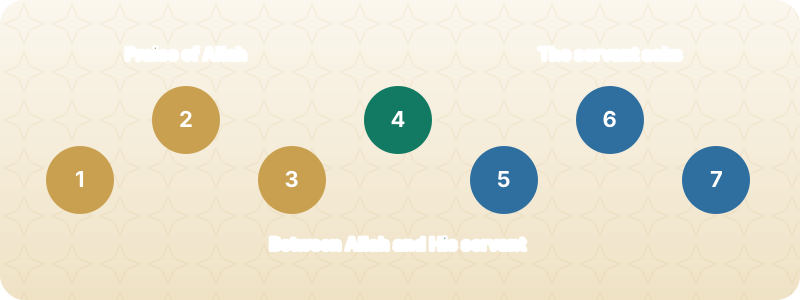
Reciting at least one verse in each of the first two rak'ahs of the fard is the fard of recitation. Reciting al-Fatihah itself is wajib: in the first two rak'ahs of the fard, and every rak'ah of witr, sunnah and nafl.
Left out by mistake? Sajdah sahw repairs it. Recited twice before the surah by mistake? Also sajdah sahw. Learn its letters with a teacher: the ḍ and the 'ayn need care.
From the hadith
Amin, with the angels
وَعَنْ أَبِي هُرَيْرَةَ رَضِيَ اللَّهُ عَنْهُ قَالَ: قَالَ رَسُولُ اللَّهِ صَلَّى اللَّهُ عَلَيْهِ وَسَلَّمَ: " إِذَا أَمَّنَ الْإِمَامُ فَأَمِّنُوا فَإِنَّهُ مَنْ وَافَقَ تَأْمِينُهُ تَأْمِينَ الْمَلَائِكَةِ غُفِرَ لَهُ مَا تقدم من ذَنبه) وَفِي رِوَايَةٍ قَالَ: " إِذَا قَالَ الْإِمَامُ: (غَيْرِ المغضوب عَلَيْهِم وَلَا الضَّالّين) فَقُولُوا: آمِينَ فَإِنَّهُ مَنْ وَافَقَ قَوْلُهُ قَوْلَ الْمَلَائِكَةِ غُفِرَ لَهُ مَا تَقَدَّمَ مِنْ ذَنْبِهِ ". هَذَا لَفْظُ الْبُخَارِيِّ وَلِمُسْلِمٍ نَحْوُهُ وَفِي أُخْرَى لِلْبُخَارِيِّ قَالَ: «إِذَا أَمَّنَ الْقَارِئُ فَأَمِّنُوا فَإِنَّ الْمَلَائِكَةَ تُؤَمِّنُ فَمَنْ وَافَقَ تَأْمِينُهُ تَأْمِينَ الْمَلَائِكَةِ غفر لَهُ مَا تقدم من ذَنبه»
Abu Huraira reported God’s Messenger as saying, “Say Amen when the imam says it, for if anyone’s utterance of Amen synchronises with that of the angels, he will be forgiven his past sins. ’ (Bukhari and Muslim.) In a version he said, “When the imam says, ‘Not of those with whom Thou art angry nor of those who go astray’, say Amen, for if anyone’s words synchronise with those of the angels he will be forgiven his past sins.” This is Bukhari’s wording, and Muslim has something similar. In another version by Bukhari he said, “Say Amen when the reciter (i.e. the imam) says it, for the angels do so, and if anyone’s utterance of Amen synchronises with that of the angels, he will be forgiven his past sins.”
Reveal
What does the hadith teach?
Think about it first, then open the card.
- Amin, quietly After al-Fatihah, say Āmīn ("O Allah, accept"). It is said quietly, by everyone, even when the imam recites aloud.
Put in order
From takbir to the surah
Put these in the right order.
- Opening takbir
- Thana
- Seeking refuge (ta'awwudh)
- Bismillah
- Al-Fatihah
- Amin, quietly
- A surah
Show the answer
Praise first, then refuge, then the Name of Allah, then al-Fatihah, Amin, and a surah.
Choose Check your understanding
In which rak'ah do you say the thana?
Show the answer
The thana opens the prayer, so it is said once, in the first rak'ah. Bismillah is repeated before al-Fatihah in every rak'ah.
Reveal
Common mistakes
Think of the right answer first, then flip each card.
- "I start the takbir while bending for ruku." The opening takbir of a fard is said standing. Said while bowing, it does not open the prayer.
- "Bismillah is said aloud with al-Fatihah." It is always quiet in the prayer.
- "Amin is said aloud behind the imam." Amin is said quietly by everyone.
- "If I miss the thana, I need sajdah sahw." The thana is Sunnah. Missing it needs no repair.
Lesson finished
Opening the prayer
You added a rak'ah to a prayer mat that fills, rak'ah by rak'ah.
What you learnt
- Takbir (fard, standing) → thana (Sunnah) → seeking refuge → Bismillah, quietly → al-Fatihah (wajib) → Amin, quietly → a surah.
- Say Allahu akbar clearly, without stretching its vowels.
- Bismillah is quiet in every rak'ah.
- done
- 0
- right first time
- 0
- to review
- 0
Your deed · Try it today
In your next prayer, say the thana slowly after the opening takbir, knowing what each part means.
What you kept
Sign in to keep your progress on every device.