
0 kept
Step inside
The masjid in Madinah, long ago
Learned by watching
The companions watch and listen closely. A whole way of life is learned from one man ﷺ.
Look
Who taught you to pray?

The Quran tells Muslims to pray many times, but it never lists the steps: how many rak’ahs, what to say in sujud, when to sit. So how does every Muslim know?
From the Prophet ﷺ. He told the Companions to copy the prayer they had watched him pray. What he said, did and showed is called his Sunnah.
From the hadith
Learning salah by watching him
وَعَنْهُ قَالَ: قَالَ لَنَا رَسُولُ اللَّهِ صَلَّى اللَّهُ عَلَيْهِ وَسَلَّمَ: «صَلُّوا كَمَا رَأَيْتُمُونِي أُصَلِّي فَإِذا حضرت الصَّلَاة فليؤذن لكم أحدكُم وليؤمكم أكبركم»
He also told of God's Messenger saying to them, “Pray as you have seen me prayer, and when the time for prayer comes one of you should call the adhan for you and the oldest of you should act as imam.”* * In this tradition the plural is used throughout; in the preceding the dual is used, two persons being referred to. (Bukhari and Muslim.)
Look
Three words

- Hadith: a report of what the Prophet ﷺ said, did or approved, or a description of him.
- Sunnah: his way, the path that the reports show. It also names a ruling: a sunnah act.
- Athar: reports from the Companions and their students.
A hadith is a report; the Sunnah is the way it describes.
Find them
Four kinds of report
Tap the picture to find each part. Each one opens a card.
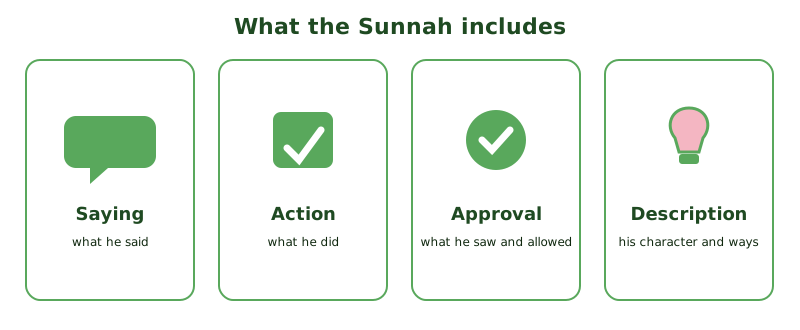
- Saying What he said, such as his teachings and duas.
- Action What he did, such as how he prayed.
- Approval What he saw a Companion do and allowed by staying silent or smiling.
- Description His character, his appearance and his ways.
Look
An approval

Once a roasted lizard was served at a meal. The Prophet ﷺ did not eat it, as it was not food of his people, but Khalid ibn al-Walid ate it while he watched and allowed it.
Even so, it is not eaten (makruh tahrimi), because of other reports: one report is always read beside the rest.
From the hadith
He watched and allowed it
وَعَن ابنِ عبَّاسٍ: أَنَّ خَالِدَ بْنَ الْوَلِيدِ أَخْبَرَهُ أَنَّهُ دَخَلَ مَعَ رَسُولِ اللَّهِ صَلَّى اللَّهُ عَلَيْهِ وَسَلَّمَ عَلَى مَيْمُونَةَ وَهِيَ خَالَتُهُ وَخَالَةُ ابْنِ عَبَّاسٍ فَوَجَدَ عِنْدَهَا ضَبًّا مَحْنُوذًا فَقَدَّمَتِ الضَّبَّ لِرَسُولِ اللَّهِ صَلَّى اللَّهُ عَلَيْهِ وَسَلَّمَ فَرَفَعَ رَسُولُ اللَّهِ صَلَّى اللَّهُ عَلَيْهِ وَسَلَّمَ يَدَهُ عَنِ الضَّبِّ فَقَالَ خَالِدٌ: أَحْرَامٌ الضَّبُّ يَا رَسُولَ اللَّهِ؟ قَالَ: «لَا وَلَكِنْ لَمْ يَكُنْ بِأَرْضِ قَوْمِي فَأَجِدُنِي أَعَافُهُ» قَالَ خَالِدٌ: فَاجْتَرَرْتُهُ فَأَكَلْتُهُ وَرَسُولُ اللَّهِ صَلَّى اللَّهُ عَلَيْهِ وَسَلَّمَ يَنْظُرُ إِلَيّ
Ibn Abbas said he was told by Khalid b. al-Walid that he went with God’s messenger to visit Maimuna who was both his and Ibn 'Abbas's maternal aunt and found that she had a roasted lizard. She offered the lizard to God's messenger, and when he withdrew his hand from it Khalid asked him whether lizards were prohibited. He replied, ''No; but there were none in the land of my people, and I find that I dislike them.'' Khalid said, ''I then chewed and ate it while God’s messenger was looking at me." (Bukhari and Muslim.)
Match Match
Match the word to its meaning
- Hadith A report of the Prophet’s ﷺ words, deeds or approval
- Sunnah His way, which the reports describe
- Athar Reports from the Companions and their students
- Taqrir His silent approval
Show the answer
A hadith is a report of his words, deeds or approvals, the sunnah is the way those reports describe, and athar are reports from those after him. Words for a lifetime of study.
Sort it
Saying, action, approval or description?
Sort each report by its kind.
Saying
- He taught that deeds are judged by their intentions
- He told the companions to pass on even one verse
Action
- He prayed, and the companions copied him
Approval
- A lizard was eaten at his table and he did not forbid it
Description
- His generosity was beyond anyone’s
- He smiled often
Tap the spot Tap the spot
Tap the kind of report shown by the lizard story.
Show the answer
The approval card. He saw it and did not object, which is a taqrir, a silent approval.
Read
In your day
Hadith are the reports; the Sunnah is the way they show. Deed: learn one Sunnah you can do today and do it.
Reveal
Common mistakes
Think of the right answer first, then flip each card.
- "Hadith and Sunnah are unrelated." The reports show the way.
- "Sunnah means optional." It means his way; some is wajib, some extra.
Lesson finished
Hadith, sunnah and athar
You added a flower to a garden that grows.
What you learnt
- Hadith: reports.
- Sunnah: his way.
- One Sunnah today.
- done
- 0
- right first time
- 0
- to review
- 0
Your deed · Try it today
Notice one thing you do today that you learned from a hadith, and thank Allah for those who passed it on.
What you kept
Sign in to keep your progress on every device.