
0 kept
Step inside
Seventeen times a day
In the five daily prayers you say al-Fatihah at least seventeen times. In its middle verse are two present verbs, and you are the one doing them.
From the Quran
We worship, we ask for help
إِيَّاكَ نَعْبُدُ وَإِيَّاكَ نَسْتَعِينُ﴿5﴾
5 Thee (alone) we worship; Thee (alone) we ask for help.
Watch
Watch: two present verbs in al-Fatihah
Word by word
Word by word
- إِيَّاكَ iyyāka
- نَعْبُدُ naʿbudu to worship, to serve · عبد
- وَإِيَّاكَ waʾiyyāka
- نَسْتَعِينُ nastaʿīnu to ask for help, to seek help · عون
Thee (alone) we worship; Thee (alone) we ask for help.
Read
Muḍāriʿ: the present
A present verb (muḍāriʿ) adds a letter in front: ya- he, ta- you or she, a- I, na- we. Naʿbudu, we worship; nastaʿīnu, we ask for help.
The present covers now and the future, and things that go on: we worship, and we keep worshipping.
Look
Who is doing it?
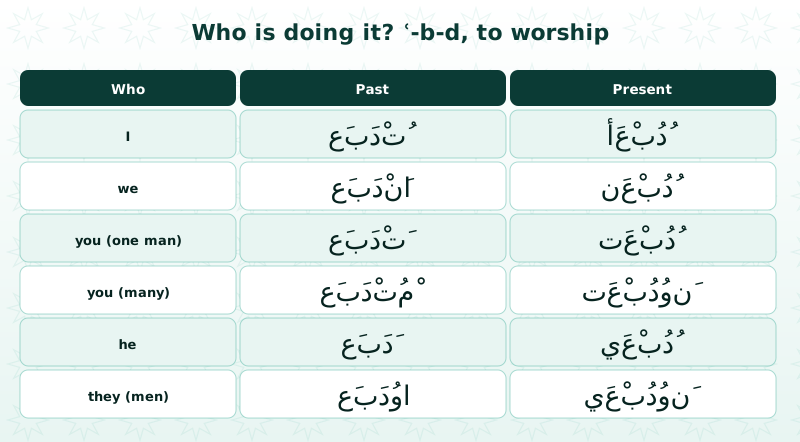
The front letter and the ending say who: aʿbudu, I worship; naʿbudu, we worship; taʿbudu, you worship; yaʿbudu, he worships.
In al-Fatihah you speak as “we”: one worshipper among many.
Tap the spot Tap the spot
Tap “we worship”.
Show the answer
Na'budu: the na- at the front means we, so it means we worship.
Build it
Build it
Build “we worship”
na (we) ʿbud (worship) u (the present’s -u)
Match Match
Match the front letter to who
- a- I
- na- we
- ta- you (or she)
- ya- he
Show the answer
Four front letters, easy to remember: a, na, ta, ya.
Choose Check
Why do you say “we” in al-Fatihah, even praying alone?
Show the answer
Scholars note the humility and unity in “we”: you stand with all who worship Allah.
True or false True or false?
Naʿbudu is a present verb.
Show the answer
True. Na- at the front and -u at the end mark a present verb.
Lesson finished
The present: we do, we ask
You added a page to a mushaf whose pages turn.
What you learnt
- A front letter makes the present: a-, na-, ta-, ya-.
- done
- 0
- right first time
- 0
- to review
- 0
Your deed · Try it today
At 1:5 in your next salah, feel the “we”: you are one of many worshippers.
What you kept
Sign in to keep your progress on every device.