
0 kept
Step inside
The Prophet’s ﷺ household, Madinah
Children of a widow
Four small children come with their mother into a new home. She worries about every coin she spends on them.
Look
Children of a widow

Umm Salamah (radiyallahu ’anha) came into the Prophet’s ﷺ home with her children. He cared for them as his own.
Her daughter Zaynab, the Prophet’s ﷺ stepdaughter, grew up to be a scholar too.
From the hadith
Spending on her children
وعن أم سلمة رضي الله عنها قالت: قلت يارسول الله، هل لي أجر في بني أبي سلمة أن أنفق عليهم، ولست بتاركتهم هكذا وهكذا إنما هم بني؟ فقال: " نعم لك أجر ما أنفقت عليهم" ((متفق عليه)).
Umm Salamah (May Allah be pleased with her) reported: I asked Messenger of Allah (ﷺ), "Would I be rewarded for what I spend on Abu Salamah's sons? For I can't let them go here and there (to beg people)." Messenger of Allah (ﷺ) replied, "Spend on them and you will be rewarded for what you spend on them"..
Look
Reward in every coin

She asked whether she would be rewarded for spending on Abu Salamah’s children. She was told yes.
Single parents and step-parents: every meal and every school bill for the children in your care is sadaqah.
Guess
Four children
How many children did Umm Salamah bring from her marriage to Abu Salamah?
Show the answer
4 children Four: Salamah, ’Umar, Zaynab and Durrah, all raised in the Prophet’s ﷺ house.
Match
Umm Salamah’s family
Match each one with its pair.
- Abu Salamah Her first husband, died 4 AH
- Salamah Her son, after whom she was named
- Zaynab bint Abi Salamah Her daughter, a later scholar
- The Prophet ﷺ Married her in 4 AH
Show the answer
Abu Salamah was her first husband, who died in 4 AH, Salamah was her son, and Zaynab bint Abi Salamah her daughter. Umm Salamah means mother of Salamah.
Fill the gap Fill the gap
Umm Salamah means “mother of ______”.
Show the answer
Her own name was Hind bint Abi Umayyah.
Choose Check
Was Umm Salamah rewarded for spending on her children?
Show the answer
Yes. Spending on your own children is rewarded, even though it is also a duty.
Read
Manners taught at the table
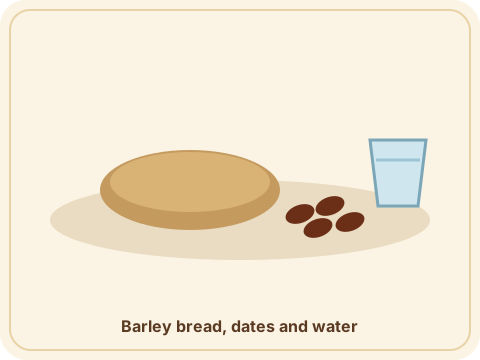
The Prophet ﷺ raised Umm Salamah’s children in his home. Al-Bukhari reports that he gently taught her son ’Umar three table manners: begin with Allah’s name, use the right hand, and take from the side of the dish nearest you.
Go deeper: her children
Her children were Salamah, ’Umar, Zaynab and Durrah. ’Umar ibn Abi Salamah later narrated hadith and served as a governor under ’Ali.
Reveal
Common mistakes
Flip each card: what people often get wrong, and what is right.
- “Stepchildren matter less.” The Prophet ﷺ raised hers as his own.
- “Spending on your family is not charity.” It is rewarded, as Umm Salamah was told.
- “Orphans only need money.” They need love, teaching and time.
Read
Blended families

Many families today join children from earlier marriages. The Sunnah shows the way: fairness, patience, gentle teaching, and respect for the parent who has gone.
Read
For your life

If you are a step-parent, or raising someone else’s child, teach them gently, as the Prophet ﷺ taught ’Umar ibn Abi Salamah, and speak well of their late parent.
Think about it
A heart moment
Who in your family needs more of your time, not your money? Give it to them this week.
Only you can see this. It is kept on this device.
Read
The lesson in three lines
Umm Salamah came into the Prophet’s ﷺ home with four young children. He raised them and taught them gently. She was told she was rewarded for every coin spent on them.
Lesson finished
A mother of orphans
You added a star to a constellation that lights up, one star per person.
What you learnt
- Umm Salamah raised her orphans and was rewarded for every coin spent on them.
- done
- 0
- right first time
- 0
- to review
- 0
Your deed · Try it today
Spend on your family today with the intention of reward.
What you kept
Sign in to keep your progress on every device.