
0 kept
Step inside
Is it allowed to...?
Is it allowed to play football? Drink coffee? Learn to code? New Muslims sometimes think every action needs a special permission.
Read
The principle is the other way round: in daily life, things are permitted unless there is evidence they are forbidden.
From the hadith
Do what you can
عَنْ أَبِي هُرَيْرَةَ عَبْدِ الرَّحْمَنِ بْنِ صَخْرٍ رَضِيَ اللهُ عَنْهُ قَالَ: سَمِعْت رَسُولَ اللَّهِ صلى الله عليه و سلم يَقُولُ: مَا نَهَيْتُكُمْ عَنْهُ فَاجْتَنِبُوهُ، وَمَا أَمَرْتُكُمْ بِهِ فَأْتُوا مِنْهُ مَا اسْتَطَعْتُمْ، فَإِنَّمَا أَهْلَكَ الَّذِينَ مِنْ قَبْلِكُمْ كَثْرَةُ مَسَائِلِهِمْ وَاخْتِلَافُهُمْ عَلَى أَنْبِيَائِهِمْ .<br>[رَوَاهُ الْبُخَارِيُّ] ،[وَمُسْلِمٌ]
On the authority of Abu Hurayrah (ra): I heard the Messenger of Allah (ﷺ) say, “What I have forbidden for you, avoid. What I have ordered you [to do], do as much of it as you can. For verily, it was only the excessive questioning and their disagreeing with their Prophets that destroyed [the nations] who were before you.”
Read
The rulings in a line
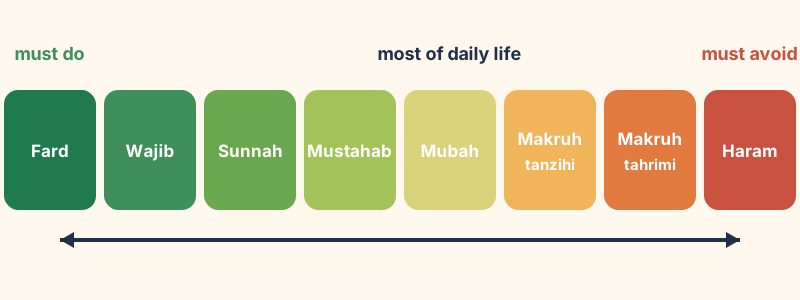
Most of daily life sits in the middle: mubah.
Find them
The scale of rulings
Explore the picture: find all 8 points.
- Fard Obligatory by clear proof: the five prayers, Ramadan. Denying it is disbelief; leaving it is a grave sin.
- Wajib Required, a step below fard: witr, sadaqat al-fitr. Leaving it is a sin.
- Sunnah The Prophet's ﷺ regular practice: rewarded, and blameworthy to abandon as a habit.
- Mustahab Recommended: rewarded, no sin if left.
- Mubah Permitted: most of daily life. Neutral, and rewarded with a good intention.
- Makruh tanzihi Mildly disliked: better avoided, no sin.
- Makruh tahrimi Strongly disliked, close to haram: sinful to do.
- Haram Forbidden by clear proof: alcohol, riba, backbiting.
Watch
Watch: The scale of rulings
Read
Mubah: most of life

Football, coffee, coding, gardening, painting, a walk in the park: all mubah. You need no proof to do them.
With a good intention, they even become rewarded: exercise for health, work for your family, a walk to clear your head before prayer.
Match
Where on the scale?
Match each one with its pair.
- The five daily prayers Fard
- Witr Wajib
- Drinking coffee Mubah
- Drinking alcohol Haram
Show the answer
Most of life sits in the wide middle: permitted, and rewarded with a good intention.
Read
Two kinds of makruh

There are two kinds of disliked acts. Makruh tahrimi is close to haram and sinful to do, like praying while the sun is rising. Makruh tanzihi is lighter: better left, but not a sin, like praying with sleeves rolled up for no reason.
When a teacher says "makruh", it is fine to ask which kind.
Go deeper: wajib and fard
Fard, proven by evidence that leaves no doubt, is told apart from wajib, proven by strong but less certain evidence. Both must be done; denying a fard is disbelief, while leaving a wajib is a sin.
Reveal
Common mistakes
Flip each card.
- "Everything needs a proof that it is allowed." Daily things are allowed unless proven forbidden.
- Treating sunnah as fard and judging others A missed sunnah is a lost reward, not a sin.
- Treating makruh as nothing Makruh tahrimi is close to haram; leave it.
Tap the spot Find mubah
Tap where 'playing football' belongs on the scale.
Show the answer
Sport is mubah: permitted. With the intention of keeping healthy, it is rewarded.
Read
A moment for the heart
Allah made the forbidden list short and the permitted world wide. Every time you enjoy something halal, a walk, a meal, a game with your children, you are enjoying His generosity.
Thank Him for the wide door, and walk through it with a good intention.
Reveal
In one line
Sum up the lesson in your own words first, then tap to check.
- The lesson in one line Rulings run from fard and wajib through sunnah and mubah to makruh and haram; most of daily life is mubah, allowed by default.
Lesson finished
Halal by default, and the scale of rulings
You added a ray of light to a sunrise that brightens lesson by lesson.
What you learnt
- done
- 0
- right first time
- 0
- to review
- 0
Your deed · Try it today
Next time you wonder “is this allowed?”, start from the principle: allowed unless there is proof it is not, then check with a teacher.
What you kept
Sign in to keep your progress on every device.