
0 kept
Step inside
A letter with no year
In the time of 'Umar ibn al-Khattab ( radiyallahu 'anhu ), letters were arriving dated only by month: "Sha'ban". But which Sha'ban? The Muslim state was growing and needed a clear count of years.
Look
The choice

'Umar consulted the Companions. They chose to count from the year of the Hijrah, when the Prophet ﷺ and the believers moved from Makkah to Madinah and the first Muslim community was built.
The first year of the calendar, 1 AH (after Hijrah), began with Muharram in 622 CE. The calendar was adopted around 17 AH (638 CE); reports differ slightly on the exact year.
Timeline
How the calendar began
-
622 CE
The Hijrah
The Prophet ﷺ reaches Madinah in Rabi' al-Awwal of the year that becomes 1 AH.
-
1 Muharram, 1 AH
Year one begins
The count starts from the beginning of that Hijri year.
-
about 17 AH / 638 CE
'Umar's decision
The Companions agree on the Hijri count of years.
-
Today
1447 and 1448 AH
The year 1448 AH begins in June 2026.
Look
Why Muharram first?
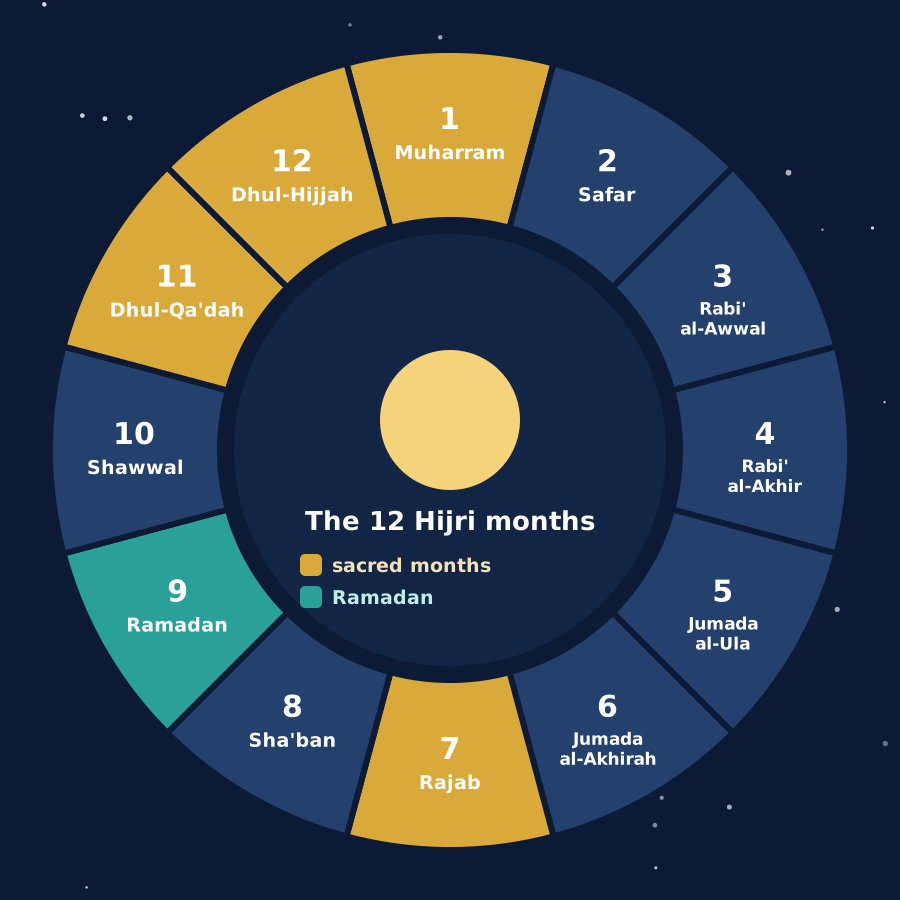
Muharram was already the first month for the Arabs, and it comes after the Hajj, when people return home and a new year of work begins. The Hijrah itself happened in Rabi' al-Awwal, but the year was counted from its start.
Look
A calendar that travels
Fill the gap Fill the gap
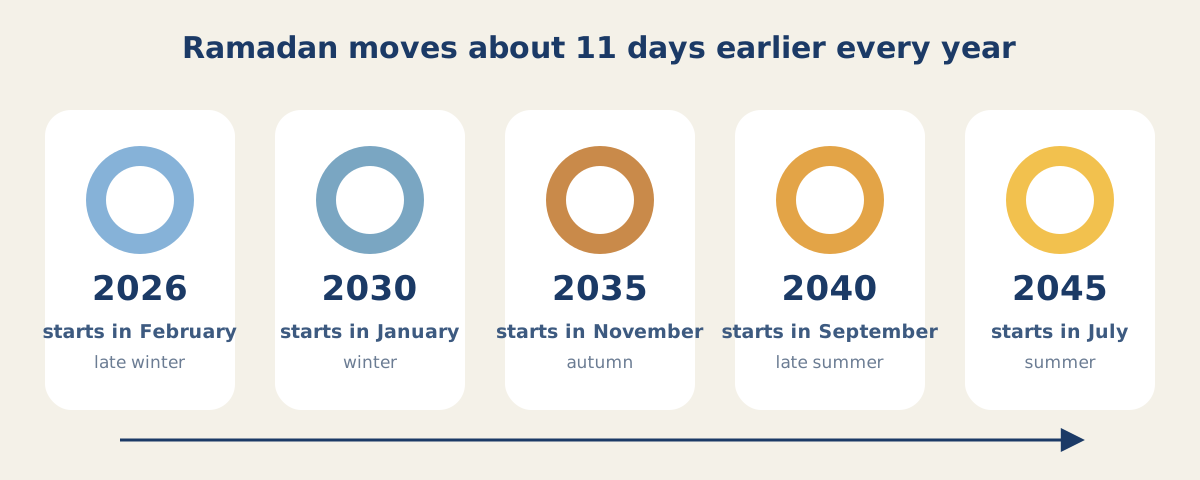
A Hijri year has about ______ days, so Ramadan moves earlier every year.
Show the answer
354 or 355 days: twelve months of 29 or 30 days. That is why Ramadan passes through winter and summer over about 33 years, so every Muslim fasts in every season.
Choose Check your understanding
Why did the Companions count the years from the Hijrah?
Show the answer
They chose the Hijrah because it marked the start of the Muslim community and state in Madinah. The birth and first revelation were also considered, but the Hijrah was agreed on.
Read
Hijri dates in your own life

Use the Hijri date for the things that are worship: your zakat day, the start of Ramadan, the days you vowed to fast, a widow's iddah counted in months.
Many families also note the Hijri date of births and nikahs. Write "AH" after a Hijri year, as in 1448 AH.
Think about it
Pause and think
The Hijrah, a journey of trust in Allah, opens every Muslim year. What would you like to leave behind this year?
Only you can see this. It is kept on this device.
True or false True or false?
The Hijri calendar counts from the year of the Prophet's ﷺ birth.
Show the answer
It counts from the year of the Hijrah to Madinah, chosen in the time of 'Umar.
Reveal
Common mistakes
Think of the right answer first, then flip each card.
- "The Islamic year starts with Ramadan." It starts with Muharram.
- "The calendar starts at the Prophet's ﷺ birth." It starts from the year of the Hijrah.
- "Hijri dates are only for scholars." Zakat, fasting and the iddah run on them for everyone.
Lesson finished
Why the count starts from the Hijrah
You added a month to a moon that waxes through the months.
What you learnt
- The calendar counts from the Hijrah, chosen in the time of 'Umar.
- Muharram is the first month.
- Use Hijri dates for zakat, fasts and the iddah.
- done
- 0
- right first time
- 0
- to review
- 0
Your deed · Try it today
Find today’s Hijri date and write it at the top of your next note or letter.
What you kept
Sign in to keep your progress on every device.