
0 kept
Step inside

A study circle by lamplight
A message passed hand to hand
Scrolls, an inkwell and a book under the stars. Every word on these pages came to us through people who checked it.
Look
A message passed hand to hand

Think of a precious letter carried across the world, hand to hand, each carrier signing their name. That is how a hadith reaches you.
The first hands were the companions. They heard the Prophet ﷺ, memorised his words, and passed them on.
Explore the picture
A chain of narrators

- The Prophet ﷺ He said or did something.
- A companion Saw or heard it, and remembered.
- A student A tabi’i, of the next generation, learnt it.
- Teachers Each passed it on by name.
- A collector Al-Bukhari, Muslim and others wrote it in books.
- Our books Riyad as-Salihin and Mishkat gather from them.
Read
The <em>isnad</em>
The list of names is the isnad, the chain. Scholars checked every name: was this person honest, was their memory strong, did they really meet the one before?
No other religion’s history was checked this carefully, name by name.
From the hadith
Hear, keep and pass on
وَعَنِ ابْنِ مَسْعُودٍ قَالَ: قَالَ رَسُولُ اللَّهِ صَلَّى اللَّهُ عَلَيْهِ وَسَلَّمَ: «نَضَّرَ اللَّهُ عَبْدًا سَمِعَ مَقَالَتِي فَحَفِظَهَا وَوَعَاهَا وَأَدَّاهَا فَرُبَّ حَامِلِ فِقْهٍ غَيْرِ فَقِيهٍ وَرُبَّ حَامِلِ فِقْهٍ إِلَى مَنْ هُوَ أَفْقَهُ مِنْهُ. ثَلَاثٌ لَا يَغِلُّ عَلَيْهِنَّ قَلْبُ مُسْلِمٍ إِخْلَاصُ الْعَمَلِ لِلَّهِ وَالنَّصِيحَةُ لِلْمُسْلِمِينَ وَلُزُومُ جَمَاعَتِهِمْ فَإِنَّ دَعْوَتَهُمْ تُحِيطُ مِنْ ورائهم» . رَوَاهُ الشَّافِعِي وَالْبَيْهَقِيّ فِي الْمدْخل وَرَوَاهُ أَحْمَدُ وَالتِّرْمِذِيُّ وَأَبُو دَاوُدَ وَابْنُ مَاجَهْ وَالدَّارِمِيُّ عَنْ زَيْدِ بْنِ ثَابِتٍ. إِلَّا أَنَّ التِّرْمِذِيّ وَأَبا دواد لَمْ يَذْكُرَا: «ثَلَاثٌ لَا يَغِلُّ عَلَيْهِنَّ» . إِلَى آخِره
Ibn Mas'ud reported God’s messenger as saying, “God brighten a man who hears what I say, gets it by heart, retains it, and passes it on to others! Many a bearer of knowledge is not versed in it, and many a bearer of knowledge conveys it to one who is more versed than he is. There are three things on account of which no rancour enters a Muslim's heart: sincere action for God’s sake, good counsel to Muslims, and holding fast to their community, for their invitation includes those who are beyond them.” Shafi‘i transmitted it, also Baihaqi in al-Madkhal. Ahmad, Tirmidhi, Abu Dawud, Ibn Majah and Darimi transmitted it from Zaid b. Thabit, but Tirmidhi and Abu Dawud did not mention, “There are three things on account of which no rancour enters..." to the end.
Watch
Watch: Four carriers of knowledge
Light the stars
Four carriers of knowledge
Tap each star.
- Abu Hurayrah radiyallahu ’anhu
- ’Abdullah ibn Mas’ud radiyallahu ’anhu
- ’Abdullah ibn ’Abbas radiyallahu ’anhuma
- Zayd ibn Thabit radiyallahu ’anhu
Match
Four scholars of the companions
Match each one with its pair.
- Abu Hurayrah Narrated the most hadith
- Ibn Mas’ud Master of the Quran, teacher of Kufah
- Ibn ’Abbas Interpreter of the Quran
- Zayd ibn Thabit Scribe of the revelation
Show the answer
Each carried a different part of the Prophet’s ﷺ legacy.
Put in order
Order the chain
Put these in the right order.
- The Prophet ﷺ
- A companion
- A student of the companion
- A collector of hadith
- A book you can read today
Show the answer
From the Prophet ﷺ to a companion, a student, a collector of hadith, and a book you can read today. Every link was checked, so we know where each word came from.
Read
Why the chain matters

Without the chain, anyone could say "the Prophet ﷺ said" and add whatever they liked. The early scholar ’Abdullah ibn al-Mubarak said the isnad is part of the religion for exactly this reason.
The chain lets us ask: who said this, and can we trust each person who passed it on?
Go deeper: grades, lightly
Scholars sort reports as sound (sahih), good (hasan) or weak (da’if), and reject the ones that were made up. You do not need the details. Just ask where a hadith comes from and how the scholars graded it.
Reveal
Common mistakes
Flip each card: what people often get wrong, and what is right.
- “Anything that begins ‘the Prophet ﷺ said’ is a hadith.” Many sayings shared that way are weak or made up. Ask for the source.
- “Hadith were only written down two centuries later.” Companions and their students memorised and wrote from the start. The great books gathered what had already been carefully kept.
- “A weak hadith is a lie.” Weak means the chain is not strong enough to be sure. It is not the same as invented.
Read
The first link: the companions
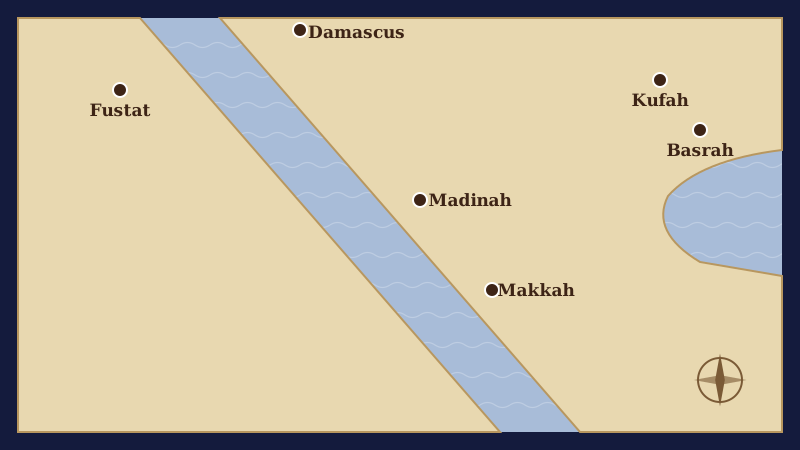
Ahl as-Sunnah hold that every companion is trustworthy in passing on what the Prophet ﷺ said. They lived with him, loved him and feared lying about him.
So scholars checked the names after them, generation by generation, from Madinah to Kufah to Damascus.
Read
For your life
Before you forward a hadith, ask: which book is it in, and how is it graded? If you do not know, ask someone who does, or do not share it.
A good habit: name the book every time you share a hadith.
Think about it
A heart moment
Every hadith you know reached you through people who cared enough to check it, one after another, for fourteen centuries. Make dua for them now.
Only you can see this. It is kept on this device.
Read
The lesson in three lines
A hadith reaches us through an isnad, a chain of named narrators. The companions were its first link, and scholars checked every name after them. We share hadith with their source, and ask before we share what we are unsure of.
Lesson finished
How knowledge reached us
You added a star to a constellation that lights up, one star per person.
What you learnt
- Knowledge reached us through checked chains of people, starting with the companions.
- done
- 0
- right first time
- 0
- to review
- 0
Your deed · Try it today
Learn one hadith today and its source.
What you kept
Sign in to keep your progress on every device.