
Running a Halal Business · Beginner · Lesson 2/3 A niyyah and a plan

Step inside

A kitchen table, late

The notebook

Amina has a recipe for spiced chutneys that everyone loves. Tonight she opens a notebook and writes at the top: "Bismillah. My business." What comes next?

Look

Intention first, then numbers

A clipboard, a calculator and a small plant: planning a business

A business started for Allah’s sake aims to provide halal, serve people and give. Then come the numbers: what it costs to start, what it costs each month, and how long before it pays its way. Many good businesses fail only because they ran out of money before they found their customers.

Build it

Build it

Build a simple business plan, in order.

  1. Make your niyyah
  2. Find who needs what you make
  3. Work out start-up and monthly costs
  4. Find halal money to start
  5. Open small, learn, then grow

Watch

Watch: Work it out

Watch 0:52

Work it out

Work it out

How long can your savings carry the business?

  • Start-up costs (equipment, stock)
  • Halal money available
  • Monthly costs (rent, stock, bills)
  • Expected sales in the first months
  1. Left after start-up
  2. Monthly shortfall
  3. Months you can last

Tap the spot Tap the month

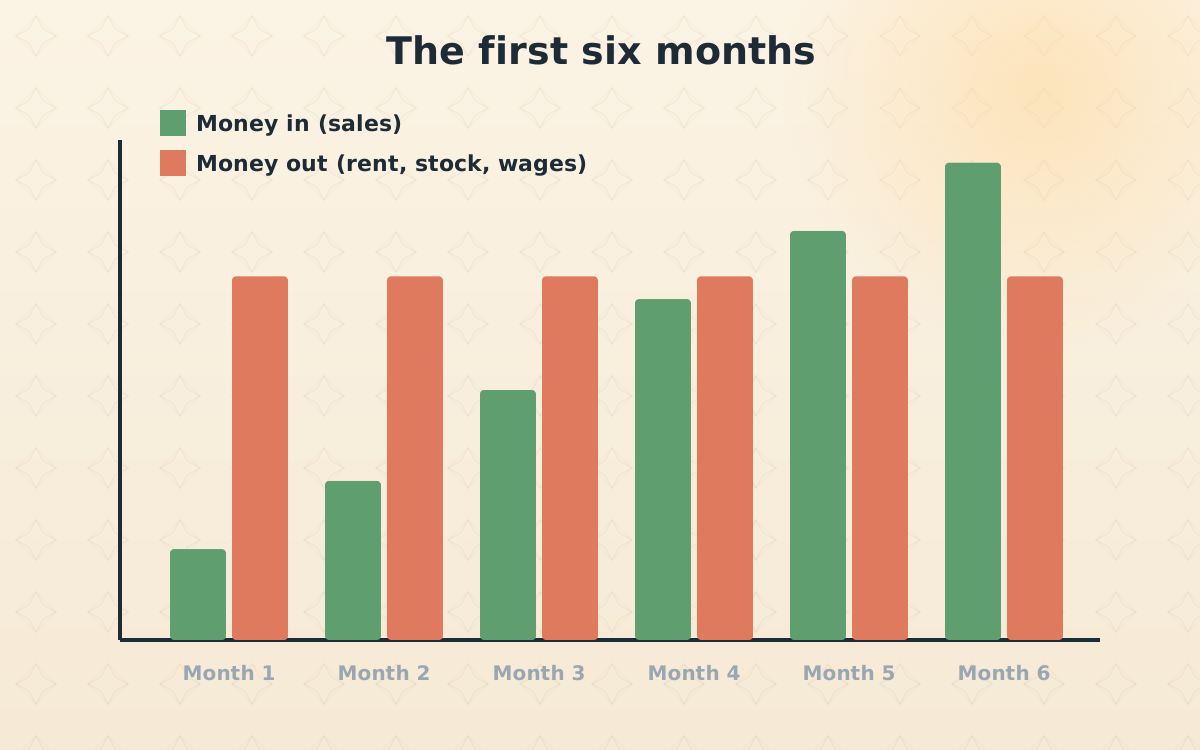
In this chart, when does money in first reach money out? Tap that month.

A cash-flow chart for the first six months of a small business. Money in from sales grows each month. Money out for rent, stock and wages stays the same. From month five the business pays its way
Show the answer

Month 5. Before that the business needs savings to cover the gap; that is why the plan matters.

From the hadith

Blessing in the morning

وعن صخر بن وداعة الغامدي الصحابي رضي الله عنه أن رسول الله صلى الله عليه وسلم قال: “اللهم بارك لأمتي في بكورها" وكان إذا بعث سرية أو جيشاً بعثهم من أول النهار. وكان صخر تاجراً فكان يبعث تجارته أول النهار، فأثري وكثر ماله” ((رواه أبو داود والترمذي وقال: حديث حسن)).

Sakhr bin Wada'ah Al-Ghamidi (May Allah be pleased with him) reported: The Messenger of Allah (ﷺ) said, "O Allah! Bless my people in the early part of the day (morning). Whenever he dispatched a detachment or an army-unit, he would dispatch it at the beginning of the day (soon after dawn). The narrator, Sakhr (May Allah be pleased with him) was a merchant, and he used to send off his merchandise at the beginning of the day. So his trade flourished and he made a good fortune..

Related by Abu Dawud and at-Tirmidhi, who said: a hasan hadith (رواه أبو داود والترمذي وقال: حديث حسن) · Hasan

Choose Check

Amina has £3,000 and her plan needs £8,000. What is the wisest halal step?

  • Start smaller, or bring in a partner who shares profit and loss
  • Take a credit card loan at interest
  • Give up the idea
Show the answer

Smaller, or a musharakah partner. Riba is not a way to start a blessed business.

Read

A simple plan

A business plan

Write: what you sell, who buys it, what it costs, how you will fund it (halal capital), and your cash for six months.

Intention first: to provide halal, to serve people, to give charity.

True or false True or false?

A business plan should include how it is funded without riba.

TrueFalse
Show the answer

True. Halal capital from the start.

Choose Check your understanding

What comes first in a halal business plan?

  • A sincere intention and halal funding
  • A loan with interest
  • Advertising
Show the answer

Intention and halal foundation.

Reveal

Common mistakes

Flip each card.

  • Starting with an interest loan Find halal capital first.

Lesson finished

A niyyah and a plan

You added a key to a set of keys collected.

What you learnt

  • Intention first, then a plan.
  • Halal capital.
  • Six months of cash.

Your deed · Try it today

Write your business niyyah and the three biggest costs of your idea.

Sign in to keep your progress on every device.