
0 kept
Step inside
A café his mother loves
The café
A month after swearing never to go back, his mother asks to meet at that very café.
Look
The café

Zaid swore, “Wallahi, I’ll never eat at that café again.” A month later his mother wants to meet him there for her birthday.
From the hadith
Do the better, and expiate
وَعَنْ أَبِي هُرَيْرَةَ أَنَّ رَسُولَ اللَّهِ صَلَّى اللَّهُ عَلَيْهِ وَسَلَّمَ قَالَ: «مَنْ حَلَفَ عَلَى يَمِينٍ فَرَأَى خَيْرًا مِنْهَا فَلْيُكَفِّرْ عَنْ يَمِينِهِ وليفعل» . رَوَاهُ مُسلم
Abu Huraira reported God’s Messenger as saying, "If anyone swears an oath and considers something else to be better than it he should make atonement for his oath and do that.” Muslim transmitted it.
From the Quran
The expiation of an oath
لَا يُؤَاخِذُكُمُ ٱللَّهُ بِٱللَّغْوِ فِىٓ أَيْمَٰنِكُمْ وَلَٰكِن يُؤَاخِذُكُم بِمَا عَقَّدتُّمُ ٱلْأَيْمَٰنَ ۖ فَكَفَّٰرَتُهُۥٓ إِطْعَامُ عَشَرَةِ مَسَٰكِينَ مِنْ أَوْسَطِ مَا تُطْعِمُونَ أَهْلِيكُمْ أَوْ كِسْوَتُهُمْ أَوْ تَحْرِيرُ رَقَبَةٍۢ ۖ فَمَن لَّمْ يَجِدْ فَصِيَامُ ثَلَٰثَةِ أَيَّامٍۢ ۚ ذَٰلِكَ كَفَّٰرَةُ أَيْمَٰنِكُمْ إِذَا حَلَفْتُمْ ۚ وَٱحْفَظُوٓا۟ أَيْمَٰنَكُمْ ۚ كَذَٰلِكَ يُبَيِّنُ ٱللَّهُ لَكُمْ ءَايَٰتِهِۦ لَعَلَّكُمْ تَشْكُرُونَ﴿89﴾
89 Allah will not take you to task for that which is unintentional in your oaths, but He will take you to task for the oaths which ye swear in earnest. The expiation thereof is the feeding of ten of the needy with the average of that wherewith ye feed your own folk, or the clothing of them, or the liberation of a slave, and for him who findeth not (the wherewithal to do so) then a three days' fast. This is the expiation of your oaths when ye have sworn; and keep your oaths. Thus Allah expoundeth unto you His revelations in order that ye may give thanks.
Word by word
Word by word
- لَا lā no, not; (before a command) do not
- يُؤَاخِذُكُمُ yuʾākhidhukumu
- ٱللَّهُ allāhu Allah, God: the proper name of the One God
- بِٱللَّغْوِ billaghwi
- فِىٓ fī in, inside; about, concerning
- أَيْمَٰنِكُمْ aymānikum right hand, right side; an oath (plural ayman) · يمن
- وَلَٰكِن walākin but, however
- يُؤَاخِذُكُم yuʾākhidhukum
- بِمَا bimā what, that which, whatever
- عَقَّدتُّمُ ʿaqqadttumu
- ٱلْأَيْمَٰنَ al-ʾaymāna right hand, right side; an oath (plural ayman) · يمن
- فَكَفَّٰرَتُهُۥٓ fakaffāratuhū one who disbelieves or rejects · كفر
- إِطْعَامُ iṭʿāmu
- عَشَرَةِ ʿasharati
- مَسَٰكِينَ masākīna
- مِنْ min from, of, out of, some of
- أَوْسَطِ awsaṭi
- مَا mā what, that which, whatever
- تُطْعِمُونَ tuṭʿimūna
- أَهْلِيكُمْ ahlīkum people (of), family, inhabitants · أهل
- أَوْ aw or
- كِسْوَتُهُمْ kiswatuhum
- أَوْ aw or
- تَحْرِيرُ taḥrīru
- رَقَبَةٍۢ raqabatin
- فَمَن faman who, whoever, the one who
- لَّمْ lam did not (makes the following verb past and negative)
- يَجِدْ yajid to find · وجد
- فَصِيَامُ faṣiyāmu
- ثَلَٰثَةِ thalāthati three · ثلث
- أَيَّامٍۢ ayyāmin days (plural of yawm) · يوم
- ذَٰلِكَ dhālika that (pointing to something further away)
- كَفَّٰرَةُ kaffāratu one who disbelieves or rejects · كفر
- أَيْمَٰنِكُمْ aymānikum right hand, right side; an oath (plural ayman) · يمن
- إِذَا idhā when, whenever; (idhan) then, in that case
- حَلَفْتُمْ ḥalaftum
- وَٱحْفَظُوٓا۟ waḥfaẓū
- أَيْمَٰنَكُمْ aymānakum right hand, right side; an oath (plural ayman) · يمن
- كَذَٰلِكَ kadhālika that (pointing to something further away)
- يُبَيِّنُ yubayyinu to make clear, to explain · بين
- ٱللَّهُ allāhu Allah, God: the proper name of the One God
- لَكُمْ lakum for, to, belonging to (a one-letter word joined to the next)
- ءَايَٰتِهِۦ āyātihī sign, proof; a verse of the Quran · أيي
- لَعَلَّكُمْ laʿallakum so that perhaps, that you may
- تَشْكُرُونَ tashkurūna to give thanks, to be grateful · شكر
Allah will not take you to task for that which is unintentional in your oaths, but He will take you to task for the oaths which ye swear in earnest. The expiation thereof is the feeding of ten of the needy with the average of that wherewith ye feed your own folk, or the clothing of them, or the liberation of a slave, and for him who findeth not (the wherewithal to do so) then a three days' fast. This is the expiation of your oaths when ye have sworn; and keep your oaths. Thus Allah expoundeth unto you His revelations in order that ye may give thanks.
Look
The kaffarah of an oath
Look
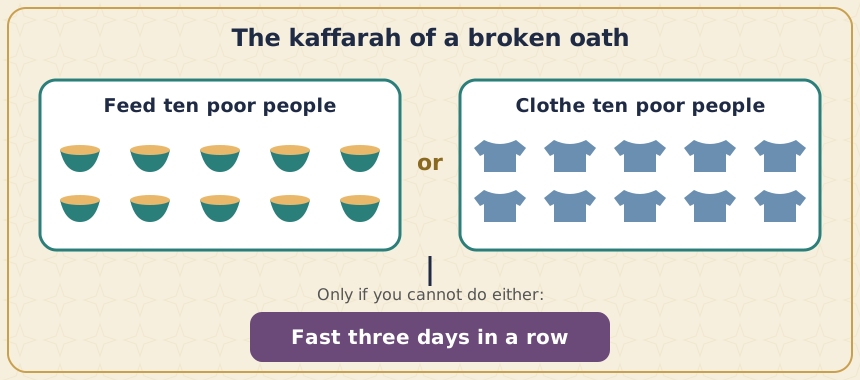
The kaffarah, in order

- Feed ten poor people two full meals each, of the kind your family eats, or give each the value of half a sa’ of wheat; or clothe ten poor people with a garment each.
- Only if you cannot do either: fast three days in a row. (Three days in a row is the rule.)
The kaffarah comes after the oath is broken, not before.
Read
Feeding, in practice

There are three easy ways to feed ten:
- serve ten poor people two full meals each, lunch and dinner, of the kind you normally eat;
- or give each of the ten the value of one sadaqat al-fitr;
- or feed one poor person on ten days.
Zaid chose the easiest: he gave a local food bank run by the masjid the value of ten sadaqat al-fitr, asking them to give it to ten poor people.
Read
Three days of fasting: only if unable

Fasting three days in a row is only for someone who cannot afford to feed or clothe ten. A wealthy person who fasts instead has not paid the kaffarah.
The three days must be consecutive: a missed day restarts them. The kaffarah comes after the oath is broken, not before.
A student with no savings beyond her needs may fast the three days; her employed brother, who can afford it, must feed or clothe ten.
Watch
Watch: Work out the kaffarah
Work it out
Work out the kaffarah
Feed ten poor people, or clothe ten; only if you cannot, fast three days in a row.
- Can you afford to feed or clothe ten?
- Value of feeding one poor person (two meals, or the sadaqat al-fitr value)
- Give to ten poor people
- Or, only if unable: fast in a row
Count it
Zaid’s kaffarah
Feeding ten poor people
- The first Zaid gives a poor neighbour lunch and dinner, the kind of food his family eats.
- Halfway Five people fed. He could also feed one poor person on ten different days; that counts.
- Done Ten fed. The kaffarah is complete. He keeps the broken oath in mind and swears less.
Feed or clothe ten. Fasting is only for those who cannot.
Put in order
Zaid’s steps
Put these in the right order.
- He sees it is better to go with his mother
- He goes, breaking the oath
- He feeds or clothes ten poor people
- He resolves to swear less
Show the answer
He sees going with his mother is better, goes, breaking the oath, then feeds or clothes ten poor people. Do the better thing, then expiate.
Tap the spot The last step
Tap the kaffarah allowed only for someone who cannot feed or clothe ten.
Show the answer
Fasting three days in a row comes only after feeding and clothing are impossible.
True or false True or false?
A wealthy man who breaks an oath may simply fast three days.
Show the answer
Fasting is only for one who cannot feed or clothe ten poor people.
Reveal
Common mistakes
Think of the right answer first, then flip each card.
- "I'll just fast three days; it's easier." Fasting is only for those unable to feed or clothe ten.
- "Feeding means one meal for ten." Two full meals each, or the value of sadaqat al-fitr each.
- "I'll pay the kaffarah first, then break the oath." The kaffarah comes after the oath is broken.
- "Keeping a bad oath is more pious." If breaking it is better, break it and expiate.
Lesson finished
Breaking an oath: the kaffarah
You added a key to a set of keys collected.
What you learnt
- Break an oath if the better lies in breaking it.
- Kaffarah: feed ten (two meals each, or their value) or clothe ten.
- Only if unable: three days of fasting in a row.
- done
- 0
- right first time
- 0
- to review
- 0
Your deed · Try it today
If you owe the kaffarah of an oath, pay it this week.
What you kept
Sign in to keep your progress on every device.