
0 kept
Step inside
Where were you?
You finish Asr and realise you spent all four rak'ahs planning dinner. The body prayed; the heart went shopping. Every Muslim knows this feeling.
Look
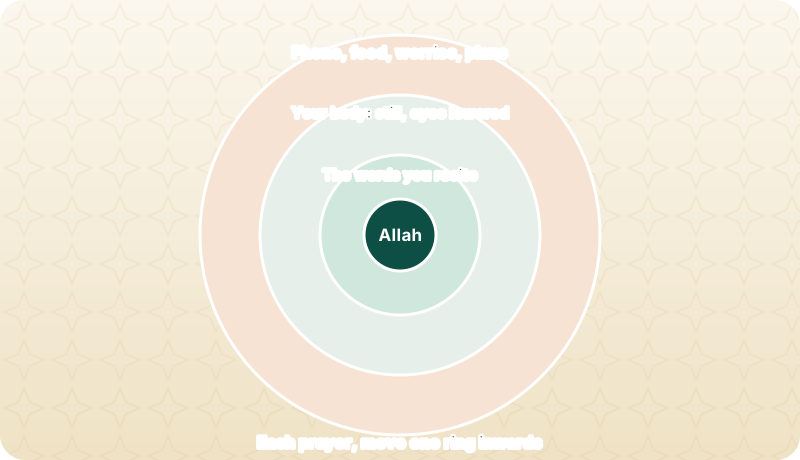
Khushū' is the cure: a heart that is present and humble before Allah, and a body that is calm and still because of it.
It is not a special feeling that comes to a few. It is a skill every Muslim can grow, one prayer at a time, with simple steps: before the prayer, in the eyes, in the body, in the words and in the heart. This course walks through each.
From the Quran
The successful believers
بِسْمِ ٱللَّهِ ٱلرَّحْمَٰنِ ٱلرَّحِيمِ قَدْ أَفْلَحَ ٱلْمُؤْمِنُونَ﴿1﴾ ٱلَّذِينَ هُمْ فِى صَلَاتِهِمْ خَٰشِعُونَ﴿2﴾
1 Successful indeed are the believers
2 Who are humble in their prayers,
Reveal
What the verses teach
Think about it first, then open the card.
- What does the verse teach? Success, real success, begins with prayer done with humility. The verses do not say "those who pray" but those who are humble in prayer. The quality of the prayer is what Allah praises.
From the hadith
To worship as though you see Him
عَنْ عُمَرَ رَضِيَ اللهُ عَنْهُ أَيْضًا قَالَ: بَيْنَمَا نَحْنُ جُلُوسٌ عِنْدَ رَسُولِ اللَّهِ صلى الله عليه و سلم ذَاتَ يَوْمٍ، إذْ طَلَعَ عَلَيْنَا رَجُلٌ شَدِيدُ بَيَاضِ الثِّيَابِ، شَدِيدُ سَوَادِ الشَّعْرِ، لَا يُرَى عَلَيْهِ أَثَرُ السَّفَرِ، وَلَا يَعْرِفُهُ مِنَّا أَحَدٌ. حَتَّى جَلَسَ إلَى النَّبِيِّ صلى الله عليه و سلم . فَأَسْنَدَ رُكْبَتَيْهِ إلَى رُكْبَتَيْهِ، وَوَضَعَ كَفَّيْهِ عَلَى فَخِذَيْهِ، وَقَالَ: يَا مُحَمَّدُ أَخْبِرْنِي عَنْ الْإِسْلَامِ. فَقَالَ رَسُولُ اللَّهِ صلى الله عليه و سلم الْإِسْلَامُ أَنْ تَشْهَدَ أَنْ لَا إلَهَ إلَّا اللَّهُ وَأَنَّ مُحَمَّدًا رَسُولُ اللَّهِ، وَتُقِيمَ الصَّلَاةَ، وَتُؤْتِيَ الزَّكَاةَ، وَتَصُومَ رَمَضَانَ، وَتَحُجَّ الْبَيْتَ إنْ اسْتَطَعْت إلَيْهِ سَبِيلًا. قَالَ: صَدَقْت . فَعَجِبْنَا لَهُ يَسْأَلُهُ وَيُصَدِّقُهُ! قَالَ: فَأَخْبِرْنِي عَنْ الْإِيمَانِ. قَالَ: أَنْ تُؤْمِنَ بِاَللَّهِ وَمَلَائِكَتِهِ وَكُتُبِهِ وَرُسُلِهِ وَالْيَوْمِ الْآخِرِ، وَتُؤْمِنَ بِالْقَدَرِ خَيْرِهِ وَشَرِّهِ. قَالَ: صَدَقْت. قَالَ: فَأَخْبِرْنِي عَنْ الْإِحْسَانِ. قَالَ: أَنْ تَعْبُدَ اللَّهَ كَأَنَّك تَرَاهُ، فَإِنْ لَمْ تَكُنْ تَرَاهُ فَإِنَّهُ يَرَاك. قَالَ: فَأَخْبِرْنِي عَنْ السَّاعَةِ. قَالَ: مَا الْمَسْئُولُ عَنْهَا بِأَعْلَمَ مِنْ السَّائِلِ. قَالَ: فَأَخْبِرْنِي عَنْ أَمَارَاتِهَا؟ قَالَ: أَنْ تَلِدَ الْأَمَةُ رَبَّتَهَا، وَأَنْ تَرَى الْحُفَاةَ الْعُرَاةَ الْعَالَةَ رِعَاءَ الشَّاءِ يَتَطَاوَلُونَ فِي الْبُنْيَانِ. ثُمَّ انْطَلَقَ، فَلَبِثْتُ مَلِيًّا، ثُمَّ قَالَ: يَا عُمَرُ أَتَدْرِي مَنْ السَّائِلُ؟. قُلْتُ: اللَّهُ وَرَسُولُهُ أَعْلَمُ. قَالَ: فَإِنَّهُ جِبْرِيلُ أَتَاكُمْ يُعَلِّمُكُمْ دِينَكُمْ . [رَوَاهُ مُسْلِمٌ]
Also on the authority of `Umar (ra) who said: While we were one day sitting with the Messenger of Allah (ﷺ) there appeared before us a man dressed in extremely white clothes and with very black hair. No traces of journeying were visible on him, and none of us knew him. He sat down close by the Prophet (ﷺ) rested his knees against the knees of the Prophet (ﷺ) and placed his palms over his thighs, and said: "O Muhammad! Inform me about Islam." The Messenger of Allah (ﷺ) replied: "Islam is that you should testify that there is no deity worthy of worship except Allah and that Muhammad is His Messenger (ﷺ), that you should perform salah (ritual prayer), pay the zakah, fast during Ramadan, and perform Hajj (pilgrimage) to the House (the Ka`bah at Makkah), if you can find a way to it (or find the means for making the journey to it)." He said: "You have spoken the truth." We were astonished at his thus questioning him (ﷺ) and then telling him that he was right, but he went on to say, "Inform me about Iman (faith)." He (the Prophet) answered, "It is that you believe in Allah and His angels and His Books and His Messengers and in the Last Day, and in fate (qadar), both in its good and in its evil aspects." He said, "You have spoken the truth." Then he (the man) said, "Inform me about Ihsan." He (the Prophet) answered, "It is that you should serve Allah as though you could see Him, for though you cannot see Him yet He sees you." He said, "Inform me about the Hour." He (the Prophet) said, "About that the one questioned knows no more than the questioner." So he said, "Well, inform me about its signs." He said, "They are that the slave-girl will give birth to her mistress and that you will see the barefooted ones, the naked, the destitute, the herdsmen of the sheep (competing with each other) in raising lofty buildings." Thereupon the man went off. I waited a while, and then he (the Prophet) said, "O `Umar, do you know who that questioner was?" I replied, "Allah and His Messenger know better." He said, "That was Jibril. He came to teach you your religion."
Reveal
What does the hadith teach?
Think about it first, then open the card.
- The highest level In this hadith Jibril asks about iḥsān, excellence. The answer: worship Allah as though you see Him; and if you cannot reach that, know that He sees you. That second step is where khushu begins. You may not feel Him, but you know He is watching.
Read
Two sides: the body and the heart
Khushu has an outside and an inside.
- Outside: still hands, eyes resting low, no fidgeting, every position settled.
- Inside: knowing Whom you stand before, understanding what you say, humility.
Read
Valid, but how full?

A prayer said with a wandering mind is still valid: the duty is done. But its reward follows your presence. The scholars say a person may leave the prayer with half of it, a quarter, or a tenth, depending on how present they were.
So never stop praying because your mind wanders. Pray, and aim to take a little more of each prayer home with you.
Go deeper: khushu and the wajibs
Some parts of khushu are rulings, not only feelings. Stillness in each position is wajib, and turning the face to look around is disliked. So the outside of khushu is partly a duty; the inside is the growing, lifelong part.
Sort it
Body and heart
Sort each card: Khushu of the body, or Khushu of the heart?
Khushu of the body
- Still hands, no fidgeting
- Eyes resting low
Khushu of the heart
- Knowing Allah sees you
- Understanding what you recite
Guess
Seventeen conversations
How many times a day do you recite al-Fatihah in the five fard prayers alone?
Show the answer
17 times Seventeen: once in every fard rak'ah. That is seventeen chances a day to speak to Allah and be answered, before any sunnah is counted.
Read
Signs to look for

How do you know khushu is growing? Not by tears alone. Look for small signs:
- you remember what you recited;
- you notice when your mind drifts, and come back;
- you are in no hurry to finish;
- you leave the mat calmer than you came.
Choose Check your understanding
Is a prayer without full concentration valid?
Show the answer
A prayer with its pillars and conditions is valid. Khushu decides how much of it rises and is rewarded. Do not repeat prayers because of wandering thoughts; work on the next one.
Fill the gap Fill the gap
Ihsan is to worship Allah as though you see Him, and if not, to know that ______.
Show the answer
Knowing He sees you is the first step of khushu.
Reveal
Common mistakes
Think of the right answer first, then flip each card.
- "Without khushu my prayer doesn't count, so why bother?" It counts. Keep praying; khushu grows inside the prayers you keep.
- "Khushu means crying every time." It means presence and humility. Tears may come, or not.
- "Khushu is only in the heart." The body is half of it: stillness and the eyes at rest.
- "Only the pious can have khushu." It is a skill, practised step by step by anyone.
Think about it
Pause and think
Think of your last prayer. For how much of it were you really there? What took you away?
Only you can see this. It is kept on this device.
Lesson finished
What khushu is
You added a rak'ah to a prayer mat that fills, rak'ah by rak'ah.
What you learnt
- Khushu: a present, humble heart and a calm, still body.
- The prayer is valid without it; its reward follows your presence.
- Seventeen Fatihahs a day: seventeen conversations.
- done
- 0
- right first time
- 0
- to review
- 0
Your deed · Try it today
In your next prayer, remember for one rak‘ah that you stand before Allah, who sees you.
What you kept
Sign in to keep your progress on every device.