
0 kept
Step inside
A family round the table
The family round the table
A wife, a son, a daughter, his mother and father, and two brothers: who receives a share?
Look
The family round the table

Yusuf’s father left a wife, a son, a daughter, his own mother and father, and two brothers. Who inherits, and who does not?
Family tree
Yusuf’s father’s family
- His fatherInherits
- The deceasedYusuf’s father
- Yusuf, his sonInherits
- His daughterInherits
- His brotherExcluded by his son
- His second brotherExcluded by his son
- The deceasedYusuf’s father
- His motherInherits
- His wifeInherits
Look
Five who are never left out

Five heirs always receive something when they are alive: the husband or wife, the son, the daughter, the father and the mother.
Other relatives, such as brothers, sisters, uncles and grandchildren, inherit only when nearer heirs do not block them. A son blocks the brothers. That is why Yusuf’s uncles receive nothing here.
Read
Two kinds of heir

- Sharers (ashab al-furud) receive a fixed fraction named in the Quran or Sunnah.
- Residuaries (’asabah) take what is left, nearest first: sons, then grandsons through sons, then the father, then brothers, and so on.
Go deeper: blocking
Blocking (hajb) means a nearer heir keeps a farther one out. The son and the father block brothers and sisters entirely.
The five never left out, spouse, son, daughter, father and mother, can see their share reduced by others, but never removed.
Read
Nearer blocks farther

Within the same line, a nearer relative blocks a farther one:
- a son blocks the deceased's brothers, sisters and grandsons;
- the father blocks the grandfather and the brothers and sisters;
- the mother blocks the grandmothers.
So before asking "what does the uncle get?", ask "who is nearer than him?" The answer often settles the question.
Read
Adopted, step and in-law
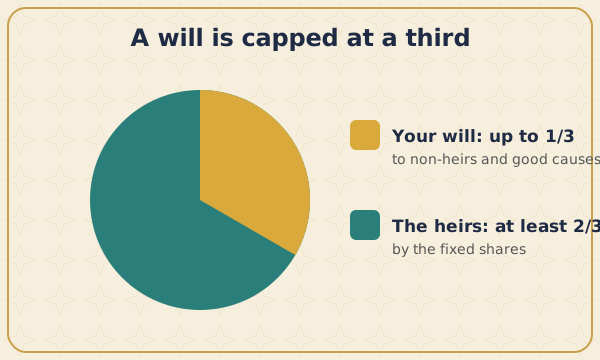
A will can also name a step-child's or adopted child's guardian, so they are cared for as well as provided for.
Match
Inherits here?
Match each one with its pair.
- His wife Yes: a sharer
- His mother Yes: a sharer
- Yusuf, his son Yes: a residuary
- His brother No: blocked by the son
Show the answer
The wife, the mother and the son inherit, while the brother is blocked by the son. Nearer heirs block farther ones.
Look

Sort it
Sharer, residuary or blocked?
Sort each relative of Yusuf’s father.
A sharer: a fixed fraction
- His wife
- His mother
- His father
A residuary: takes what is left
- Yusuf, his son
- His daughter
Blocked here
- His two brothers
True or false True or false?
A daughter can be blocked from inheriting by her uncle.
Show the answer
A daughter is one of the five who are never left out.
Think about it
Pause and think
Every name on the family tree is someone Allah has given a right. Whose rights in your own family do you need to remember and protect?
Only you can see this. It is kept on this device.
Reveal
Common mistakes
Think of the right answer first, then flip each card.
- "The eldest son takes everything." Every heir takes the share Allah named.
- "The brother always inherits." A son or the father blocks him.
- "My adopted daughter is my heir." She does not inherit, but you may leave her up to a third by will.
- "Daughters can be blocked by uncles." Daughters are never blocked.
Lesson finished
Who inherits
You added a key to a set of keys collected.
What you learnt
- Five are never left out: husband or wife, father, mother, son, daughter.
- Sharers take fractions; residuaries take what is left.
- Nearer heirs block farther ones in the same line.
- done
- 0
- right first time
- 0
- to review
- 0
Your deed · Try it today
Draw your own family tree and mark who would be a sharer.
What you kept
Sign in to keep your progress on every device.