Calligraphy and the Scripts · Beginner · Lesson 3/3 Naskh, the script you read

Step inside

Your own room

A printed mushaf

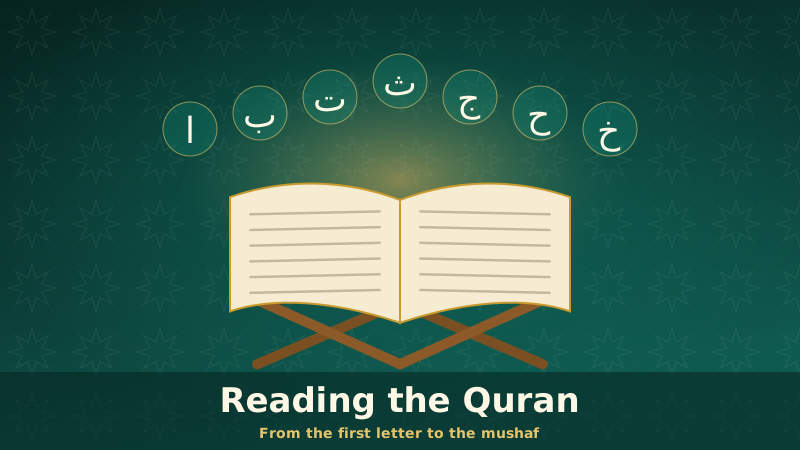
You open the mushaf on your shelf. The letters are round, clear and even. They are almost certainly written in Naskh.

Look

Clear and rounded

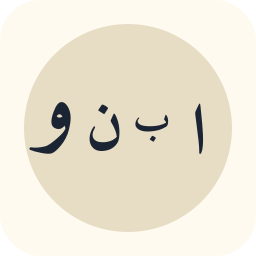
The letters alif, ba, nun and waw in the Naskh style: clear and rounded: the script you read
Naskh means "copying". It is round, clear and easy to read, which is why most printed mushafs and books use it today.

Look

Measured by the dot

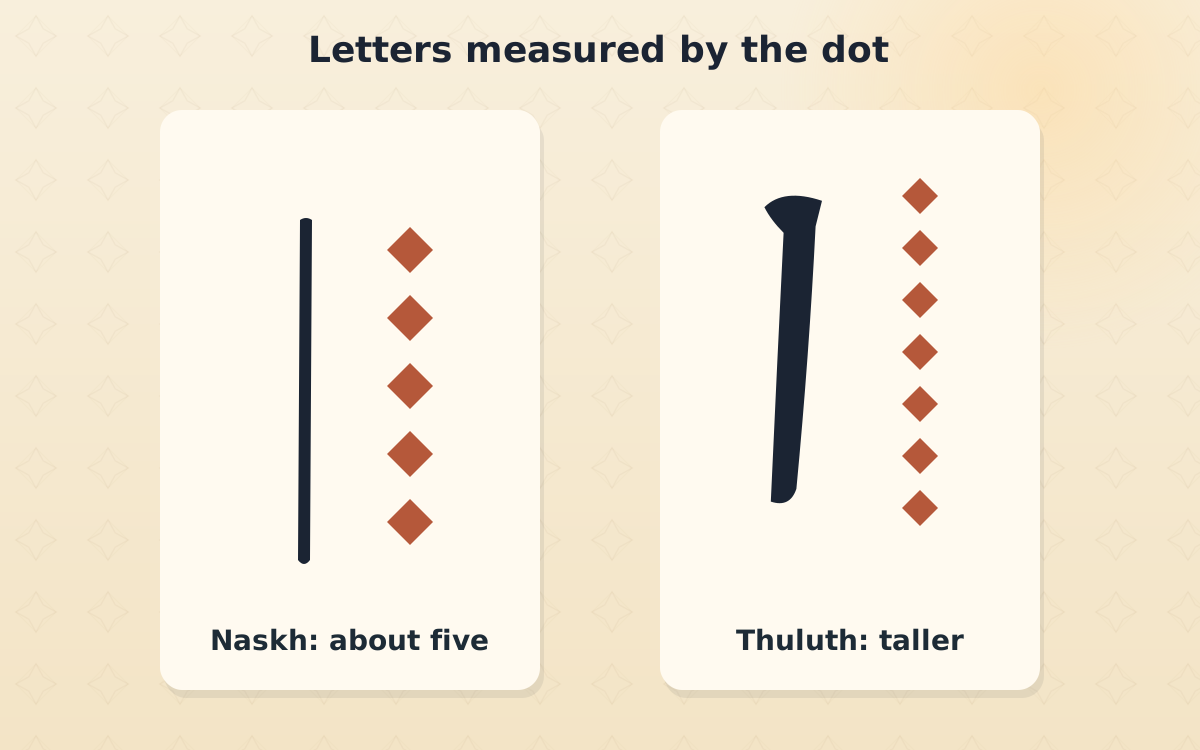
The letter alif in Naskh, measured with a column of five rhombic dots beside it; and the taller alif of Thuluth beside a taller column of seven dots

Calligraphers measure letters with the rhombic dot, the mark the pen makes when pressed once. In Naskh, the alif is about five dots tall. Every other letter is sized from the alif.

Guess

Estimate

About how many dots tall is the Naskh alif in many teaching traditions?

Show the answer

5 dots About five. Teachers differ slightly, but the idea is the same: the dot is the measure.

Trace it

Trace it

Trace ba: a long low bowl, then the dot below.

ب

Ba

Read

Letters that join

The letters alif, ba, nun and waw in Naskh

Most letters join the letter after them. Six never do: alif, dal, dhal, ra, zay and waw. That is why some words have little gaps inside them.

Letters also change shape at the start, middle and end of a word. Learning those shapes is half of learning to read.

Go deeper: a hand that became print

Hafiz Osman of Istanbul (died 1698) wrote Naskh so clearly that his mushaf was copied and printed for centuries, and many printed mushafs still follow hands like his.

Listen Listen

Which letter do you hear?

Show the answer

Nun: a deep round bowl with one dot above.

From the hadith

Two rewards for the one who struggles

وعن عائشة رضي الله عنها قالت: قال رسول الله صلى الله عليه وسلم : "الذي يقرأ القرآن وهو ماهر به مع السفرة الكرام البررة، والذي يقرأ القرآن ويتتعتع فيه وهو عليه شاق له أجران" ((متفق عليه)).

'Aishah (May Allah be pleased with her) reported: The Messenger of Allah (ﷺ) said, "The one who is proficient in the recitation of the Qur'an will be with the honourable and obedient scribes (angels) and he who recites the Qur'an and finds it difficult to recite, doing his best to recite it in the best way possible, will have two rewards."

Agreed upon (al-Bukhari and Muslim) (متفق عليه) · Sahih

Look

Struggle is rewarded

A stack of practice sheets and a reed pen

This stored hadith promises two rewards to the one who finds reading the Quran hard but keeps trying. Learning to read Naskh letters, slowly, is part of that blessed struggle.

Think about it

Reflect

Which letters do you find hardest to read? Write them down, and plan to practise them this week.

Only you can see this. It is kept on this device.

Reveal

Common mistakes

Flip each card: what people often get wrong, and what is right.

  • “Naskh here means cancelling.” In calligraphy, naskh means copying.
  • “Every letter joins on both sides.” Six letters never join to the one after.
  • “Printed mushafs have nothing to do with calligraphy.” They follow the hands of great calligraphers.

Read

For your life

A stack of practice sheets and a reed pen

Learn the six letters that never join the next letter. Then open your mushaf, with wudu, and find a word on the first page where one of them leaves a gap.

Reveal

The lesson in three lines

Sum up the lesson in your own words first, then tap to check.

  • The lesson in one line Naskh, “copying”, is the clear, round script of the mushaf you read. Its alif is about five dots tall, and six letters never join the next. Struggling to read is rewarded twice.

Lesson finished

Naskh, the script you read

You added a century to a map whose borders change.

What you learnt

  • Naskh is the clear, round script of the mushaf you read.

Your deed · Try it today

Find the letters alif, ba, nun and waw in your mushaf today, without reading aloud, and touch it only with wudu.

Sign in to keep your progress on every device.