Al-Andalus: Muslim Spain · Beginner · Lesson 2/3 Cordoba, the bright city

Step inside

The Great Mosque of Cordoba

The bright city

A forest of red and white striped arches by lamplight. A prince who escaped Damascus began it.

Look

The prince who escaped

A lone palm tree by the river in Cordoba, far from the land where palms grow

In 750 the Umayyads of Damascus were overthrown. A young prince, ’Abd al-Rahman, escaped and crossed North Africa in hiding. In 756 he took Cordoba and founded a new Umayyad state.

He missed Sham all his life. The histories say he planted a palm tree in his garden and wrote a poem to it, a stranger like himself.

Choose Check

Why did ’Abd al-Rahman plant a palm tree in Cordoba?

  • It reminded him of Sham, the home he had lost
  • Palms were sold in the market
  • It marked the qiblah
Show the answer

He escaped Damascus as a young man and missed it all his life.

Look

The great mosque

The red and white double arches of the Great Mosque of Cordoba

In about 785 ’Abd al-Rahman began the Great Mosque of Cordoba. His successors enlarged it again and again for two centuries, until it was one of the largest mosques in the world.

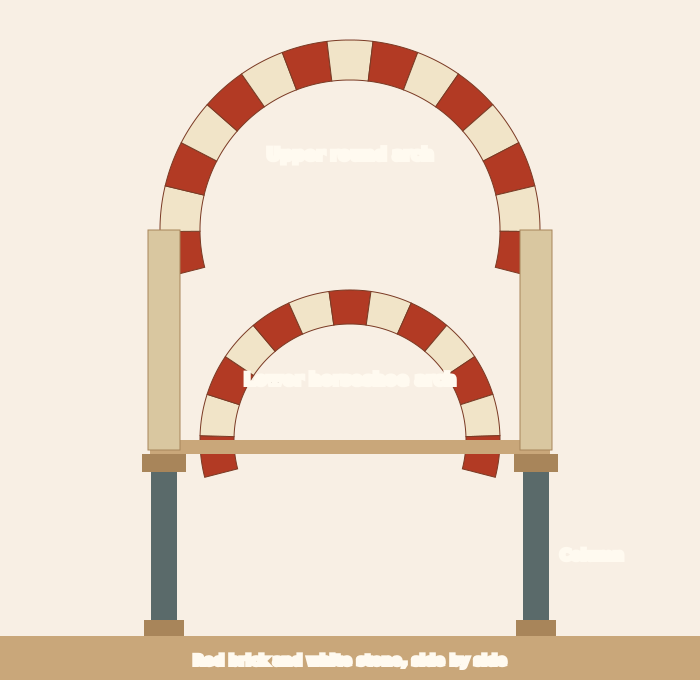
Its forest of columns holds up double arches, striped in red brick and white stone. The design let the builders raise a high roof on short, reused Roman columns.

Explore the picture

Read the arches

Diagram of one bay of the Great Mosque of Cordoba. A lower horseshoe arch and an upper round arch, both striped with red brick and white stone, rest on piers above slender stone columns
  1. Horseshoe arch The lower arch curves in at the bottom, like a horseshoe.
  2. Round arch A second arch on top lifts the roof higher.
  3. Column Many columns were reused from Roman and Visigothic buildings.

Tap the spot Find the arch

Tap the lower horseshoe arch.

Diagram of one bay of the Great Mosque of Cordoba. A lower horseshoe arch and an upper round arch, both striped with red brick and white stone, rest on piers above slender stone columns
Show the answer

The horseshoe arch is the lower one, which curves in at its feet.

Look

A caliph in Cordoba

Horseshoe and round arches on columns

In 929 ’Abd al-Rahman III declared himself caliph. Near Cordoba he built a palace city, Madinat al-Zahra. Cordoba became one of the largest cities in Europe, with baths, markets and paved streets.

His son al-Hakam II gathered a famous library. Reports speak of 400,000 books; historians think the figure is exaggerated, but it was surely very large.

Read

A city that worked

A whitewashed street in Cordoba with arched doors, balconies and pots of flowers

Reports describe Cordoba under its caliphs as a city of paved streets, public baths, markets and many mosques, with water brought in by aqueducts.

Its chief judge was a powerful figure. The histories tell of Cordoba’s judges who refused gifts and ruled against the powerful, princes included.

Go deeper: Madinat al-Zahra

The palace city of ’Abd al-Rahman III was looted and ruined in the civil war that began in 1009, only about seventy years after it was begun. Its ruins outside Cordoba are now a World Heritage site.

Choose Check

Who gathered the famous library of Cordoba?

  • Al-Hakam II
  • Tariq ibn Ziyad
  • Boabdil
Show the answer

Al-Hakam II, son of ’Abd al-Rahman III, was a great collector of books.

Guess

A mosque that grew

The Great Mosque of Cordoba was begun about 785 and enlarged until about 987. About how many years did it grow?

Show the answer

200 years About two hundred years, enlarged by ruler after ruler.

Fill the gap Fill the gap

In 929 the ruler of Cordoba, ’Abd al-Rahman III, took the title of ______.

  • caliph
  • sultan
  • king of France
Show the answer

Cordoba, Baghdad and Fatimid Cairo then all had caliphs.

Think about it

Building for the ages

Generation after generation added to the mosque at Cordoba. What good work could your family keep adding to for generations?

Only you can see this. It is kept on this device.

Reveal

Common mistakes

Flip each card: what people often get wrong, and what is right.

  • “The library surely held 400,000 books.” That is a report; historians think the numbers may be exaggerated.
  • “The Great Mosque was built in one go.” It was begun about 785 and enlarged for two centuries.
  • “Its qiblah wall faces exactly towards Makkah.” It faces nearly south; historians give several reasons.

Read

For your life

The red and white double arches of the Great Mosque of Cordoba

The Great Mosque grew because each generation added to it. Start a family habit your children can carry on: a small monthly gift in their names to a masjid or school, or a yearly visit to help at one.

Reveal

The lesson in three lines

Sum up the lesson in your own words first, then tap to check.

  • The lesson in one line ’Abd al-Rahman, the prince who escaped, founded Umayyad Cordoba in 756 and began its Great Mosque. In 929 ’Abd al-Rahman III became caliph and built Madinat al-Zahra. Cordoba became one of Europe’s great cities.

Lesson finished

Cordoba, the bright city

You added a century to a map whose borders change.

What you learnt

  • ’Abd al-Rahman founded Umayyad Cordoba; its Great Mosque grew for two centuries.

Your deed · Try it today

Start one good thing today that your children could continue.

Sign in to keep your progress on every device.