Tous les cours
44 cours sur 429
 The Duty and Reward of Dawah
49 min
Études avancées
What dawah really is, whose duty it is, the reward that keeps growing, why results belong to Allah, and why you speak only from what you know.
 Contient 1 vidéo
The Prophet’s Way of Inviting ﷺ
51 min
Études avancées
How the Prophet ﷺ invited: wisdom, good counsel and the best way of arguing; the core first; gentleness; patience after rejection; and real friendships with people of other faiths.
 Manners of the Caller
51 min
Études avancées
Character first; listening before speaking; never forcing anyone; respect for every faith with no mocking; and knowing when to stop a conversation.
 Dawah to Family and Friends
48 min
Études avancées
The nearest first: parents who are not Muslim, friends and housemates, Muslim relatives who have drifted, and the long patience that family dawah needs.
 Contient 1 vidéo
Dawah at Work, at School and Online
59 min
Études avancées
Being a Muslim worth asking about at work and on campus, the manners of a street stall, answering online comments wisely, and a simple plan for quiet dawah every day.
 Contient 1 vidéo
Welcoming New Muslims
51 min
Études avancées
When someone says "I want to become Muslim": the Shahadah moment, the first weeks, staying with them through the first year, the hard moments, and a masjid that truly welcomes.
 Contient 1 vidéo
What Christians Believe
55 min
Études avancées
The main churches, the creed, worship and the Christian year, and fourteen centuries of Christians and Muslims living side by side.
 ’Isa and Maryam in the Quran
55 min
Études avancées
What the Quran teaches about Maryam and ’Isa, set beside what Christians believe: the titles, the miracles, the cross and the return.
 The Bible and Its History
52 min
Études avancées
How the Bible’s books were written, gathered, copied and translated, and what the Quran teaches about the earlier scriptures.
 Tawhid and the Trinity
53 min
Études avancées
What Christians mean by the Trinity, how the doctrine took shape, and how the Quran teaches the oneness of Allah, with wisdom for real conversations.
 Salvation, Sin and Forgiveness
53 min
Études avancées
Adam’s slip, original sin and the cross in Christian belief; fitrah, tawbah and the mercy of Allah in Islam; and the hardest question, who will be saved.
 Conversations with Christians
53 min
Études avancées
Practise real conversations: Christmas at work, “Is Allah the same God?”, street preachers, hard questions and interfaith evenings, with kindness and clear limits.
 Contient 1 vidéo
What Jewish People Believe
53 min
Études avancées
Jewish belief and practice as Jews describe them: the Shema, the thirteen principles, the movements, Shabbat and the festivals, and thirteen centuries in Muslim lands.
 Contient 1 vidéo
The Prophets We Share
54 min
Études avancées
Ibrahim, Musa, Dawud, Sulayman and the other prophets of the Children of Israel, in the Hebrew Bible and in the Quran: what we share and where we differ.
 Contient 1 vidéo
The Torah in Islam
52 min
Études avancées
The Tawrah Allah gave Musa, the Torah and Talmud as Jews know them, what the Quran says about the Torah today, the teachings we share, and centuries of shared scholarship.
 Law, Worship and the Covenant
54 min
Études avancées
Halakha and shariah, prayer and the two qiblahs, food laws, fasting and the Sabbath, the covenant, and the Messiah, in Judaism and Islam side by side.
 Conversations with Jewish Friends
51 min
Études avancées
Practise real conversations: a Shabbat dinner, “Do Muslims hate Jews?”, Jerusalem without politics, common questions and working together for good.
 Contient 1 vidéo
Hinduism
51 min
Études avancées
The faith of more than a billion people, described as Hindus describe it: its books, ideas, worship and festivals; where Islam agrees and differs; a thousand years of shared history in South Asia; and Diwali with good neighbours.
 Contient 1 vidéo
Buddhism
53 min
Études avancées
The path taught by Siddhartha Gautama, described as Buddhists describe it: the Four Noble Truths, the Eightfold Path, the three great schools and their festivals; where Islam agrees and differs; Muslims and Buddhists in history; and mindfulness and friendship today.
 Contient 1 vidéo
Sikhism
54 min
Études avancées
The faith of Guru Nanak and the ten Gurus, described as Sikhs describe it: one God, the Guru Granth Sahib, the Khalsa and the gurdwara; where Islam agrees and differs; Muslims and Sikhs in Punjab's history, told with balance; and Vaisakhi with Sikh friends.
 Contient 1 vidéo
Chinese and Japanese Traditions
56 min
Études avancées
Confucius and Laozi, Chinese folk religion and the ancestors, Shinto and Japanese Buddhism, described as their followers describe them; where Islam agrees and differs; thirteen centuries of Islam in China and the newer story in Japan; and New Year and Obon with friends.
 Tawhid for the Eastern Mind
53 min
Études avancées
How to explain the One God to Hindu, Buddhist, Sikh and East Asian friends: start from shared ground, show the Creator who is never one with creation, one life and the meeting with a merciful Lord, why messengers, and conversations that respect.
 Does God Exist?
53 min
Études avancées
The classical arguments, plainly and fairly: what atheists, agnostics and humanists actually believe; the cosmological and contingency arguments; fine-tuning; the moral argument and the fitrah; and what arguments can and cannot do.
 Contient 1 vidéo
Science and Faith
54 min
Études avancées
What science can and cannot tell us; Muslims in the history of science; the universe and the "scientific miracle" trap; evolution, stated carefully with the views of Sunni scholars; and how laws of nature, causes and miracles fit together.
 Morality and Meaning
43 min
Études avancées
Can we be good without God, and what is life for? Secular ethics stated fairly, the Euthyphro question and the Muslim answers, meaning after nihilism and existentialism, and what really makes a good life.
 Why Is There Suffering?
51 min
Études avancées
The hardest question, stated fairly: the logical and evidential problems of evil. The Islamic answers: a test, a next life of full justice, freedom and the order of nature, a wisdom we cannot see. Then living with pain, and talking with someone who is hurting.
 Free Will and Purpose
41 min
Études avancées
Are we just machines? Determinism, neuroscience and free will stated fairly; qadar and real choice in the Ash'ari and Maturidi schools; who is responsible, including those the message never reached; and a purpose you can live.
 Talking with Atheists and Agnostics
51 min
Études avancées
Putting the path into practice: listening for the real reason behind unbelief, asking good questions, caring for a Muslim friend with doubts, staying calm online and at work, and whole conversations to practise from start to finish.
 Contient 1 vidéo
Women in Islam
1 heures
Études avancées
Calm, sourced answers to the questions people ask most: equal worth, the rights she holds, inheritance and testimony, hijab, marriage, polygyny and divorce, and the women who led.
 Jihad, Peace and Extremism
49 min
Études avancées
What jihad means, the rules that bind even in war, reading the fighting verses in their setting, why mainstream scholars condemn extremist groups, and peace in daily life.
 What Is Sharia?
50 min
Études avancées
What the word means and what most of it is about. The aims it protects, penalties in their real setting and the hard question of apostasy. And what it means for a Muslim in a non-Muslim country.
 Contient 1 vidéo
Islam and Other Faiths
50 min
Études avancées
One message through many messengers; what Islam claims about truth and salvation; tolerance in practice; how a merciful God and hell fit together; and living well alongside people of every faith and none.
 Contient 1 vidéo
Questions about History
50 min
Études avancées
Reading history fairly; slavery in its setting and the doors Islam opened to freedom; conquest and conversion; what a caliphate was; and the bright and dark chapters, told honestly.
 Hard Questions, Calmly
58 min
Études avancées
How to answer when you don’t know, and where to find good answers. Short, calm answers on suffering, science and the Quran’s preservation. And how to stay calm when a question is really an attack.
 Contient 3 vidéos
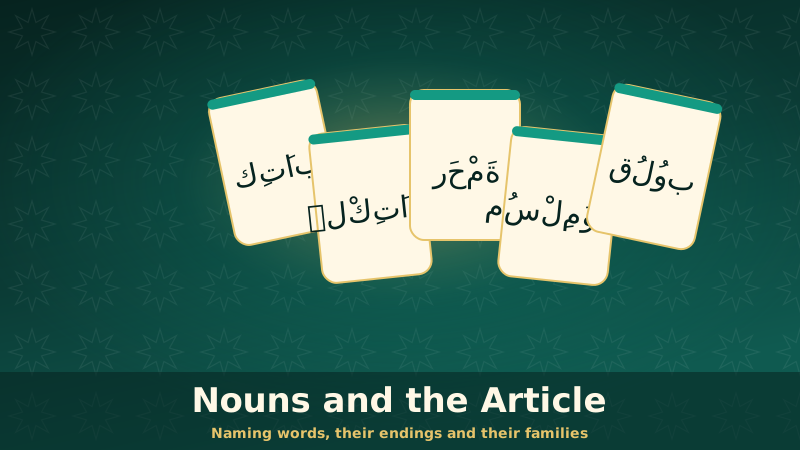
Nouns and the Article
1.3 heures
Études avancées
The naming words of the Quran: the signs of a noun, al- and tanwin, gender and number, broken plurals, the three endings, joined nouns, adjectives and the patterns that shape meaning.
 Contient 3 vidéos
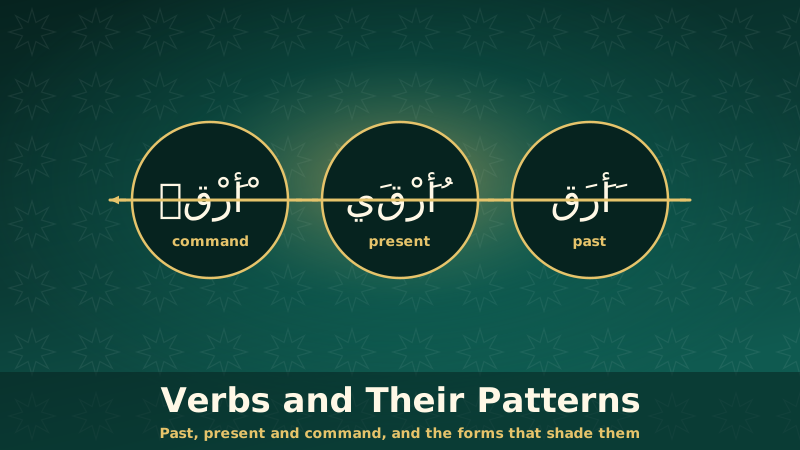
Verbs and Their Patterns
1.3 heures
Études avancées
The verbs of the Quran: past, present and command, who is doing it, six ways to say no, the passive, the ten forms, the maṣdar and the participles.
 Contient 3 vidéos
Pronouns and Particles
1.3 heures
Études avancées
The small words that carry the verses: pronouns, endings that say whose, pointing words, prepositions, the words for “and then”, who and which, certainty, three kinds of if, questions and the exception.
 Contient 3 vidéos
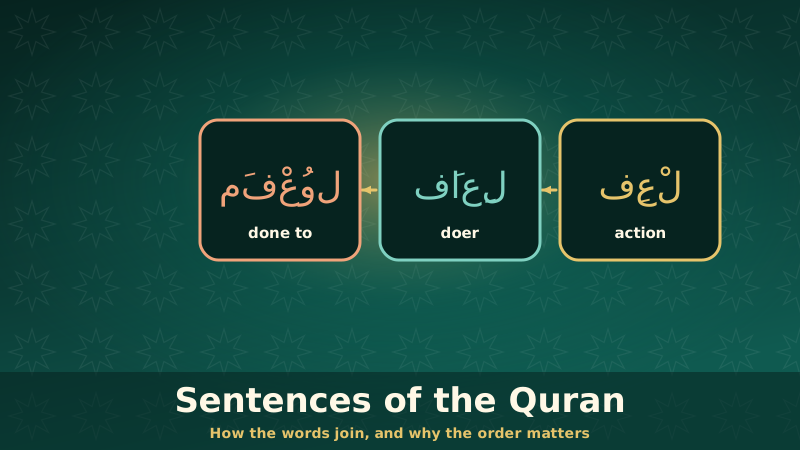
Sentences of the Quran
1.3 heures
Études avancées
How the words join: naming and action sentences, word order that singles out, the families of kāna and inna, the call, conditions, oaths, and what a translation can only hint at.
 Contient 1 vidéo
What Is Usul al-Fiqh?
50 min
Études avancées
The roots beneath every ruling: what usul al-fiqh is, how a ruling is graded by the strength of its proof, who is accountable, and the Hanafi books that teach the method.
 The Quran and Sunnah as Sources
50 min
Études avancées
How the first two sources work in Hanafi usul: the Quran as the definite Book, the Sunnah that explains it, the three kinds of report, what a single-narrator hadith can and cannot do to a verse, and abrogation.
 Ijma‘ and Qiyas
50 min
Études avancées
The third and fourth sources: the consensus of the scholars and its kinds, and analogy with its four parts, shown through wine and new drinks, the six items of exchange, and the Prophet’s ﷺ own reasoning.
 Istihsan, ‘Urf and Maslahah
50 min
Études avancées
The Hanafi tools for hard cases: istihsan, taking the stronger proof over a plain analogy; ‘urf, the custom that rulings respect; and the purposes of the Shariah, ease and necessity, with the other schools where they help.
 Commands, Prohibitions and Words
50 min
Études avancées
How a text is read in Hanafi usul: specific and general words, commands and prohibitions, the eight steps of clear and unclear, and the four ways a text speaks. Each is shown on real verses.
 The Madhhabs and Ijtihad
50 min
Études avancées
Who may make ijtihad, the levels of the Hanafi scholars, and how a fatwa is found in the school. Then why ordinary Muslims follow a madhhab, and how new questions are answered today.