
0 gardé
Entre dans la scène
An office kitchen
“Where does it say that?”
“Where in the Quran does it say Maghrib has three rak’ahs?” Your colleague is only half joking.
Regarder
“Where does it say that?”
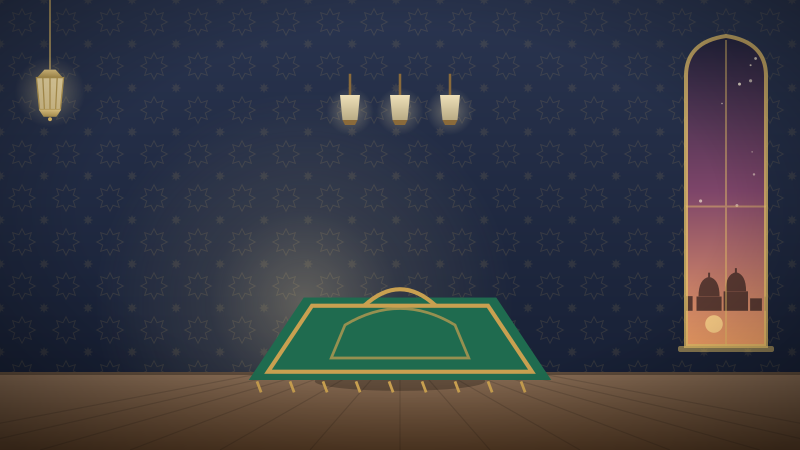
A colleague asks Bilal, “Where in the Quran does it say Maghrib has three rak’ahs?” It does not say so in the Quran. Bilal is puzzled.
The answer is that rulings come from four sources, not one.
Trouve-les
Four sources
Tap the picture to find each part. Each one opens a card.
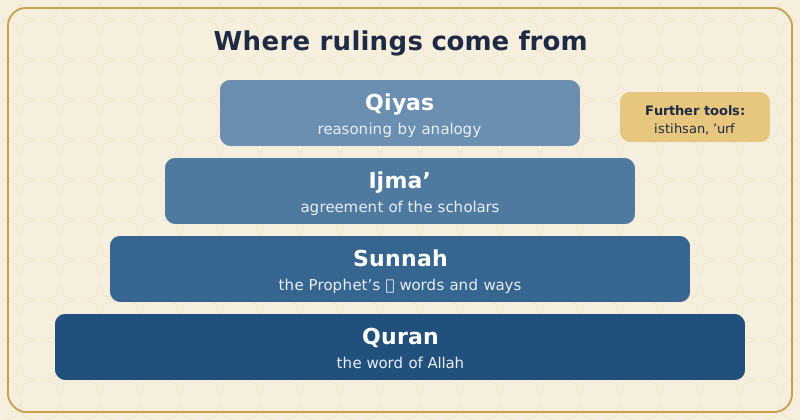
- Quran The word of Allah, the first source. Everything else rests on it.
- Sunnah The Prophet’s ﷺ words, actions and approvals. It explains the Quran: the number of rak’ahs comes from here.
- Ijma’ The agreement of the qualified scholars of an age on a ruling. The Ummah as a whole does not agree on error.
- Qiyas Analogy: a new case takes the ruling of an old one when they share the same reason. Drugs share the reason that made wine haram.
Du Coran
Return it to Allah and His Messenger
يَٰٓأَيُّهَا ٱلَّذِينَ ءَامَنُوٓا۟ أَطِيعُوا۟ ٱللَّهَ وَأَطِيعُوا۟ ٱلرَّسُولَ وَأُو۟لِى ٱلْأَمْرِ مِنكُمْ ۖ فَإِن تَنَٰزَعْتُمْ فِى شَىْءٍۢ فَرُدُّوهُ إِلَى ٱللَّهِ وَٱلرَّسُولِ إِن كُنتُمْ تُؤْمِنُونَ بِٱللَّهِ وَٱلْيَوْمِ ٱلْءَاخِرِ ۚ ذَٰلِكَ خَيْرٌۭ وَأَحْسَنُ تَأْوِيلًا﴿59﴾
59 O ye who believe! Obey Allah, and obey the messenger and those of you who are in authority; and if ye have a dispute concerning any matter, refer it to Allah and the messenger if ye are (in truth) believers in Allah and the Last Day. That is better and more seemly in the end.
Mot à mot
Word by word
- يَٰٓأَيُّهَا yāʾayyuhā which, whichever; in ya ayyuha: O (you)
- ٱلَّذِينَ alladhīna those who (masculine plural)
- ءَامَنُوٓا۟ āmanū to believe, to have faith · أمن
- أَطِيعُوا۟ aṭīʿū to obey · طوع
- ٱللَّهَ allāha Allah, God: the proper name of the One God
- وَأَطِيعُوا۟ waʾaṭīʿū to obey · طوع
- ٱلرَّسُولَ ar-rasūla messenger (plural rusul) · رسل
- وَأُو۟لِى waʾulī possessors of, people of (ulu al-albab: people of understanding)
- ٱلْأَمْرِ al-ʾamri command; matter, affair · أمر
- مِنكُمْ minkum from, of, out of, some of
- فَإِن faʾin if; (in some verses) not
- تَنَٰزَعْتُمْ tanāzaʿtum
- فِى fī in, inside; about, concerning
- شَىْءٍۢ shāʾin thing; anything · شيأ
- فَرُدُّوهُ faruddūhu to return, to turn back, to reject · ردد
- إِلَى ilā to, towards, until
- ٱللَّهِ allāhi Allah, God: the proper name of the One God
- وَٱلرَّسُولِ warrasūli messenger (plural rusul) · رسل
- إِن in if; (in some verses) not
- كُنتُمْ kuntum to be, was; (kana yaf'al) used to do · كون
- تُؤْمِنُونَ tuʾminūna to believe, to have faith · أمن
- بِٱللَّهِ billāhi Allah, God: the proper name of the One God
- وَٱلْيَوْمِ walyawmi day · يوم
- ٱلْءَاخِرِ al-ʾākhiri the Hereafter; last, final (akhir) · أخر
- ذَٰلِكَ dhālika that (pointing to something further away)
- خَيْرٌۭ khayrun good; better, best · خير
- وَأَحْسَنُ waʾaḥsanu best, better, most beautiful · حسن
- تَأْوِيلًا taʾwīlan
O ye who believe! Obey Allah, and obey the messenger and those of you who are in authority; and if ye have a dispute concerning any matter, refer it to Allah and the messenger if ye are (in truth) believers in Allah and the Last Day. That is better and more seemly in the end.
Regarder
What the verse teaches

When Muslims differ, the answer is sought in the Quran and the Sunnah. Ijma’ and qiyas are not new religions; they are ways of reading those two sources faithfully.
The Hanafi scholars add two tools: istihsan (preferring a stronger proof over a plain analogy) and ’urf (local custom where the texts leave room).
Lire
The Sunnah explains the Quran
The Quran commands the prayer, but you learn how to pray from the Sunnah: the times, the rak'ahs, the words, the positions. The same with zakat: the Quran commands it, the Sunnah gives the 2.5% and the nisab.
So when your colleague asks where Maghrib's three rak'ahs are written, the answer is: in the Sunnah, which the Quran tells us to follow, passed on by the whole community.
Lire
Ijma' and qiyas in your day
Touchez le bon endroit Find the source
Tap the source that means the agreement of the scholars.
Voir la réponse
Ijma’ is the agreement of the qualified scholars of an age. It is the third source.
Regarder
Watch: where rulings come from
Mettre en ordre
Put the sources in order of strength
Mettez-les dans le bon ordre.
- Quran
- Sunnah
- Ijma’
- Qiyas
Voir la réponse
The Quran comes first and the Sunnah explains it. Agreement and analogy build on both.
Lire
Two Hanafi tools: istihsan and custom

Construis-le
The steps of a ruling
Put the steps in order: how do we know drugs are forbidden?
- The Quran forbids wine
- The Sunnah forbids every intoxicant
- The reason (ʿillah) is that it intoxicates
- Drugs share that reason
- So, by qiyas, drugs are forbidden
Compléter le trou Fill the gap
Treating drugs like wine because both intoxicate is an example of ______.
Voir la réponse
Qiyas gives a new case the ruling of an old one when the reason is the same.
Révéler
Common mistakes
Think of the right answer first, then flip each card.
- "If it isn't in the Quran, it isn't Islam." The Quran itself tells us to follow the Sunnah, which explains it.
- "Qiyas is just opinion." Qiyas extends a ruling by a cause found in the Quran or Sunnah, by strict rules.
- "Custom can make anything allowed." Custom only fills in details within the Quran and Sunnah; it cannot allow the forbidden.
- "New things have no ruling." Fiqh reaches new things through qiyas and the principles of the sources.
Réfléchissez-y
Pause and think
What new thing in your life (an app, a product, a kind of work) would you like to know the ruling on? Who could you ask?
Vous seul pouvez le voir. C'est gardé sur cet appareil.
Leçon terminée
Where rulings come from
Vous avez ajouté une clé à un trousseau de clés rassemblées.
Ce que vous avez appris
- Quran, Sunnah, ijma', qiyas: in that order of strength.
- The Sunnah shows how to do what the Quran commands.
- Qiyas carries rulings to new things by a shared cause.
- faits
- 0
- juste du premier coup
- 0
- à revoir
- 0
Votre action · Essayez aujourd'hui
Ask the source of one ruling you follow, and find it.
Ce que vous avez gardé
Connectez-vous pour garder votre progression sur tous vos appareils.