
0 gardé
Entre dans la scène
From Spain to the Indus, 711
One year, two frontiers
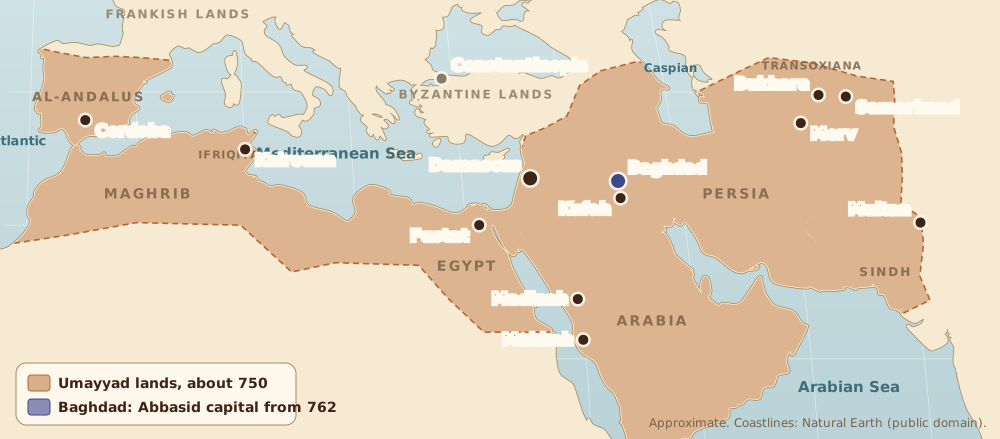
The map of the Umayyad lands. In one year, armies crossed into Spain in the west and reached Sindh in the east.
Lire
One year, two frontiers
711 CE. At the western end of the world they knew, an army crosses the strait into Spain. At the eastern end, nearly 7,000 kilometres away, another army enters Sindh, in today’s Pakistan.
Both answer to one caliph in Damascus. At its widest, about 750, Umayyad rule ran from the Atlantic to Central Asia.
Regarder
Regarder
Watch: from Spain to the Indus
L'itinéraire
The frontiers of the Umayyads
- Damascus The capital, where orders and governors were sent from.
- Kairouan, 670 ’Uqbah ibn Nafi’ founds a new city in Ifriqiya (Tunisia).
- Cordoba, from 711 Tariq ibn Ziyad crosses into Spain; al-Andalus begins.
- Multan, 711–713 Muhammad ibn al-Qasim reaches Sindh and the Punjab.
- Samarkand, about 712 Qutaybah ibn Muslim reaches Transoxiana.
- Constantinople, 717–718 A great siege fails. The city stands for seven more centuries.
The frontiers were finally fixed by failure at Constantinople (718), defeat in France near Tours (732) and, under the Abbasids, the battle of Talas in Central Asia (751).
Lire
Sindh: a new kind of land

In Sindh the Muslims met Hindus and Buddhists. A later history, the Chach Nama, says Muhammad ibn al-Qasim let them keep their temples and treated them as protected people, like Christians and Jews. Historians debate how much of that book is accurate.
Trade had already brought Muslims to India’s coasts. Much of the region’s later faith came through traders and Sufis, not armies.
Lire
Tariq and the Rock

In 711 Tariq ibn Ziyad, a Berber commander serving the governor Musa ibn Nusayr, crossed the strait with a small army. The great rock where he landed still carries his name: Gibraltar, from Jabal Tariq, the Mountain of Tariq.
Within a few years most of the peninsula was under Muslim rule.
Go deeper: the burned ships
A famous story says Tariq burned his ships so his men could not turn back. It appears only in much later writings, and historians doubt it. A good story is not always a true one.
Choisir Check
Where does the name Gibraltar come from?
Voir la réponse
The rock was named after Tariq ibn Ziyad, who landed there in 711.
Lire
Where the advance stopped
In 717–718 a great Umayyad siege of Constantinople failed against its sea walls and a hard winter.
In the west, in 732, a raiding army was beaten near Tours in France. European books made that battle famous; Muslim writers remembered it as Balat ash-Shuhada, the Pavement of the Martyrs. The frontiers settled after that.
Trouve-les
Explore the map
Find the frontiers and cities of the Umayyads.

- Damascus The capital.
- Kairouan Founded in 670 in Ifriqiya.
- Cordoba In al-Andalus, from 711.
- Multan In Sindh, 711–713.
- Samarkand In Central Asia, about 712.
- Constantinople Besieged in 717–718, without success.
Touchez le bon endroit Find the city
Tap Kairouan, the new city of Ifriqiya.
Voir la réponse
Kairouan, in today’s Tunisia, became the base for all of North Africa.
Compléter le trou Fill the gap
The commander who crossed into Spain in 711 was Tariq ibn ______.
Voir la réponse
Gibraltar still carries his name: Jabal Tariq, the mountain of Tariq.
Choisir Check
Where did a great Umayyad siege fail in 717–718?
Voir la réponse
The Byzantine capital held. It was opened by the Ottomans in 1453.
Réfléchissez-y
Many peoples, one ummah
Within a century, Berbers, Persians, Sindhis and Spaniards were praying in the same direction. What do you share with Muslims from a land far from yours?
Vous seul pouvez le voir. C'est gardé sur cet appareil.
Révéler
Common mistakes
Flip each card: what people often get wrong, and what is right.
- “Islam came to India only by the sword.” Traders reached its coasts first, and much of the faith later spread through traders and Sufis.
- “Tariq burned his ships.” A much later story that historians doubt.
- “The caliph ran every village himself.” Governors ran the provinces, and local leaders much of daily life.
Lire
For your life

Your masjid may already hold Muslims from five or more countries. Learn the names of two people from a land far from yours, ask where their family is from, and invite them to eat. One qiblah made one ummah from Spain to Sindh; it can do the same in your town.
Révéler
The lesson in three lines
Sum up the lesson in your own words first, then tap to check.
- The lesson in one line In 711 Tariq crossed into Spain and Muhammad ibn al-Qasim entered Sindh. By about 750 Umayyad rule ran from the Atlantic to Central Asia. The advance stopped at Constantinople and in France, and the faith spread further by trade and teaching.
Leçon terminée
From Spain to the Indus
Vous avez ajouté un siècle à une carte dont les frontières changent.
Ce que vous avez appris
- Under the Umayyads, Islam reached from Spain to the Indus.
- faits
- 0
- juste du premier coup
- 0
- à revoir
- 0
Votre action · Essayez aujourd'hui
Learn one thing today about Muslims in a land far from yours.
Ce que vous avez gardé
Connectez-vous pour garder votre progression sur tous vos appareils.