
0 gardé
Entre dans la scène
The valley of ’Uranah, by Arafah, 9 Dhul Hijjah 10 AH
A plain full of people
A vast crowd stands in the sun. He speaks from his camel, and men repeat his words so the edges can hear.
Regarder
A plain full of people

On 9 Dhul Hijjah he stood on his camel in the valley of ’Uranah, by the plain of Arafah, and spoke to the crowd. Men with strong voices repeated his words to those far away. He spoke again at Mina on the Day of Sacrifice.
These words are known as the Farewell Sermon. The sound collections preserve parts of it in several reports.
Regarder
The plain of Arafah
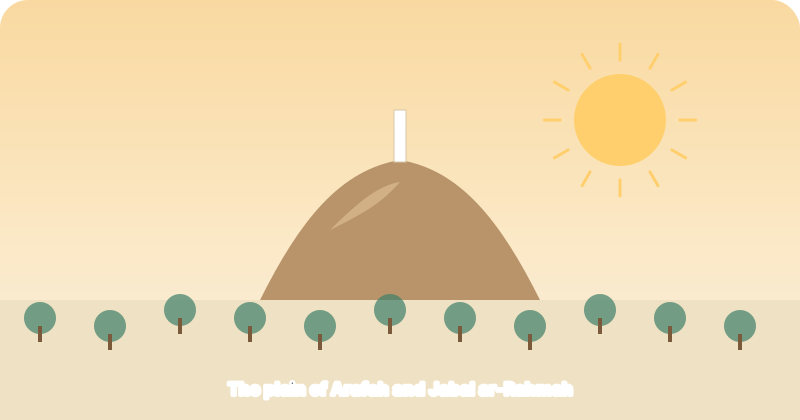
Choisir Check
How did people at the edges of the huge crowd hear him?
Voir la réponse
Men with strong voices passed each sentence on, so the whole plain could hear.
Du hadith
Sacred, like this day
وعن أبي بكر رضي الله عنه أن رسول الله صلى الله عليه وسلم قال في خطبته يوم النحر بمنًى في حجة الوداع: "إن دماءكم، وأموالكم، وأعراضكم حرام عليكم كحرمة يومكم هذا، في شهركم هذا، في بلدكم هذا، ألا هل بلغت” ((متفق عليه)).
Abu Bakrah (May Allah be pleased with him) said: Delivering the sermon during the Farewell Pilgrimage on the day of Sacrifice at Mina, the Messenger of Allah (ﷺ) said, "Verily your blood, your property and your honour are as sacred and inviolable as the sanctity of this day of yours, in this month of yours and in this town of yours. Verily! I have conveyed this message to you."
Du hadith
Five things that lead to Paradise
الخامس: عن أبي أمامة صدي بن عجلان الباهلي رضي الله عنه قال: سمعت رسول الله صلى الله عليه وسلم يخطب في حجة الوداع فقال : اتقوا الله ، وصلوا خمسكم، وصوموا شهركم، وأدوا زكاة أموالكم، وأطيعوا أمراءكم، تدخلوا جنة ربكم" ((رواه الترمذي، في آخر كتاب الصلاة وقال : حديث حسن صحيح)).
Abu Umamah (May Allah be pleased with him) said: I heard Messenger of Allah (ﷺ) during the sermon of the Farewell Pilgrimage saying, "Be mindful of your duty to Allah; perform your five daily Salat, observe Saum during the month (of Ramadan) , pay the Zakat on your properties and obey your leaders; (if you do so) you will enter the Jannah of your Rubb"..
Vrai ou faux Check
The Farewell Sermon comes to us as one fixed text in a single report.
Voir la réponse
Parts of it are preserved in several sound reports, given at Arafah and at Mina.
Du hadith
His warning against fighting each other
عن جرير بن عبد الله رضي الله عنه قال: قال لي رسول الله صلى الله عليه وسلم في حجة الوداع: "استنصت الناس" ثم قال: لا ترجعوا بعدي كفاراً يضرب بعضكم رقاب بعض" ((متفق عليه)) .
Jarir bin 'Abdullah (May Allah be pleased with him) reported: Messenger of Allah (ﷺ) asked me on the occasion of the Farewell Pilgrimage to tell the people to keep silent, then he (ﷺ) said, "Do not revert to disbelief after me, chopping the heads of one another."
Côte à côte
The heart of the sermon
| Theme | What he taught, in summary |
|---|---|
| Life, property, honour | As sacred as that day, that month and that city |
| Worship | Fear Allah, pray, fast, give zakat, obey those in authority |
| Unity | Do not turn into enemies striking one another after him |
| Old wrongs | Blood feuds and usury of the Jahiliyyah cancelled, the reports add |
| Women | Treat them well, the reports add; they have rights over you as you have over them |
| Witness | He asked if he had conveyed the message, and called Allah to witness |
Lire
Bearing witness at Arafah
Again and again he asked the crowd whether he had conveyed the message. They answered yes. He raised his finger to the sky, and then pointed to them, asking Allah to bear witness.
Then he told those present to pass it on to those absent. That includes us.
Lire
The rights of women

In the sermon he turned to the men and told them to fear Allah in how they treat their wives. He set out rights on both sides: kindness, provision and clothing from the husband; faithfulness and care of the home from the wife.
On the most public day of his life, he spoke up for those who were often treated worst.
Go deeper: ending old debts and feuds
He cancelled the interest owed from the days before Islam, starting with the interest owed to his own uncle, al-'Abbas. He ended old blood feuds too, starting with a claim of his own family. A leader who ends injustice begins with his own.
Révéler
Common mistakes
Flip each card: what people often get wrong, and what is right.
- “The sermon was only for those present.” He told them to pass it on to those absent, and that includes us.
- “He ended interest for others but not his family.” He began by cancelling his own uncle’s.
- “Honour matters less than life or wealth.” Life, wealth and honour are all made sacred.
Lire
One human family

The sermon is remembered for teaching that no race, colour or tribe is better than another; only taqwa, mindfulness of Allah, raises a person.
The crowd that heard it was Arab, Abyssinian, Persian and Roman, free and freed. It is still the clearest answer to racism.
Trie
The heart of the sermon
Sort each by what the sermon did.
Made sacred and protected
- Each person’s life, wealth and honour
- The rights of wives
Ended for ever
- The blood feuds of the Jahiliyyah
- The riba of the Jahiliyyah
- Pride in race or colour over others
Associer
Hadith and teaching
Associez chacun à sa paire.
- Sacred like this day Life, property and honour
- Five deeds Taqwa, prayer, fasting, zakat, obedience
- Do not turn back No fighting among Muslims
- Pass it on Those present tell those absent
Voir la réponse
Life, property and honour are sacred, five deeds lead to Paradise, Muslims must never fight each other, and those present pass it on. These are teachings of the Farewell Sermon.
Choisir Check
Where was the Farewell Sermon given?
Voir la réponse
At Arafah on the 9th, and at Mina on the Day of Sacrifice.
Lire
For your life

Choose one line of the sermon to live this week. Keep a person's honour sacred: no gossip or mockery. Pay a debt on time. Be kinder to your spouse. Treat someone of another background exactly as you would your own.
Réfléchissez-y
A heart moment
He asked the crowd whether he had passed on the message, and they said yes. One day we will be asked what we did with it. What would you like to be able to answer?
Vous seul pouvez le voir. C'est gardé sur cet appareil.
Révéler
The lesson in three lines
Sum up the lesson in your own words first, then tap to check.
- The lesson in one line At Arafah and Mina he gave the Farewell Sermon. He made life, wealth and honour sacred, ended interest and old feuds starting with his own family, and spoke for women and for equality. He told those present to pass it on.
Leçon terminée
The Farewell Sermon
Vous avez ajouté une étape du voyage à un voyage à travers l'Arabie.
Ce que vous avez appris
- The Farewell Sermon made life, wealth and honour sacred, and ended the old injustices.
- faits
- 0
- juste du premier coup
- 0
- à revoir
- 0
Votre action · Essayez aujourd'hui
Treat one person’s honour as sacred today: no gossip, no mockery.
Ce que vous avez gardé
Connectez-vous pour garder votre progression sur tous vos appareils.