
0 gardé
Entre dans la scène
Taraweeh in the living room
Noor has a newborn and cannot get to the masjid. Her husband is at work late. She wants to pray taraweeh at home but is not sure how it goes, or whether it counts.
Regarder
How it is prayed

- Pray Isha: its fard and sunnah first.
- Intend taraweeh and pray two rak'ahs like any sunnah prayer, ending with salam.
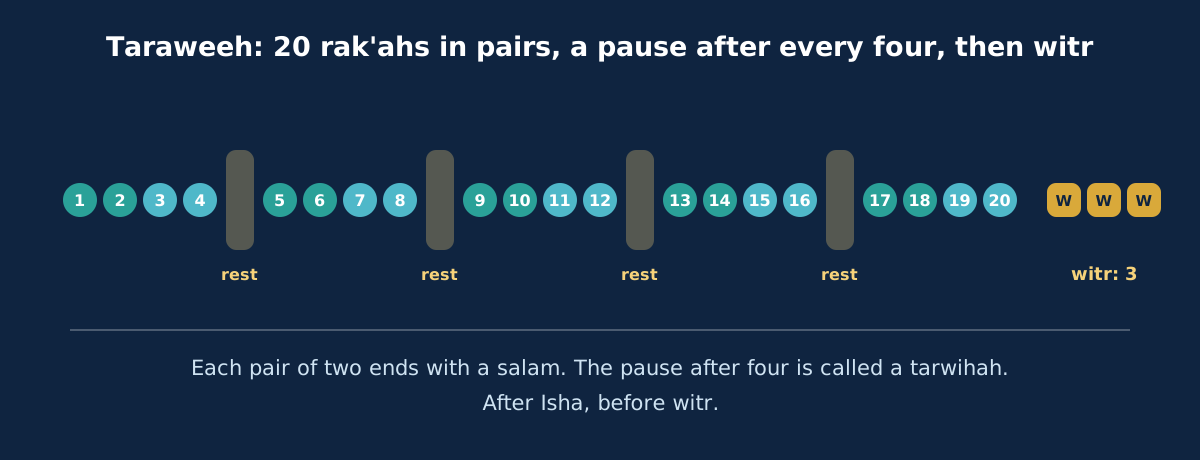
- After every four, sit for a short rest (tarwihah), about as long as the four took or less. Many people quietly make dhikr, send salawat on the Prophet ﷺ or sit in silence; no fixed words are required.
- Complete twenty, then pray witr.
Touchez le bon endroit The first rest
Tap where the first rest (tarwihah) comes.
Voir la réponse
The first rest comes after four rak'ahs, that is after the second pair.
Regarder
At home, or at the masjid?

For men, praying taraweeh in congregation at the masjid is the Sunnah way, and the masjid as a whole must keep it alive. A man who prays at home has prayed taraweeh, but misses the congregation.
For women, praying at home is allowed and many scholars teach that it is better. Noor's taraweeh at home is complete. She recites whatever she knows, even short surahs.
Regarder
Watch: a night of taraweeh in order
Lire
The rests between
After every four rak'ahs comes a short rest, the tarwīḥah that gives taraweeh its name. Sit for about as long as four rak'ahs took, in quiet dhikr, salawat or reflection.
There is no fixed dhikr for the rest; any remembrance is good. It is a breath, not a break for chatting or the phone.
Lire
Praying it at home
At home, pray it in twos, reciting what you know: short surahs are fine. If your family prays together, one who recites well leads.
Twenty rak'ahs with short surahs take about forty minutes. A woman who cannot stand for long may sit for some of them, as with any nafl.
Mettre en ordre
Put Noor's night in order
Mettez-les dans le bon ordre.
- Isha: fard
- Isha: sunnah
- Taraweeh: twenty rak'ahs in pairs
- Witr
Voir la réponse
Isha comes first, then taraweeh, then witr. Taraweeh is not valid before the Isha fard has been prayed.
Vrai ou faux True or false?
Someone who does not know long surahs may not pray taraweeh.
Voir la réponse
Any surahs you know are fine, even the short ones from the last part of the Quran, repeated. What matters is a calm prayer.
Réfléchissez-y
Pause and think
Taraweeh is a night meeting with the Quran. What would you like to feel in those long rak‘ahs?
Vous seul pouvez le voir. C'est gardé sur cet appareil.
Vrai ou faux True or false?
The rest after every four rak'ahs has one fixed dhikr that must be said.
Voir la réponse
There is no fixed dhikr; any remembrance, salawat or quiet reflection is good.
Réfléchissez-y
Pause and think
What is one thing from this lesson you will do differently this Ramadan?
Vous seul pouvez le voir. C'est gardé sur cet appareil.
Choisir A tired night
Noor is exhausted after work in Ramadan. What is best?
Voir la réponse
Short surahs, and sitting when needed, keep the twenty within reach on hard nights.
Révéler
Common mistakes
Think of the right answer first, then flip each card.
- "The rests are for talking." They are for quiet remembrance.
- "At home I need long surahs." Short surahs are fine.
- "If I can't do twenty, do nothing." Pray what you can, and keep coming back.
Leçon terminée
Praying it well, at the masjid or at home
Vous avez ajouté un mois à une lune qui croît au fil des mois.
Ce que vous avez appris
- Twenty in twos, with a rest after every four.
- At home, short surahs are fine.
- Sitting for some is allowed when tired.
- faits
- 0
- juste du premier coup
- 0
- à revoir
- 0
Votre action · Essayez aujourd'hui
Pray two rak‘ahs of nafl at home tonight, slowly, as practice for taraweeh.
Ce que vous avez gardé
Connectez-vous pour garder votre progression sur tous vos appareils.