
0 gardé
Entre dans la scène
In front of a mirror
A map inside your mouth
Hand on your throat, you say “ah”, then “ba”, then “ma”, and feel the sound travel forward.
Regarder
A map inside your mouth

Say “ah”, then “ba”, then “ma” with your hand on your throat. You feel the sounds move from deep inside to your lips.
Each Arabic letter has its makhraj, its exit point. Scholars grouped them into five areas.
Trouve-les
The five areas
Tap the picture to find each part. Each one opens a card.
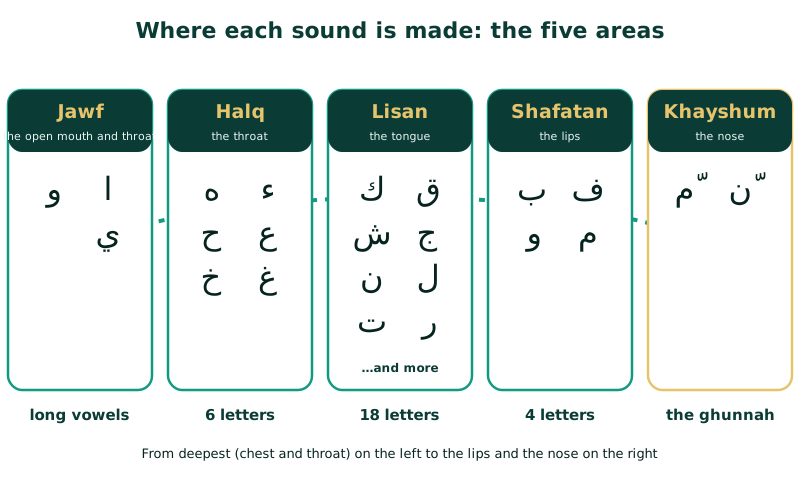
- Jawf The open space of the mouth and throat: the long vowels, alif, waw and ya, when they are stretched.
- Halq (throat) Six letters: hamzah and ha from the deepest part, ʿayn and ḥa from the middle, ghayn and kha from the top.
- Lisan (tongue) Eighteen letters, from the back of the tongue (qaf) to its tip (ta, dal, sin).
- Shafatan (lips) Four letters: fa, ba, mim and waw.
- Khayshum (nose) The ghunnah, the hum of nun and mim.
Regarder
Find it yourself
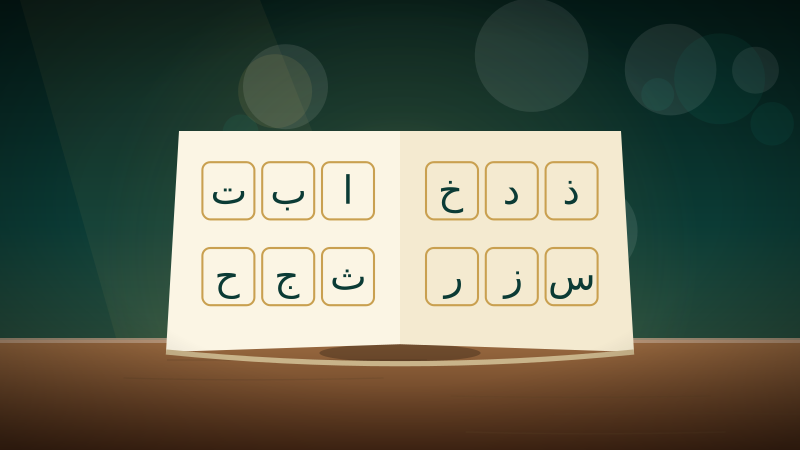
To find a letter’s exit point, put a sukun on it and a vowel before it: say “ab”, “aq”, “aʿ”. Stop on the letter and notice where your mouth closes or tightens.
The Qaida’s level 4 has a lesson for each area: “The five areas of the mouth”.
Touchez le bon endroit Tap the spot
Tap the area that makes the letters fa, ba and mim.
Voir la réponse
The lips (shafatan) make fa, ba, mim and waw.
Associer Match
Match the letter to its area
- ʿayn The throat
- qaf The tongue
- mim The lips
- the ghunnah The nose
Voir la réponse
Five areas, from the chest to the nose.
Écouter Where is it made?
Listen. Where is this letter made?
Voir la réponse
That was kha, from the top of the throat, nearest the mouth: one of the six throat letters.
Compléter le trou Fill the gap
To find a letter’s exit point, say it with a ______ and a vowel before it.
Voir la réponse
Stopping on the letter shows exactly where it is made.
Réfléchissez-y
Pause and think
The Prophet ﷺ taught each sound to the Companions by mouth, and it reached you unbroken. Which letter will you work on this week?
Vous seul pouvez le voir. C'est gardé sur cet appareil.
Écouter Listen and repeat
Listen. Which letter is this?
Voir la réponse
That was ḍad, made with the side of the tongue. Repeat it slowly.
Révéler
Common mistakes
Think of the right answer first, then flip each card.
- "Letters sound the same." Each has its own place.
- "Ḍad and dal are the same." Ḍad is heavy, from the side of the tongue.
- "Reading is enough to learn it." Listen and repeat.
Leçon terminée
Where each sound is made
Vous avez ajouté une page à un mushaf dont les pages tournent.
Ce que vous avez appris
- Five areas: throat, tongue, lips, nose, the open mouth.
- Find a letter by saying it with a vowel before it.
- Listen and repeat each one.
- faits
- 0
- juste du premier coup
- 0
- à revoir
- 0
Votre action · Essayez aujourd'hui
Say five letters with a sukun and a vowel before them (ab, aq, aʿ, am, af) and feel where each is made.
Ce que vous avez gardé
Connectez-vous pour garder votre progression sur tous vos appareils.