
0 gardé
Entre dans la scène
A lake, a kettle and a bottle
You are camping by a lake. Your friend has a kettle of tea and a bottle of rose water. Fajr is in ten minutes. Which of these can you use for wudu?
Regarder

Islam gives a clear answer. Only plain water (mā' muṭlaq: water that is still simply "water") lifts the state of impurity. This lesson shows you how to recognise it.
Trouve-les
Plain water comes in many forms
Explore the picture: find all 6 points.
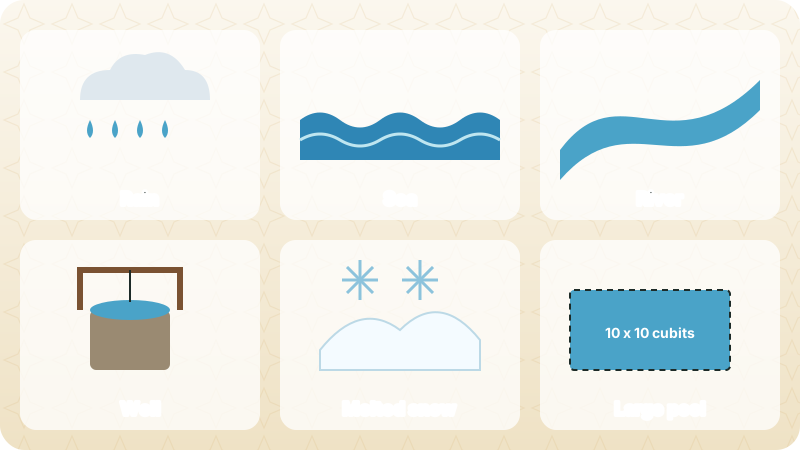
- Rain Rain falls pure and purifying. Collected rainwater is perfect for wudu.
- Sea Salty, but still plain water. Use it freely.
- River Running water stays pure unless an impurity changes its colour, taste or smell.
- Well Well and spring water are plain water.
- Melted snow Snow and hail, once melted, are plain water.
- Large pool A pool of about ten by ten cubits counts as "much" water (see the next screens).
Du Coran
Allah sends down pure water
وَهُوَ ٱلَّذِىٓ أَرْسَلَ ٱلرِّيَٰحَ بُشْرًۢا بَيْنَ يَدَىْ رَحْمَتِهِۦ ۚ وَأَنزَلْنَا مِنَ ٱلسَّمَآءِ مَآءًۭ طَهُورًۭا﴿48﴾
48 And He it is Who sendeth the winds, glad tidings heralding His mercy, and We send down purifying water from the sky,
Révéler
What the verse teaches
Think about it first, then open the card.
- What does the verse teach? Water is a gift sent down to clean us, inside and out. So treat it with thanks. Use it well, and do not waste it, even beside a river. Every water that still carries the plain name "water" can be used: tap water, bottled water, sea water, a little water that has picked up dust or leaves.
Du hadith
The sea is pure
وَعَنْ أَبِي هُرَيْرَةَ قَالَ: سَأَلَ رَجُلٌ رَسُولَ اللَّهِ صَلَّى اللَّهُ عَلَيْهِ وَسَلَّمَ فَقَالَ يَا رَسُولَ اللَّهِ إِنَّا نَرْكَبُ الْبَحْرَ وَنَحْمِلُ مَعَنَا الْقَلِيلَ مِنَ الْمَاءِ فَإِنْ تَوَضَّأْنَا بِهِ عَطِشْنَا أفنتوضأ من مَاء الْبَحْرِ فَقَالَ رَسُولُ اللَّهِ صَلَّى اللَّهُ عَلَيْهِ وَسَلَّمَ: «هُوَ الطَّهُورُ مَاؤُهُ الْحِلُّ مَيْتَتُهُ» . رَوَاهُ مَالك وَالتِّرْمِذِيّ وَالنَّسَائِيّ وَابْن مَاجَه والدارمي
Abu Huraira said that a man told God’s messenger that he sailed on the sea taking a small quantity of water with him. As he would suffer from thirst if he used this for ablution, he asked whether he might use sea water for that purpose, and received the reply, “Its water is pure, and what dies a natural death in it is lawful food.” Malik, Tirmidhi, Abu Dawud, Nasa'i, Ibn Majah and Darimi transmitted it.
Révéler
What does the hadith teach?
Think about it first, then open the card.
- Sea water and the sailor A sailor was afraid of running out of drinking water. The Prophet ﷺ told him the sea itself was pure. The lesson for us: you never have to save your drinking water and pray without wudu when the sea is beside you.
Regarder
Watch: Plain water comes in many forms
Choisir Which can you use?
Which of these can you use for wudu?


Voir la réponse
Sea water is plain water. Tea and rose water have become different drinks with their own names, so they no longer purify.
Regarder
When water stops being "plain"
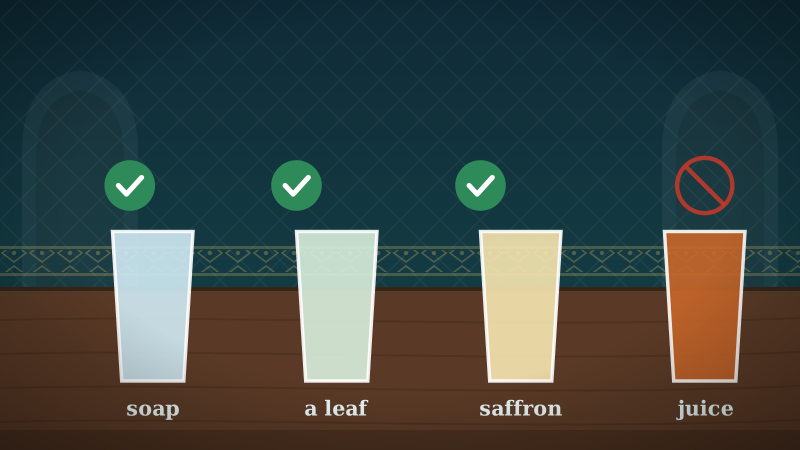
- Still usable: water with a little soap, dust, leaves or saffron, as long as it stays thin and is still called water.
- Not usable: water that has become something else: tea, juice, broth, vinegar, rose water.
- Used water (musta'mal): water that has run off your limbs in wudu or ghusl. It is clean, so a splash on your clothes is fine, but it does not purify again.
Lire
Used water
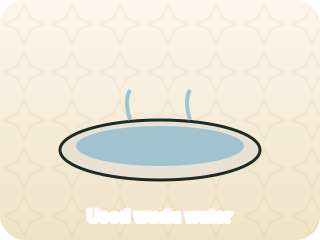
Water that has already run off your limbs in wudu or ghusl is mā' musta'mal, used water. It is pure: a splash on your clothes is nothing to worry about. But it cannot purify again. You may not collect it in a bowl and use it for another wudu.
Water becomes "used" once it leaves the limb. Water still in your jug is not used just because you scooped from it with your hand.
Go deeper: when water becomes used
Water is used when it lifted a state of impurity (wudu or ghusl) or was used as an act of worship, such as a fresh wudu made for the reward. It is used the moment it leaves the body. A little used water that falls into a larger amount of plain water does not spoil it, as long as the plain water is more. This is the position the scholars give fatwa on.
Trie
Usable or not?
Sort each card: Usable, or Not usable, or Clean but cannot purify again?
Usable
- Tap water with a little soap
- Melted snow
Not usable
- A cup of green tea
Clean but cannot purify again
- Water dripping off your arm in wudu
Lire
Little water and much water
The amount matters when impurity falls in:
- Little still water, such as a bucket or a sink: a drop of urine makes it impure, even if you cannot see any change.
- Much or running water, such as a river or a pool of about ten by ten cubits (roughly 4.5 m each side): it stays pure unless the impurity changes its colour, taste or smell.
Lire
Water left over by people and animals

What is left in a cup after someone drinks is called su'r. Its ruling follows the one who drank:
- People, any person, Muslim or not, man or woman: pure.
- Animals we may eat, such as sheep, cows and camels: pure.
- Cats, house mice and birds of prey: clean but disliked. Use other water if you have it.
- Dogs, pigs and beasts of prey: impure.
Go deeper: the donkey, the mule and two jugs
The leftover of a donkey or a mule is called doubtful in the school. If it is the only water you have, make wudu with it and then make tayammum, and pray.
If you have two jugs and know one is impure but not which: for drinking you may choose by your best guess. For wudu, when half or most of the jugs are impure, do not guess: use other water, or tayammum.
Compléter le trou Fill the gap
A drop of urine falls into a small bucket of still water. The water is now ______.
Voir la réponse
Little still water becomes impure when impurity falls in, even if you cannot see it. Pour it away and refill.
Lire
When you are unsure about water
A hotel tap, a public fountain, a stream in the hills: you do not know where the water has been. The rule is simple. Water is pure until you know otherwise. A doubt, a strange colour from mud or rust, or a leaf in it changes nothing.
What changes the ruling is knowledge: you saw impurity fall into a small amount of still water, or impurity has changed the water's colour, taste or smell.
Révéler
Common mistakes
Think of the right answer first, then flip each card.
- "Rose water is clean, so it is fine for wudu." Clean is not enough. Rose water, tea and juice are no longer plain water, so they cannot lift the state of impurity. Only water still simply called water does.
- "A little soap spoils the water." Not if the water stays thin and is still called water. Soap, dust, leaves or a little saffron do not take away its power to purify.
- "Muddy river water cannot be used." Mud and rust are pure. Only an impurity that changes the colour, taste or smell, or that falls into a little still water, makes it impure.
- "More water, more reward." Washing each part more than three times is wasteful, even beside a river. Use enough, and no more.
Leçon terminée
Which water can you use?
Vous avez ajouté une rak'a à un tapis de prière qui se remplit, rak'a après rak'a.
Ce que vous avez appris
- Only plain water, still simply called water, lifts the state of impurity.
- Used water is pure but cannot purify again.
- Leftovers follow the one who drank: people pure, a cat disliked, a dog impure.
- faits
- 0
- juste du premier coup
- 0
- à revoir
- 0
Votre action · Essayez aujourd'hui
Next time you are near rain, the sea or a lake, remember: all plain water purifies. Use it for wudu without worry.
Ce que vous avez gardé
Connectez-vous pour garder votre progression sur tous vos appareils.