
0 gardé
Entre dans la scène
A third of the Quran
After Fajr a man recites one short surah over and over, all night. In the morning his friend thinks it too little. The Prophet ﷺ says it equals a third of the Quran.
Du Coran
Al-Ikhlas
بِسْمِ ٱللَّهِ ٱلرَّحْمَٰنِ ٱلرَّحِيمِ قُلْ هُوَ ٱللَّهُ أَحَدٌ﴿1﴾ ٱللَّهُ ٱلصَّمَدُ﴿2﴾ لَمْ يَلِدْ وَلَمْ يُولَدْ﴿3﴾ وَلَمْ يَكُن لَّهُۥ كُفُوًا أَحَدٌۢ﴿4﴾
1 Say: He is Allah, the One!
2 Allah, the eternally Besought of all!
3 He begetteth not nor was begotten.
4 And there is none comparable unto Him.
Regarder
The key words
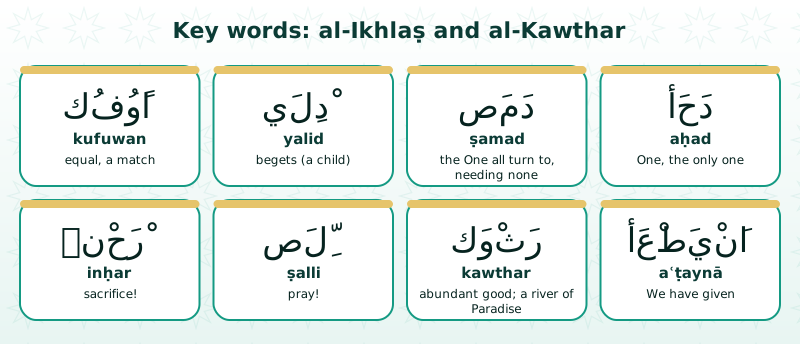
Aḥad, One; aṣ-ṣamad, the One all turn to, needing none; lam yalid, He did not beget; kufuwan, an equal.
Four short verses: who Allah is, and who He is not.
Touchez le bon endroit Tap the spot
Tap the word for the One all turn to, needing none.
Voir la réponse
Ṣamad: with al-, aṣ-Ṣamad, the only One who is so.
Trace-la
Trace aḥad
Trace aḥad, One: alif with hamzah, then ḥa, then dal.
أحد
aḥad
Mot à mot
Word by word
- وَلَمْ walam did not (makes the following verb past and negative)
- يَكُن yakun to be, was; (kana yaf'al) used to do · كون
- لَّهُۥ lahū for, to, belonging to (a one-letter word joined to the next)
- كُفُوًا kufuwan
- أَحَدٌۢ aḥadun one; anyone; (with a negative) no one · أحد
And there is none comparable unto Him.
Lire
A word order that ends on One
In the last verse, the word for an equal comes before aḥad, so the surah ends on the word One. And lam with a present verb says: He did not, and never did.
The grammar of al-Ikhlas is the grammar of tawḥīd.
Go deeper: three small tools
Three small tools carry al-Ikhlas. Qul, say!, is a command. The al- of aṣ-ṣamad singles out: the One, and no other. And lam before a present verb means did not, never did: lam yalid, lam yūlad.
Trie
Sort them
Which grammar?
lam: did not
- lam yalid
- lam yūlad
al-: the one alone
- aṣ-ṣamad
a command
- qul
Du hadith
A third of the Quran
وعن أبي سعيد الخدري رضي الله عنه أن رسول الله صلى الله عليه وسلم قال في:{ قل هو الله أحد}:" والذي نفسي بيده، إنها لتعدل ثلث القرآن". وفي رواية: أن رسول الله صلى الله عليه وسلم قال لأصحابه:" أيعجز أحدكم أن يقرأ بثلث القرآن في ليلة" فشق ذلك عليهم، وقالوا: أينا يطيق ذلك يارسول الله: فقال :" {قل هو الله أحد} ثلث القرآن.". (( رواه البخاري)).
Abu Sa'id Al-Khudri (May Allah be pleased with him) reported about Surat Al-Ikhlas (Chapter 112): The Messenger of Allah (ﷺ) said, "By Him in Whose Hand my soul is, it is equivalent to one-third of the Qur'an."According to another version, he (ﷺ) said to his Companions, "Is anyone of you incapable of reciting one-third of the Qur'an in one night?" They considered it burdensome and said: "O Messenger of Allah, which of us can afford to do that?" He (ﷺ) said, "Surat Al-Ikhlas .
Choisir A third of the Quran
Al-Ikhlas is described as equal to a third of the Quran. What does that mean for you?
Voir la réponse
Scholars explain that much of the Quran is about who Allah is, and al-Ikhlas is that, pure. Its reward is great; it is no reason to leave the rest.
Du Coran
Al-Kawthar
بِسْمِ ٱللَّهِ ٱلرَّحْمَٰنِ ٱلرَّحِيمِ إِنَّآ أَعْطَيْنَٰكَ ٱلْكَوْثَرَ﴿1﴾ فَصَلِّ لِرَبِّكَ وَٱنْحَرْ﴿2﴾ إِنَّ شَانِئَكَ هُوَ ٱلْأَبْتَرُ﴿3﴾
1 Lo! We have given thee Abundance;
2 So pray unto thy Lord, and sacrifice.
3 Lo! it is thy insulter (and not thou) who is without posterity.
Lire
Al-Kawthar: a gift, so pray
Innā aʿṭaynāka: indeed We have given you. The surah opens with a gift.
Then fa-ṣalli: so pray, and sacrifice, for your Lord. The fa- means: because of the gift. The last verse turns to reassurance. Three verses: a gift, a response, comfort.
Go deeper: the grammar
Inna, indeed, with -nā, We. Aʿṭaynā, We gave, with -ka, you. Fa- links a cause to its result: so. And inna comes back to open the last verse.
Choisir Check
Fa-ṣalli li-rabbika: what does fa- add?
Voir la réponse
Fa joins the command to the gift before it.
Vrai ou faux True or false?
Al-Kawthar is the shortest surah of the Quran.
Voir la réponse
True. Al-Kawthar, with three short verses, is the shortest surah.
Lire
For your life

When to recite them: al-Ikhlas with al-Falaq and an-Nas, morning, evening and before sleep. Al-Kawthar, the shortest surah, is easy for a first salah.
In the first two rakʿahs of a fard prayer, after al-Fatihah, you add a surah or at least three short verses: wajib. Al-Kawthar's three verses are enough.
Go deeper: what counts as enough
The least that fulfils the wajib is three short verses, or one long verse of about the same length, after al-Fatihah. In witr and voluntary prayers you add it in every rakʿah.
Révéler
Common mistakes
Think of the right answer first, then flip each card.
- Praying with al-Kawthar alone for years It is a fine start; add more surahs so your prayer grows with you.
- Saying aḥad with a light h Ḥa from the throat: aḥad.
- Taking ṣamad only as "eternal" The One all turn to in need, who needs no one.
Lire
A moment for the heart

Whatever you need today, you turn to aṣ-Ṣamad: the One who needs nothing, and to whom everything turns.
You are never asking too much of Him.
Révéler
In short
Answer each one in your head first, then tap to check.
- What does aṣ-ṣamad mean? The One all turn to, needing none.
- What does the fa- of fa-ṣalli add? So: pray, because of the gift.
- After al-Fatihah, what is the least you add in the first two rakʿahs? A surah, or three short verses.
Leçon terminée
Al-Ikhlas and al-Kawthar
Vous avez ajouté une page à un mushaf dont les pages tournent.
Ce que vous avez appris
- Al-Ikhlas: tawḥīd in its grammar. Al-Kawthar: a gift, so pray.
- faits
- 0
- juste du premier coup
- 0
- à revoir
- 0
Votre action · Essayez aujourd'hui
Recite al-Ikhlas three times today, and al-Kawthar in a sunnah prayer.
Ce que vous avez gardé
Connectez-vous pour garder votre progression sur tous vos appareils.