
0 gardé
Entre dans la scène
A laptop and a video
Easy money?
“List products you don’t own, take payment, then order from the supplier.” Easy money, the video says.
Regarder
The shop that owns nothing
Huda wants to start an online shop. A video says: “List products from a supplier. When someone pays, order it from the supplier to their door. You never touch the stock.” Is this a valid sale?
Trouve-les
Five pillars of a sale
Tap the picture to find each part. Each one opens a card.
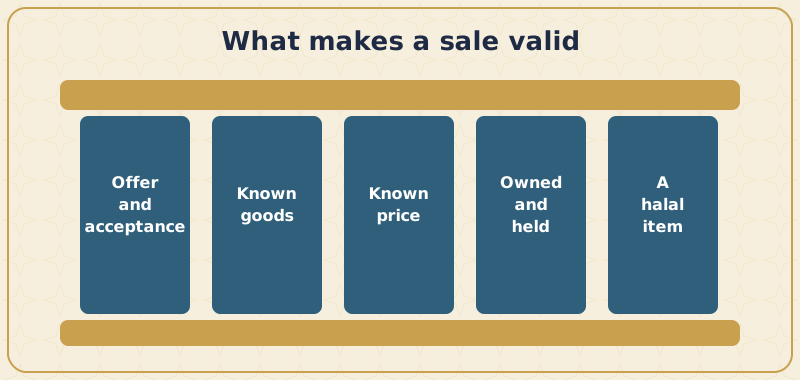
- Offer and acceptance Both agree, freely. A click on “buy” counts.
- Known goods What is sold is clearly described: kind, quality, amount.
- Known price The price and when it is paid are fixed at the deal.
- Owned and held The seller owns the goods and has taken possession of them.
- A halal item No alcohol, pork, idols or other haram goods.
Du hadith
Own it before you sell it
وَعَنْ حَكِيمِ بْنِ حِزَامٍ قَالَ: نَهَانِي رَسُولُ اللَّهِ صَلَّى اللَّهُ عَلَيْهِ وَسَلَّمَ أَنْ أَبِيعَ مَا ليسَ عندِي. رَوَاهُ التِّرْمِذِيّ فِي رِوَايَةٍ لَهُ وَلِأَبِي دَاوُدَ وَالنَّسَائِيُّ: قَالَ: قُلْتُ: يَا رَسُولَ اللَّهِ يَأْتِينِي الرَّجُلُ فَيُرِيدُ مِنِّي الْبَيْعَ وَلَيْسَ عِنْدِي فَأَبْتَاعُ لَهُ مِنَ السُّوقِ قَالَ: «لَا تبِعْ مَا ليسَ عندَكَ»
Hakim b. Hizam said God's Messenger forbade him to sell anything which was not in his possession. Tirmidhi transmitted it. In a version by Abu Dawud and Nasa’i, he had said, “Messenger of God, a man comes to me and wants me to sell him something, but I do not have it and so I buy it for him from the market.” He replied, “Do not sell what you do not possess.”
Du hadith
No sale of uncertainty
وَعَنْ أَبِي هُرَيْرَةَ قَالَ: نَهَى رَسُولُ اللَّهِ صَلَّى اللَّهُ عَلَيْهِ وَسَلَّمَ عنْ بيعِ الحصاةِ وعنْ بيعِ الغَرَرِ. رَوَاهُ مُسلم
Abu Huraira said that God’s Messenger forbade a transaction determined by throwing stones1, and the type which involves some uncertainty2. Muslim transmitted it. 1. A type of transaction in which it is made binding when the buyer or the seller throws a stone; or in which a man agrees to sell to another all the commodities on which stones which he throws alight; or in which one agrees to sell another some land up to the distance to which he can throw a stone. 2. Bai' al-gharar. One might translate this ‘aleatory contracts of sale’, but this is not the only term to which that applies. The type of transaction intended is one in which there is no guarantee that the seller can deliver the goods for which he receives payment. It could include such items as selling a runaway slave, or fish which one has not caught, etc.
Lire
A clear price and clear goods
The price must be known when you agree: "I'll pay what it's worth later" is not a sale. The goods must be known too: what, how many, what condition.
Online this means a clear description and photos, a stated price with delivery included or listed, and no hidden charges added at the checkout.
Regarder
What these teach

The first hadith forbids selling something you do not yet own. Movable goods must also be in your possession before you sell them on. The second forbids deals built on serious uncertainty (gharar), such as selling a fish still in the sea.
Que feriez-vous ?
Huda’s shop

A customer pays Huda for a lamp she has not yet bought from the supplier.
- Keep the plan: it works for everyoneShe is selling what she does not own or hold.
- Change the modelThere are halal ways to do the same business.
Lire
Fixing a dropshipping shop
Huda has two halal ways forward:
- Agency: she sells as the supplier's agent for a fixed commission, saying so clearly. The supplier owns and sells the goods.
- A promise, then a sale: she takes a promise to buy, buys the lamp, takes possession (herself or through her agent), then sells it.
Lire
Returns and conditions

Conditions both sides agree to are binding, if they are fair and not haram: a 30-day return, a warranty, free delivery over a certain amount.
A shop must honour its stated policy. A buyer must not abuse it, such as wearing a dress to a wedding and returning it as unworn.
Construis-le
A halal online shop
Put the steps in order for selling goods you buy from a supplier.
- Buy the item from the supplier
- Take possession, yourself or through your agent
- List it with a clear price and description
- Sell it to the customer
Associer
Which pillar is missing?
Associez chacun à sa paire.
- “I’ll sell you whatever is in this box” Known goods
- “Pay me whatever, whenever” Known price
- Selling your neighbour’s bike without asking Owned and held
- Selling beer A halal item
Voir la réponse
A box of unknown contents lacks known goods, and pay whatever, whenever lacks a known price. Each pillar of a sale protects both sides from harm.
Révéler
Common mistakes
Think of the right answer first, then flip each card.
- "Dropshipping is always haram." Selling what you do not own is the problem. Agency or a promise-then-sale fixes it.
- "Price can be decided later." The price must be known when the sale is agreed.
- "Return policies are just for shops." Agreed conditions bind both sides, fairly.
- "A click isn't a real contract." Offer and acceptance online are a real sale.
Réfléchissez-y
Pause and think
Think of the last thing you sold, online or face to face. Did it meet all five pillars?
Vous seul pouvez le voir. C'est gardé sur cet appareil.
Leçon terminée
What makes a sale valid
Vous avez ajouté une clé à un trousseau de clés rassemblées.
Ce que vous avez appris
- Offer and acceptance, known goods, a known price, owned and deliverable.
- Own it before you sell it.
- Dropshipping: be an agent, or sell after you own.
- faits
- 0
- juste du premier coup
- 0
- à revoir
- 0
Votre action · Essayez aujourd'hui
If you sell online, check that you own and hold what you list.
Ce que vous avez gardé
Connectez-vous pour garder votre progression sur tous vos appareils.