
0 gardé
Entre dans la scène
A repair kit inside the prayer
Everyone forgets. Allah gave the prayer its own repair: two extra prostrations, sajdah sahw (the prostration of forgetfulness). But it does not fix everything. The key is to know what kind of thing you missed.
Regarder
The decision
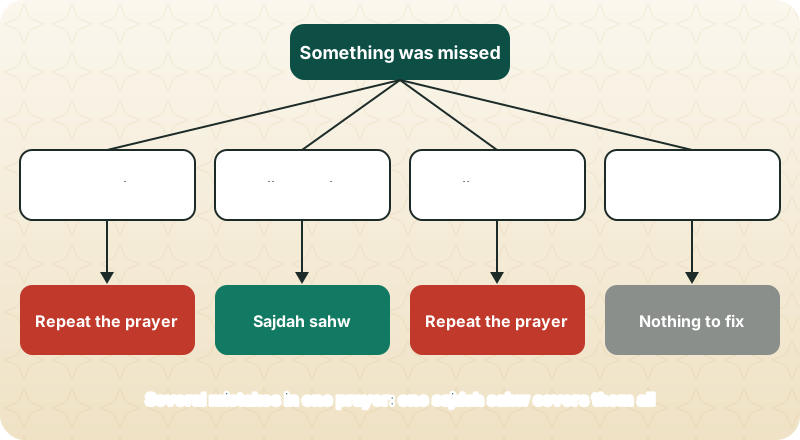
Follow the chart from the top: was the act a pillar, a wajib or a Sunnah? Was it left by mistake or on purpose? Two questions, and you know whether to carry on, add sajdah sahw, or pray again.
Côte à côte
Three levels of acts
| If you miss | Example | What to do |
|---|---|---|
| A fard (pillar) | A ruku, a sujud, the final sitting | The prayer is not valid. Repeat it. |
| A wajib, by mistake | Al-Fatihah, the surah, the first sitting, stillness, qunut in witr | Sajdah sahw at the end |
| A wajib, on purpose | Skipping the first sitting deliberately | Sajdah sahw does not fix it. Repeat the prayer. |
| A sunnah | The thana, raising the hands, the glorifications | Nothing. The prayer is complete. |
Lire
The wajibs, one list
These are the wajib acts of salah that sajdah sahw repairs when missed by mistake:
- al-Fatihah; a surah after it in the first two rak'ahs of the fard (and every rak'ah of others); al-Fatihah before the surah;
- stillness in each position; the second sujood straight after the first;
- the first sitting; the tashahhud in each sitting; standing for the third rak'ah without delay;
- the word of salam; the qunut in witr; the extra takbirs of Eid;
- the imam reciting aloud or quietly in its place.
Lire
Delay is a mistake too

A wajib or fard can be missed by being delayed. Say you stay silent by mistake, lost in thought, for as long as a pillar takes (about three tasbihs). Or in the first sitting you carry on into the salawat as far as Allāhumma ṣalli 'alā Muḥammad. Either way the next act has been delayed: sajdah sahw is due.
Pausing a moment to remember is no harm. A long, lost silence is.
Du hadith
He forgot the first sitting
وَعَن عبد لله بن بُحَيْنَة: أَنَّ النَّبِيَّ صَلَّى اللَّهُ عَلَيْهِ وَسَلَّمَ صَلَّى بِهِمُ الظُّهْرَ فَقَامَ فِي الرَّكْعَتَيْنِ الْأُولَيَيْنِ لَمْ يَجْلِسْ فَقَامَ النَّاسُ مَعَهُ حَتَّى إِذَا قَضَى الصَّلَاةَ وَانْتَظَرَ النَّاسُ تَسْلِيمَهُ كَبَّرَ وَهُوَ جَالِسٌ فَسَجَدَ سَجْدَتَيْنِ قَبْلَ أَنْ يُسَلِّمَ ثُمَّ سَلَّمَ
‘Abdallah ibn Buhaina said that the Prophet led them in the noon prayer, and when he stood up at the end of the first two rak'as and did not sit, the people stood up along with him. When he finished the prayer and the people expected him to give the salutation, he said “God is most great" while sitting and made two prostrations before giving the salutation. Then he gave it. (Bukhari and Muslim.)
Révéler
What the hadith teaches
Think about it first, then open the card.
- What is the lesson for you? The Prophet ﷺ stood up after two rak'ahs of Dhuhr without sitting. The people stood with him. At the end he made two prostrations to repair it. Three lessons: even the Prophet ﷺ forgot, so forgetting is human; the first sitting is a repairable act, not a pillar; and the congregation follows the imam's repair.
Trie
Match the mistake to its fix
Sort each card: Sajdah sahw, or Repeat the prayer, or Nothing?
Sajdah sahw
- Forgot the first sitting in Asr
- Forgot the surah after al-Fatihah in rak'ah 1
Repeat the prayer
- Forgot a whole ruku
Nothing
- Forgot the thana
Compléter le trou Fill the gap
You made three different wajib mistakes in one prayer. You do sajdah sahw ______.
Voir la réponse
One sajdah sahw at the end covers every mistake in that prayer.
Lire
A worked case: Asr with two slips
In Asr, Sana forgets the surah after al-Fatihah in rak'ah 2, then sits too long in the first sitting, lost in thought.
Two wajib slips, both by mistake. She does one sajdah sahw at the end: it covers every mistake in the prayer. Had she skipped the surah on purpose, sajdah sahw would not do: she would pray Asr again within its time.
Lire
In every prayer
Sajdah sahw belongs to every prayer: fard, witr, sunnah and nafl.
At a crowded Jumu'ah or Eid, the scholars allow the imam to leave sajdah sahw out, so the huge rows are not thrown into confusion; the prayer stands. In a normal congregation the imam does it and every follower prostrates with him.
Go deeper: when it is not needed
Sajdah sahw is never for a missed sunnah, such as the thana or the tasbihs, and never for a fard: a missed pillar means the rak'ah, or the prayer, must be redone. It is only for wajib acts missed, delayed, repeated or changed by mistake.
Choisir Check your understanding
You skipped the first sitting on purpose to finish quickly. What now?
Voir la réponse
Sajdah sahw repairs forgetfulness. Leaving a wajib on purpose is a sin, and the prayer must be repeated.
Révéler
Common mistakes
Think of the right answer first, then flip each card.
- "I forgot a ruku, so I'll do sajdah sahw." A ruku is a pillar. Sajdah sahw cannot replace it; the prayer must be repeated.
- "Two mistakes, two sets of sajdah sahw." One sajdah sahw covers every mistake in the prayer.
- "I missed the thana; better do sajdah sahw." The thana is Sunnah. Nothing is needed.
- "Skipping a wajib on purpose is fine if I do sajdah sahw." Sajdah sahw is for mistakes. Leaving a wajib on purpose means praying again in the time.
Réfléchissez-y
A mercy built in
The prayer comes with its own repair because Allah knows we forget. How does that change the way you feel about your own mistakes in prayer?
Vous seul pouvez le voir. C'est gardé sur cet appareil.
Leçon terminée
What sajdah sahw repairs
Vous avez ajouté une rak'a à un tapis de prière qui se remplit, rak'a après rak'a.
Ce que vous avez appris
- Fard missed: repeat. Wajib missed by mistake: sajdah sahw. Sunnah: nothing.
- Delaying a wajib or fard by a pillar's length, by mistake, also needs sajdah sahw.
- One sajdah sahw for all the mistakes of a prayer.
- faits
- 0
- juste du premier coup
- 0
- à revoir
- 0
Votre action · Essayez aujourd'hui
Learn the three levels by heart today, fard, wajib and sunnah, and which one sajdah sahw repairs.
Ce que vous avez gardé
Connectez-vous pour garder votre progression sur tous vos appareils.