
0 guardado
Entra en la escena
A busy café
Halal or haram?
“Is praying four rak’ahs before ʿAsr compulsory?” a friend asks. Not everything is either halal or haram.
Mira
Not everything is “halal or haram”

Amina’s friend says, “Is praying four rak’ahs before Asr compulsory?” Amina is not sure. The answer is no: it is good and rewarded, but not required.
The Hanafi scholars sort every act on a scale of eight steps. Knowing the step tells you how much it matters.
Encuéntralos
The scale
Tap the picture to find each part. Each one opens a card.
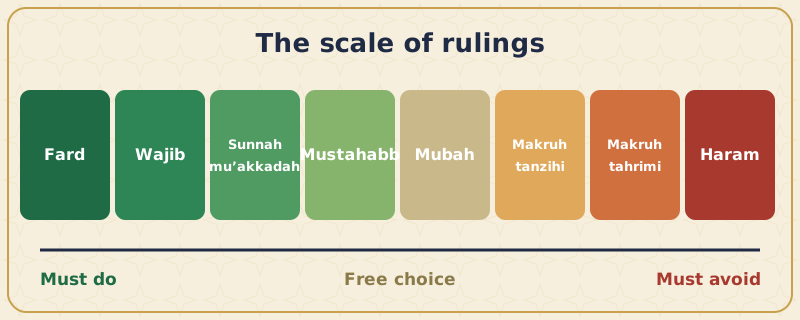
- Fard Proven by a certain proof. Leaving it is a major sin; denying it is disbelief. The five daily prayers.
- Wajib Required, by a strong but less certain proof. Leaving it is a sin. Witr; the two Eid prayers.
- Sunnah mu’akkadah The Prophet ﷺ did it regularly. Leaving it as a habit is blameworthy. Two rak’ahs before Fajr.
- Mustahabb Liked and rewarded, no blame if left. Four rak’ahs before Asr.
- Mubah Free choice. Rice or bread for dinner.
- Makruh tanzihi Better avoided; no sin. Using water a cat drank from when other water is there.
- Makruh tahrimi Close to haram; doing it is a sin. Trading after the Jumu’ah adhan.
- Haram Forbidden by a certain proof. Drinking alcohol; backbiting.
Mira
Fard and wajib: a Hanafi difference

Most schools use one word for “required”. The Hanafi school uses two:
- Fard rests on a proof that is certain, such as a clear verse.
- Wajib rests on a proof that is strong but not certain, such as a single sound hadith.
In salah you see it at once: miss a fard part and the prayer is void; miss a wajib part by mistake and sajdah sahw repairs it.
Mira
Two kinds of makruh

Makruh tanzihi is “better not”. You are not sinful, but you lose some good.
Makruh tahrimi is “almost haram”. It is sinful, though less than haram. When a Hanafi book just says “makruh”, it usually means tahrimi.
Clasifica
Fard, wajib or sunnah?
Sort each act by its Hanafi grade.
Fard
- The two rak’ahs of Fajr’s fard
- Fasting in Ramadan
Wajib
- Witr
- The Eid prayer
- Sadaqat al-fitr
Sunnah
- Four rak’ahs before Dhuhr
Clasifica
Makruh or haram?
Sort each act.
Makruh tanzihi: better not
- Drinking water standing up
Makruh tahrimi: sinful
- Praying in clothes with clear pictures of living beings
- Delaying ʿAsr until the sun turns yellow
Haram
- Eating pork
- Drinking alcohol
Lee
Most of life is mubah

Tea or coffee, blue or green, the bus or the train, football or chess: most choices of an ordinary day are mubah, allowed, with no reward or sin in themselves.
A mubah act can become rewarded through your intention: eating to have strength for work and worship, sleeping early to wake for Fajr. That is how a whole day can become worship.
Lee
The scale on a Friday
- Fard: Jumu'ah prayer, for a man.
- Wajib: going once the first adhan is called.
- Sunnah: ghusl, early arrival, al-Kahf.
- Mustahab: perfume, best clothes.
- Mubah: lunch after.
- Makruh: stepping over people.
- Haram: carrying on trading after the call.
Toca el lugar Find it on the scale
Tap the ruling that is sinful but less than haram.
Ver la respuesta
Makruh tahrimi sits right beside haram. Doing it is a sin, so treat it seriously.
Une
Match the act to its ruling
Une cada uno con su pareja.
- The five daily prayers Fard
- Witr Wajib
- Two rak’ahs before Fajr Sunnah mu’akkadah
- Choosing tea or coffee Mubah
- Drinking alcohol Haram
Ver la respuesta
These are the standard Hanafi examples. The step tells you how much each act weighs.
¿Qué harías?
"That's haram!"
A friend sees you drinking water standing and says loudly, "That's haram!" What do you say?
- "No it isn't, you're wrong!"Correcting him may be right, but harshness spoils it. There is a kinder way.
- "It's better sitting, you're right. Scholars count standing as disliked, not haram."Yes: thank him, and place it on the scale. Most things are not "halal or haram".
Piénsalo
Pause and think
Every step of the scale is Allah telling us what pleases Him. Which “better not” habit could you leave this week, just for Him?
Solo tú puedes verlo. Se guarda en este dispositivo.
Revelar
Common mistakes
Think of the right answer first, then flip each card.
- "Everything is either halal or haram." The Hanafi scale has eight steps. Most of life is mubah, and much sits in between.
- "Sunnah means I can ignore it." Leaving a stressed sunnah as a habit is blameworthy.
- "Makruh is just a word for haram." Makruh tanzihi is "better not"; makruh tahrimi is sinful but below haram.
- "Calling things haram is being careful." Calling the allowed forbidden is a serious error too. Be accurate.
Lección terminada
The Hanafi scale of rulings
Has añadido una llave a un juego de llaves reunidas.
Lo que aprendiste
- Fard, wajib, sunnah, mustahab, mubah, makruh tanzihi, makruh tahrimi, haram.
- Most of life is mubah, and intention can make it worship.
- Place an act on the scale before you call it haram.
- hechos
- 0
- bien a la primera
- 0
- para repasar
- 0
Tu obra · Pruébalo hoy
Take one act you do every day and place it on the scale.
Lo que guardaste
Inicia sesión para guardar tu progreso en todos tus dispositivos.