
0 guardado
Entra en la escena
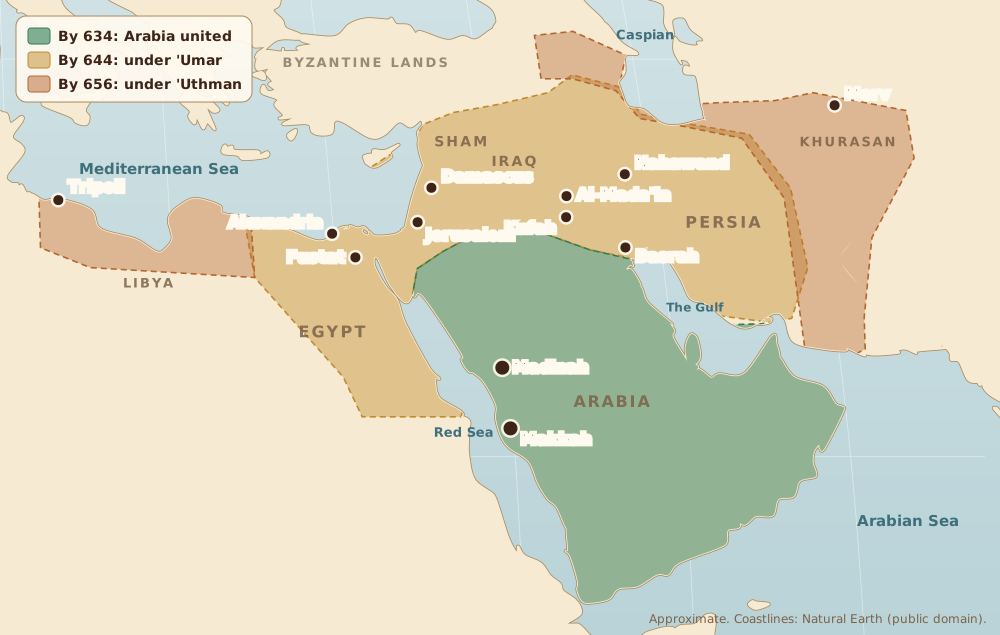
From Madinah, 632 to 656
A small city, a wide world
The map of the lands opened under the four caliphs. In twenty-five years, Arabia’s faith reached three continents.
Lee
A small city, a wide world
In 632 the Muslims ruled only Arabia. By 656, twenty-five years later, the caliph in Madinah was sending governors to Egypt, Sham (Syria and Palestine), Iraq and much of Persia.
No one planned an empire on that scale. It grew out of wars with two great powers on Arabia’s borders.
Mira
Mira
Watch: the lands open, 632 to 656
La ruta
The lands open
- Madinah The capital. Every caliph but ’Ali ruled from the Prophet’s ﷺ city.
- Damascus, 635 Sham opens. The great battle of Yarmuk follows in 636 (15 AH).
- Jerusalem, about 637–638 ’Umar travels himself to receive the city in peace.
- Al-Mada’in, 637 The Persian capital Ctesiphon falls after al-Qadisiyyah.
- Fustat, about 641 ’Amr ibn al-’As opens Egypt and founds a new city by the Nile.
- Nahawand, 642 The last great Persian army is defeated.
- Merv, 651 In ’Uthman’s time the armies reach Khurasan.
Within one generation the community stood on three continents: Asia, Africa, and soon the edge of Europe.
Mira
Why so fast? Historians differ

Historians give several reasons and weigh them differently:
- The Byzantine and Persian empires were exhausted by a long war with each other (602–628).
- The Muslim armies were united, fast and moved by faith.
- Many towns surrendered on terms that left their people, homes and churches safe.
Muslim historians also saw Allah’s help in it. Modern historians focus on the human causes. Both views can stand together.
Lee
First, holding Arabia together

When the Prophet ﷺ died, many tribes stopped paying zakat, and some followed men who claimed to be prophets, such as Musaylimah in al-Yamamah. Abu Bakr refused to let anyone keep the prayer and drop the zakat.
In about a year Arabia was united again. Many who had memorised the Quran fell at al-Yamamah in 12 AH, and that loss led to the Quran being gathered.
Go deeper: rules for the armies
Abu Bakr’s orders to his commanders are well reported: do not kill women, children or the old; do not cut down fruit trees or burn palms; do not kill animals except for food; leave alone those who have shut themselves away in worship.
Elige Check
Who led the Muslims at al-Qadisiyyah, against the Persian army?
Ver la respuesta
Sa’d led in Iraq. Khalid fought mainly in Sham, at Yarmuk, and ’Amr opened Egypt.
Lee
Two battles that changed the map

Under ’Umar two battles decided everything, both in about 15 AH (636 CE; reports differ on the exact year of the second). At Yarmuk in Sham the Byzantine army was broken, and Damascus and Jerusalem followed. At al-Qadisiyyah in Iraq the Persian army fell, and soon the Persian capital, Ctesiphon.
After that, the old powers could not stop the advance.
Clasifica
Which caliph?
Sort each event to its caliph.
Abu Bakr
- The wars of the riddah
’Umar
- Jerusalem received in peace
- Fustat founded in Egypt
’Uthman
- The Quran copied for the cities
’Ali
- Kufah made the capital
Toca el lugar Find the city
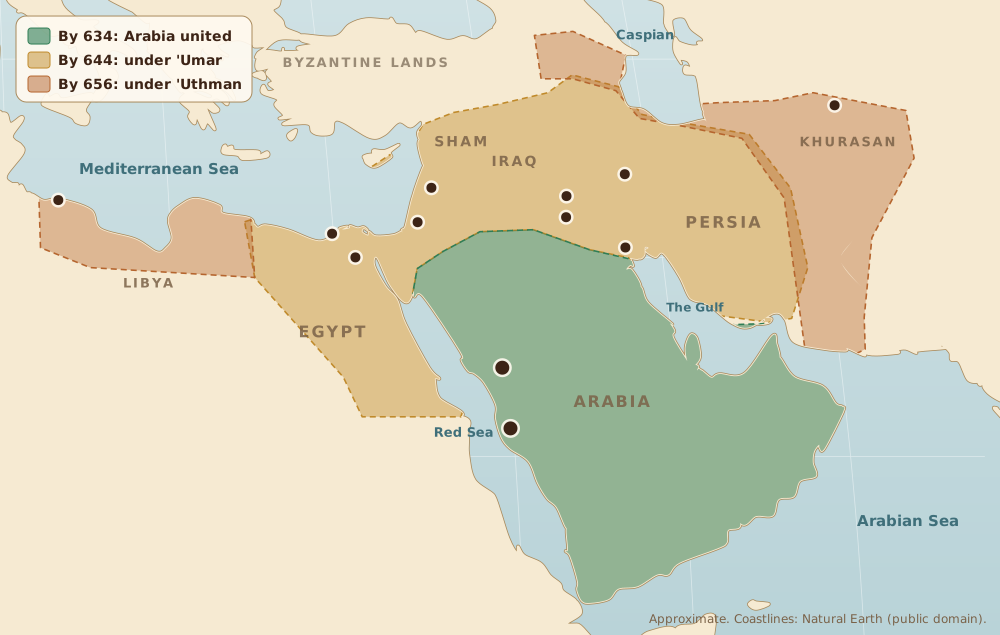
Tap Fustat, the new city of Egypt.
Ver la respuesta
Fustat stood beside the Nile, where Cairo is today.
Completa el hueco Fill the gap
The two great empires on Arabia’s borders were the Byzantine and the ______ empires.
Ver la respuesta
The Persian (Sasanian) empire ruled Iraq and Iran. It ended in the time of ’Umar and ’Uthman.
Piénsalo
Why so fast?
Historians differ on why the lands opened so fast: tired empires, the justice of the newcomers, faith. Which reason do you think mattered most, and why?
Solo tú puedes verlo. Se guarda en este dispositivo.
Revelar
Common mistakes
Flip each card: what people often get wrong, and what is right.
- “The caliphs planned a world empire from day one.” The advance grew out of border wars with two hostile powers.
- “Abu Bakr let tribes pray and skip zakat.” He refused: prayer and zakat stand together.
- “The Muslim armies won by sheer numbers.” Reports usually give them fewer men than their enemies, though old numbers are uncertain.
Lee
For your life

Abu Bakr would not split the religion into the easy part and the costly part. Check yourself: is there a duty you keep and one you quietly skip, such as zakat on savings or a debt you owe? Put the skipped one right this month.
Revelar
The lesson in three lines
Sum up the lesson in your own words first, then tap to check.
- The lesson in one line Abu Bakr first held Arabia together in the Riddah wars. Under ’Umar, Yarmuk and al-Qadisiyyah broke the Byzantine and Persian armies. In about twenty-five years the caliphate reached from Egypt to Persia.
Lección terminada
From Madinah to three continents
Has añadido un siglo a un mapa cuyas fronteras cambian.
Lo que aprendiste
- In about twenty-five years the caliphate reached from Egypt to Persia.
- hechos
- 0
- bien a la primera
- 0
- para repasar
- 0
Tu obra · Pruébalo hoy
Look at a map today and find Fustat, Damascus and Kufah.
Lo que guardaste
Inicia sesión para guardar tu progreso en todos tus dispositivos.