
0 guardado
Entra en la escena
The great square of Isfahan
Isfahan, about 1600
A vast square ringed with arcades, a blue-tiled mosque at one end. Between the Ottomans and the Mughals, a third empire.
Mira
Isfahan, about 1600
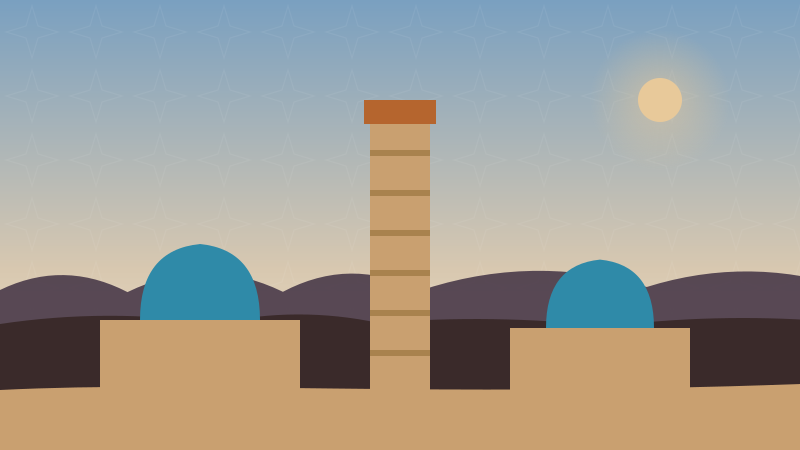
A vast square, longer than four football pitches, ringed by arcades. On one side, a mosque covered in blue tiles. On another, a palace with a high open veranda. Polo is played in the middle.
This is Isfahan, capital of Shah ’Abbas. People said: “Isfahan is half the world.”
Mira
The Safavids

In 1501 Shah Isma’il founded the Safavid state in Iran, with Tabriz as its first capital. He made Twelver Shi’ism the religion of the state, and over the next two centuries most of Iran’s people came to follow it.
The Safavids fought the Ottomans in the west, at Chaldiran in 1514, and the Uzbeks and Mughals in the east.
Lado a lado
Three empires side by side, about 1600
| Topic | Ottomans | Safavids | Mughals |
|---|---|---|---|
| Capital | Istanbul | Isfahan | Agra, Delhi, Lahore |
| Founded | About 1299 | 1501 | 1526 |
| Ruler’s title | Sultan, later also caliph | Shah | Padishah |
| Main school of law | Hanafi | Twelver Shi’i (Ja’fari) | Hanafi |
| Court language | Ottoman Turkish | Persian | Persian |
| Famous building | Süleymaniye Mosque | The great square of Isfahan | Taj Mahal |
Lee
Gunpowder empires

Historians sometimes call them the “gunpowder empires”, because cannon and muskets helped them win and hold land. All three were also centres of art, poetry, law and learning.
Persian linked them: it was the language of poets and courts from Istanbul to Delhi, the way English links many countries today.
Lee
Sunni and Shi’i, told fairly

Twelver Shi’is hold that leadership after the Prophet ﷺ belonged to ’Ali and eleven imams after him. Sunnis follow the way of the four caliphs and the companions. Both pray, fast Ramadan and go on Hajj; they differ in some beliefs and practices.
Before 1501 most of Iran was Sunni. The Safavid state pressed its people to convert, at times by force.
Go deeper: Chaldiran and the border
In 1514 the Ottomans defeated the Safavids at Chaldiran, helped by their cannon. After more than a century of wars, a treaty in 1639 drew a border close to today’s border between Iran and its western neighbours.
Elige Check
What was most of Iran before the Safavids came to power in 1501?
Ver la respuesta
Iran became mostly Shi’i over the two centuries after 1501, pressed by the state.
Lee
Isfahan’s mosques

Shah ’Abbas made Isfahan a city of tiles. The great mosque on the square, and the smaller Shaykh Lutfallah mosque facing the palace, are covered inside and out in blue, turquoise and gold tilework of flowers, patterns and calligraphy.
Persian was the language of poetry across all three empires, from Istanbul to Delhi.
Encuéntralos
Explore the map
Find the capitals and frontiers of the three empires.
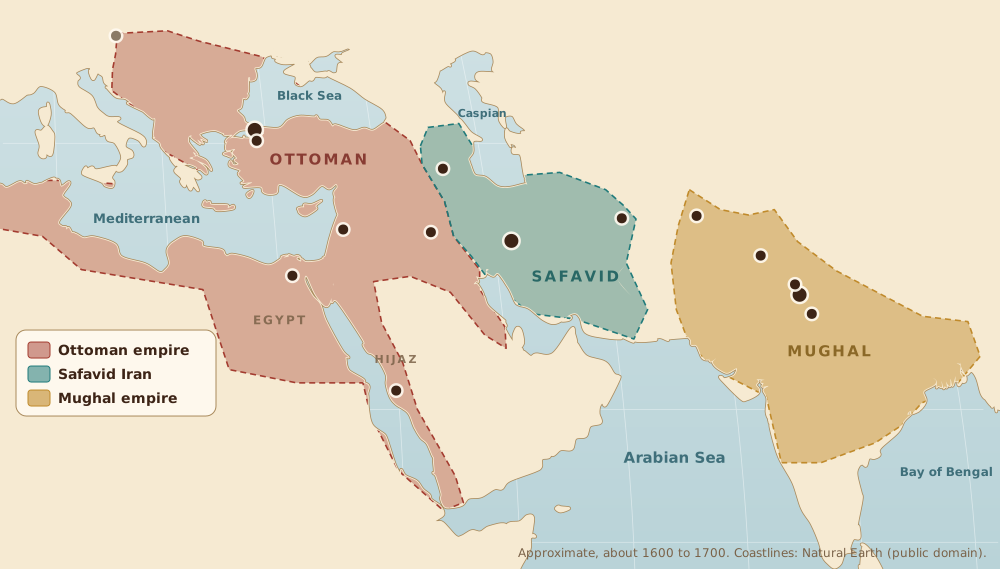
- Istanbul The Ottoman capital from 1453.
- Isfahan The Safavid capital.
- Delhi A great Mughal city.
- Vienna Twice besieged by the Ottomans, 1529 and 1683.
Une
Match the capital
Une cada uno con su pareja.
- Istanbul Ottomans
- Isfahan Safavids
- Agra Mughals
Ver la respuesta
Istanbul was the Ottoman capital, Isfahan the Safavid, and Agra the Mughal. Three capitals, three empires.
Toca el lugar Find Isfahan
Tap Isfahan, the Safavid capital.
Ver la respuesta
In the middle of Iran. Isfahan was the Safavid capital under Shah 'Abbas.
Piénsalo
Neighbours and rivals
The three empires were neighbours, sometimes allies and often rivals. How do you keep good relations with people you compete with?
Solo tú puedes verlo. Se guarda en este dispositivo.
Revelar
Common mistakes
Flip each card: what people often get wrong, and what is right.
- “Iran was always Shi’i.” Most of Iran was Sunni before 1501.
- “Sunnis and Shi’is share nothing.” They share the Quran, the qiblah and the five pillars, and differ in some beliefs.
- “The three empires were always at war.” They also traded, sent embassies and shared Persian culture.
Lee
For your life
You may work or study beside Shi’i Muslims. Be fair and courteous, never insult what others hold dear, and if a question of belief comes up, learn your own Sunni belief well from qualified scholars rather than arguing online.
Revelar
The lesson in three lines
Sum up the lesson in your own words first, then tap to check.
- The lesson in one line From 1501 the Safavids ruled Iran between the Ottomans and the Mughals and made Twelver Shi’ism its religion. Shah ’Abbas built Isfahan, a city of tiles. The three “gunpowder empires” fought, traded and shared Persian.
Lección terminada
Between them, the Safavids
Has añadido un siglo a un mapa cuyas fronteras cambian.
Lo que aprendiste
- The Safavids ruled Iran between the Ottomans and the Mughals.
- hechos
- 0
- bien a la primera
- 0
- para repasar
- 0
Tu obra · Pruébalo hoy
Be generous today to someone you compete with.
Lo que guardaste
Inicia sesión para guardar tu progreso en todos tus dispositivos.