
0 guardado
Entra en la escena
Two Asr times?
Your prayer app shows "Asr" at 3:40 and a second, later "Asr" at 4:25. A friend says the times are just made up by the masjid.
Lee
They are not. Every prayer time is written in the sky: the dawn light, the sun at its height, the length of a shadow, sunset, and the fading of the twilight. Learn to read the sky and the timetable makes sense.
Your app simply works out where the sun will be over your own town, minute by minute. That is why two masjids a few miles apart may differ by a minute or two, and why the times creep forward and back through the year. The prayer follows the sky, not the clock.
Encuéntralos
The day as the sun draws it
Explore the picture: find all 8 points.
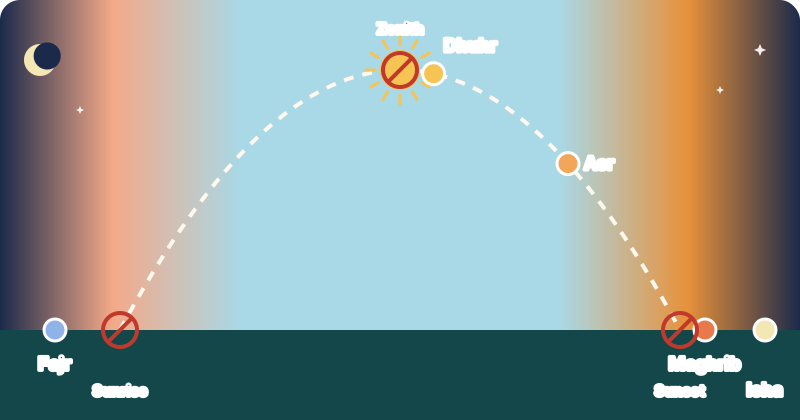
- Fajr Begins with true dawn, the white light spreading along the horizon. Ends at sunrise.
- Sunrise: no prayer From the moment the sun rises until it is clearly up, about 15 to 20 minutes.
- Zenith: no prayer The few minutes when the sun stands at its highest.
- Dhuhr Begins as soon as the sun passes its highest point.
- Asr Begins when a shadow grows long. The measure is explained in the next level.
- Sunset: no prayer As the sun sets. Only that day's Asr, if late, may still be finished.
- Maghrib Begins right after sunset.
- Isha Begins when the twilight has gone and lasts until true dawn.
Lee
True dawn and false dawn

Long before sunrise, a thin column of light can rise straight up from the horizon and then fade. This is the false dawn; Fajr has not begun.
The true dawn is a white light that spreads sideways along the whole horizon and keeps growing. Fajr begins with it and ends at sunrise. If the sun rises while you are still praying Fajr, that prayer is broken: make it up once the sun is clearly up.
Go deeper: the best time within Fajr
It is better for men to pray Fajr once the light has spread (isfār). There should still be time to recite at length, and to repeat the prayer before sunrise if something went wrong. For women praying at home, early in the time is better. At Muzdalifah during Hajj, Fajr is prayed early by everyone.
Del Corán
The times written into the Quran
أَقِمِ ٱلصَّلَوٰةَ لِدُلُوكِ ٱلشَّمْسِ إِلَىٰ غَسَقِ ٱلَّيْلِ وَقُرْءَانَ ٱلْفَجْرِ ۖ إِنَّ قُرْءَانَ ٱلْفَجْرِ كَانَ مَشْهُودًۭا﴿78﴾
78 Establish worship at the going down of the sun until the dark of night, and (the recital of) the Qur'an at dawn. Lo! (the recital of) the Qur'an at dawn is ever witnessed.
Revelar
What the verse teaches
Think about it first, then open the card.
- What does the verse teach? The verse ties prayer to the movement of the sun: from its decline at midday into the darkness of night, and the recitation at dawn. The prayers are anchors fixed in the day, not tasks we fit in when convenient.
Del hadiz
Taught by Jibril, on two days
عَنِ ابْنِ عَبَّاسٍ قَالَ قَالَ رَسُولُ اللَّهِ صَلَّى اللَّهُ عَلَيْهِ وَسَلَّمَ: «أَمَّنِي جِبْرِيلُ عِنْدَ الْبَيْتِ مَرَّتَيْنِ فَصَلَّى بِيَ الظُّهْرَ حِينَ زَالَتِ الشَّمْسُ وَكَانَتْ قَدْرَ الشِّرَاكِ وَصَلَّى بِيَ الْعَصْرَ حِين كَانَ ظلّ كل شَيْء مثله وَصلى بِي يَعْنِي الْمغرب حِين أفطر الصَّائِم وَصلى بِي الْعشَاء حِينَ غَابَ الشَّفَقُ وَصَلَّى بِيَ الْفَجْرَ حِينَ حَرُمَ الطَّعَامُ وَالشَّرَابُ عَلَى الصَّائِمِ فَلَمَّا كَانَ الْغَدُ صَلَّى بِيَ الظُّهْرَ حِينَ كَانَ ظِلُّهُ مِثْلَهُ وَصَلَّى بِيَ الْعَصْرَ حِينَ كَانَ ظِلُّهُ مِثْلَيْهِ وَصَلَّى بِيَ الْمَغْرِبَ حِينَ أَفْطَرَ الصَّائِمُ وَصَلَّى بِيَ الْعِشَاءَ إِلَى ثُلُثِ اللَّيْلِ وَصَلَّى بِيَ الْفَجْرَ فَأَسَفَرَ ثُمَّ الْتَفَتَ إِلَيَّ فَقَالَ يَا مُحَمَّدُ هَذَا وَقْتُ الْأَنْبِيَاءِ مِنْ قَبْلِكَ وَالْوَقْتُ مَا بَيْنَ هَذَيْنِ الْوَقْتَيْنِ» . رَوَاهُ أَبُو دَاوُد وَالتِّرْمِذِيّ
Ibn ‘Abbas reported God’s Messenger as saying, “Gabriel twice led me in prayer at the House (i.e. the Ka’ba). He prayed the noon prayer with me when the sun had passed the meridian to the extent of the thong of a sandal; he prayed the afternoon prayer with me when every thing’s shadow was as long as itself; he prayed the sunset prayer with me at the time when one who has been fasting breaks his fast; he prayed the night prayer with me when the twilight had ended; and he prayed the dawn prayer with me at the time when food and drink become forbidden to one who is fasting. On the following day he prayed the noon prayer with me when his shadow was as long as himself; he prayed the afternoon prayer with me when his shadow was twice as long as himself; he prayed the sunset prayer with me at the time when one who has been fasting breaks his fast; he prayed the night prayer with me when about a third of the night had passed; and he prayed the dawn prayer with me when there was clear daylight. Then turning to me he said, ‘Muhammad, this is the time observed by the prophets before you, and the time is anywhere between these two times.” Abu Dawud and Tirmidhi transmitted it.
Revelar
What does the hadith teach?
Think about it first, then open the card.
- The first and the last of each time Jibril led the Prophet ﷺ in each prayer twice: once at the start of its time, once near its end. Then he explained that the time lies between the two. So each prayer has a window. You may pray anywhere inside it, though praying early, with care, is best.
Mira
Watch: the prayer times in the sky
Lee
The best moment in each window
Each prayer is valid anywhere in its window, but each has a preferred time:
- Dhuhr: early in winter; a little later in the summer heat.
- Asr: later, while the sun is still bright, never once it turns pale.
- Maghrib: straight away.
- Isha: up to a third of the night. After midnight it is disliked.
Lee
Reading a timetable
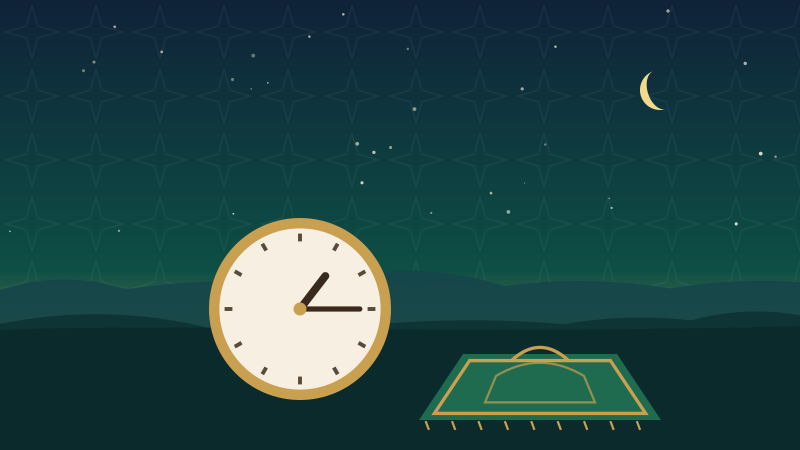
A masjid timetable or app shows six times, not five. Sunrise is there because it ends Fajr. Dhuhr is often set a few minutes after the sun's highest point, to be safe.
Many show two Asr times: the first when a shadow is once its length, the second when it is twice. Pray Asr from the second, later time.
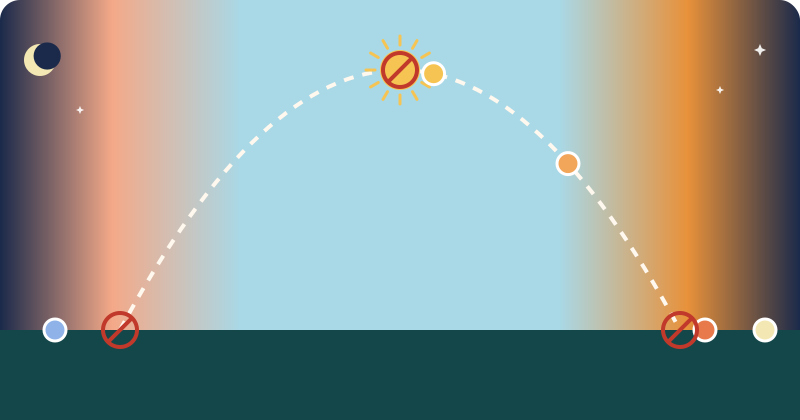
Toca el lugar Find Dhuhr
Tap the moment Dhuhr begins.
Ver la respuesta
Dhuhr begins just after the sun passes its highest point. At the very top itself, prayer is forbidden for a few minutes.
Une
Match each prayer to its window
Une cada uno con su pareja.
- Fajr True dawn until sunrise
- Dhuhr Just after midday until Asr
- Maghrib Sunset until the twilight goes
- Isha Night until true dawn
Ver la respuesta
Each prayer begins where the one before it ends, except Fajr, which ends at sunrise, leaving the morning free until midday.
Elige Read the sky
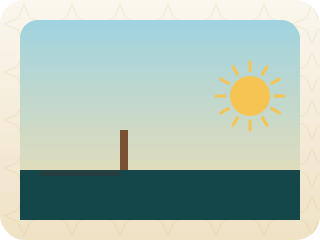
Which picture shows the time of Maghrib?


Ver la respuesta
Maghrib begins as the sun disappears below the horizon. The low sun with long shadows is Asr; the dark sky with stars is Isha.
Revelar
Common mistakes
Think of the right answer first, then flip each card.
- "Fajr ends when the masjid finishes praying." Fajr ends at sunrise. Check the sunrise time, and pray before it, even if you woke late.
- "I can pray Dhuhr the moment the sun is highest." Dhuhr begins once the sun has passed its height. The zenith itself is one of the moments with no prayer.
- "Maghrib can wait until after dinner." Its window is short and hurrying it is Sunnah. Delaying it until the stars crowd the sky is disliked.
- "Isha may be prayed any time before dawn, so midnight is fine." It is valid until dawn, but after midnight it is disliked. Pray it before you sleep.
Piénsalo
Five appointments
Five times a day the sky itself calls you to an appointment with Allah. Which of the five do you find hardest to keep on time, and what is one change that would help?
Solo tú puedes verlo. Se guarda en este dispositivo.
Lección terminada
Prayer times across the sky
Has añadido una raka a una alfombra de oración que se llena, raka a raka.
Lo que aprendiste
- Fajr: true dawn, spreading sideways, to sunrise.
- Dhuhr: after the sun passes its height, to the time of Asr.
- Asr: a shadow twice its length (plus the noon shadow), to sunset; not once the sun is pale.
- hechos
- 0
- bien a la primera
- 0
- para repasar
- 0
Tu obra · Pruébalo hoy
Look at the sky at Maghrib today and watch the sun set: that moment opens your prayer’s window.
Lo que guardaste
Inicia sesión para guardar tu progreso en todos tus dispositivos.